For this week’s lab, I spent time experimenting with AI colorization and computer vision tools using Distant Viewing Explorer. I used a monochrome image from Carleton’s CONTENTdm repository, featuring a view of the Carleton campus with a stone arch bridge. To colorize the historic image, I used DeOldify, an AI image manipulation tool. Finally, I tested the image across computer vision algorithms using the browser-based Distant Viewing Explorer to analyze how machine learning models categorize historical visual data. However, these tools raise important ethical questions about how visual media is reconstructed and interpreted.
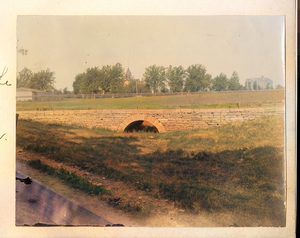
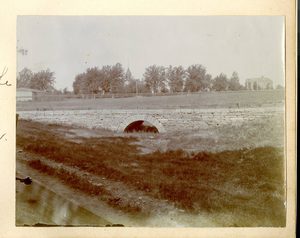
One major ethical concern with combining AI and image manipulation is the false sense of historical authenticity it creates. Colorization algorithms do not reveal true historical colors; rather, they apply statistical probabilities based on training datasets. As art historian Sonja Drimmer points out in her critique of AI in art history, “Adding color does not show things as they were but recreates what is already a recreation—a photograph—in our own image, now with computer science’s seal of approval”. When colorized or AI-reconstructed images circulate without clear contextual disclosure, they risk replacing actual historical reality with plausible-looking computational guesses.
Furthermore, running the photograph through Distant Viewing Explorer shows the disconnect between algorithmic analysis and human contextual understanding. When testing image classification, the computer vision model tagged the historical page with categories like “paper towel” (46.78%), “window screen” (4.36%), “mousetrap” (3.21%), and “microwave” (2.63%). Similarly, its image segmentation model labeled large background areas as “wall” (80.69%) and “painting” (10.63%). These absurd classifications highlight how computational tools lack the basic historical and cultural awareness necessary to interpret visual artifacts. As Drimmer observes when warning against over-relying on data-driven approaches, “Theoretical problems are steamrollered flat by the weight of data, which generates deeply simplistic results”.
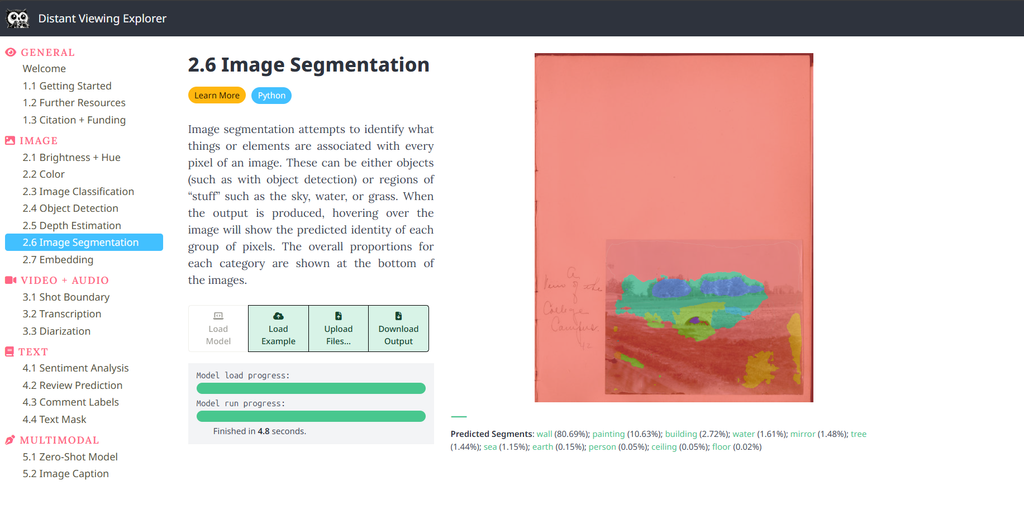
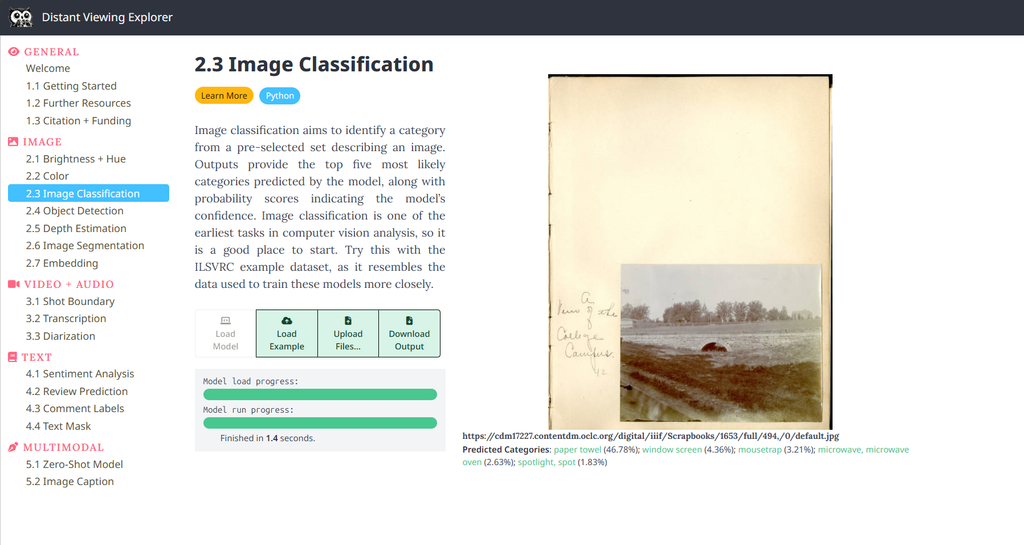
I find it really funny that the image classifier thought that your picture was a paper towel. While many people are beginning to trust the outputs of LLMs, this is a nice reminder that they can be incredibly wrong and nowadays are often wrong in more subtle ways that require close human verification and critical thinking. I do wonder, though, what the result would be if you cropped out the paper part of the image and only gave it the field. Would it be better with less noise?
It was quite interesting to learn how Distant Viewing Explorer categorized some objects in your historical picture, such as a paper towel and a microwave. This means that AI can detect some visual information without comprehending what it sees. I also support your idea that colorization of the picture with the help of AI gives an incorrect impression of authenticity. Although the picture seems more authentic because it is colored, it does not mean that the colors used are correct.
Great post! You bring up a crucial point about the ethics of AI colorization; it often masquerades as historical truth when it’s really just a statistical guess based on training data. Sonja Drimmer’s quote captures this perfectly: replacing authentic historical artifacts with plausible computational guesses risks fundamentally altering how we perceive the past.