I would like to think there are differences between an AI digitally manipulating and flat-out generating an image. Where image generation is done via the scraping (copying) of a real person’s work — and is therefore detestable in numerous ways — image manipulation is a bit more of a grey area to me. When it comes to de-aging photos, this process can be helpful for understanding the past. As the University of Ghent points out: “[photos] in color sometimes make details stand out, which makes certain information more eye-catching… [and] they reduce the perceived historical distance to what is depicted for today’s viewer.” Color images allow today’s viewers to better understand the past, and this understanding can help in a variety of fields beyond the digital humanities (such as crime investigations). At the same time, we may stand to lose our original understanding of an old scene if we rely too much on AI.
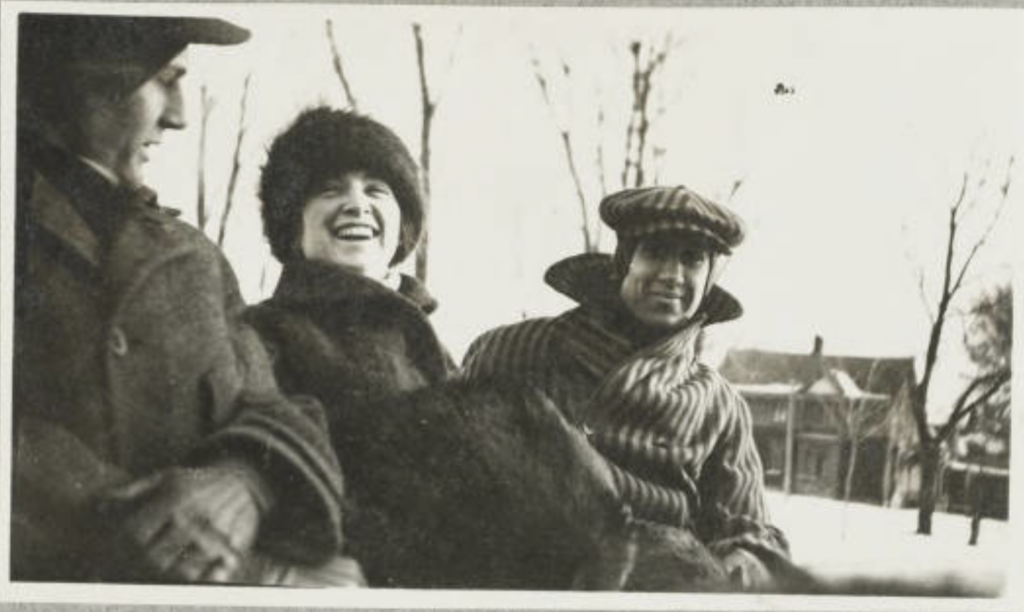
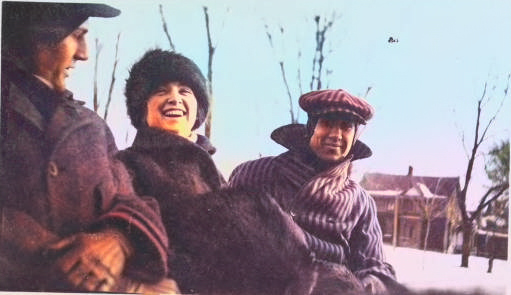
This image, taken from the Werner Ogden, 1916 scrapbook, has been artificially colored by DeepAI’s DeOldify Image Colorization tool. Though the colored image may be more visually appealing, it is noticeably quite saturated — some of the lighter parts on the peoples’ skin are yellowed and the right-most man’s hat is more red in comparison with the rest of his outfit. The way in which DeepAI goes about coloring this image helps in naturally drawing our eyes to the objects (people) in focus, but perhaps this coloration presents unlikely or unrealistic information; there is green on the rightmost tree when the image clearly takes place in winter and the left-most man’s hand is colored quite dark in comparison to his face — I theorize that this may be the AI mistaking the natural shape of his hand as a glove and therefore darkening it. The use of AI tools to color older images, though eye-catching and possibly helpful in understanding the past, should not replace our analysis of the original black-and-white image.
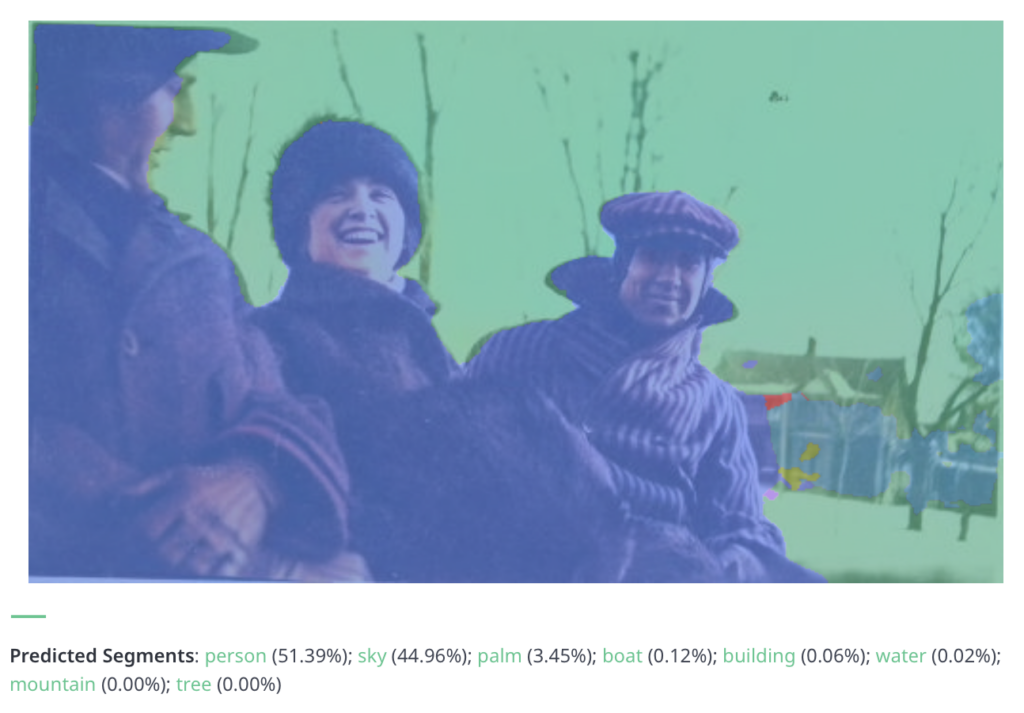
Beyond this, the AI tools which Distant Viewing Explorer presents also do not always have the best understanding of an image. While there is much the program analyzed correctly about this AI-colored photograph, the 0.12% of the building that it believes to be a boat leaves a lot to be desired. Like the University of Ghent does, I would hope these tools are used to “create a shared collection on which we can also conduct more theoretical-thematic research.” However, I believe there is a lot more testing to be done until that point.
I had a similar experience using the distant image viewer in which mine was incredibly inaccurate. I think that utilizing these tools to create that collection would be an excellent way to use them and not discredit or cause harm to the original artists. Do you think that biases to the model used in the Distant Viewing explorer could’ve played a role in the inaccuracy or do you think that the model is just inaccurate in general.
Hi Max!
I agree with you that colorizing images using AI should not replace analyzing black and white images. It risks being incorrect as it isn’t able to accurately predict the image’s color scheme. However, your image seemed to work a lot better than mine did. When I inserted my image into DeepAI’s colorization tool, it simply shifted the image’s hue to yellow, rather than colorizing it.
This is a thoughtful breakdown of the nuance between AI generation and manipulation! You make a great point about how colorization can make history feel more immediate, but your analysis of the 1916 photo perfectly demonstrates its flaws. Observing how DeOldify added green to a winter tree and mistook a hand for a glove really shows how these tools guess rather than understand context. Plus, Distant Viewing Explorer tagging part of a building as a “boat” is a hilarious reminder of their limitations! Excellent post on why AI should complement, not replace, historical analysis.
I think there is something to be said for the way that AI can train itself off of the images that we feed it, which does irk me in similar ways to flat-out image generation. Overall though. While I appreciate your analysis of the photo, the hand in that photo is quite clearly a glove. You can tell by the boning lines down the back of the hand and the folds at the wrist. I can fault AI for a lot of things, but I do believe that it got at least the glove correct.
Nice post. I really appreciated your distinction between image generation and manipulation, as well as your point about how colorization brings historical photos closer to the present viewer. Your breakdown of the 1916 photo highlights how these models guess context rather than actually understand it, such as adding green to a winter tree or having Distant Viewing Explorer tag part of the background building as a boat. It is a great example of why these tools should only complement rather than replace our original analysis.