The Digital Humanities website I chose to explore was Movie Galaxies. Movie Galaxies is a digital humanities project that visualizes the social networks inside movie scripts. Instead of treating a film as a linear narrative, the site reveals how characters connect, interact, and form clusters. By breaking down the “black box” of the project, we can better understand how it works and what academic conversations it participates in.
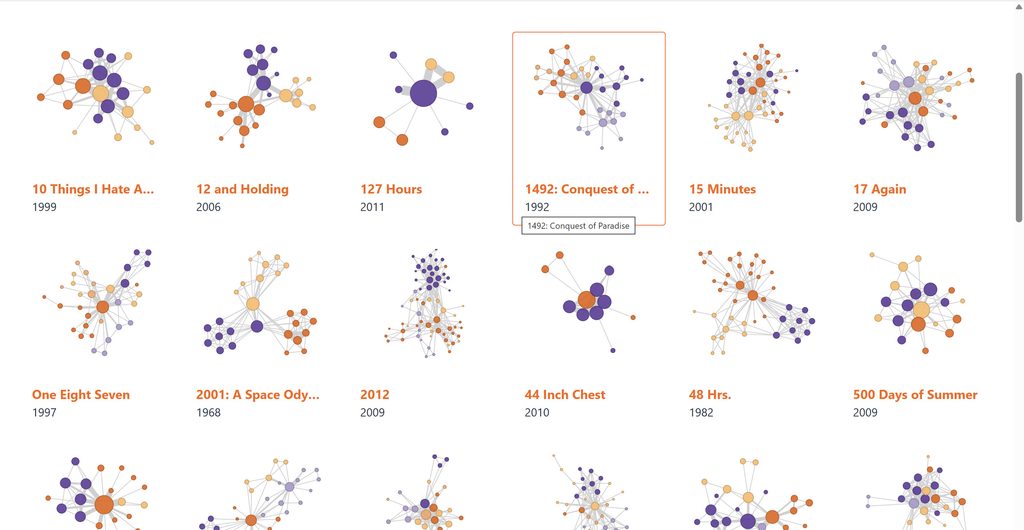
The primary assets of Movie Galaxies are movie scripts. These scripts provide the raw text from which characters, scenes, and interactions are extracted. Each script becomes a dataset of character co‑appearances, which forms the basis of the network graphs. The services the website provides are computational text‑analysis tools to identify when characters appear together in a scene. Then it applies network analysis algorithms to measure degree, betweenness, clustering, density, and other structural features. Movie Galaxies also gives insight into the archetype each character conveys in a movie such as a protagonist, antagonist, or extra to name a few. These processes transform a narrative text into quantifiable social data. The final product or display is an interactive graph for each movie. Characters appear as nodes, and their interactions appear as edges. Users can explore the network visually, compare films, and view statistics that describe the structure of each story’s social world.
Breaking down the project raises a new question for me: What would these networks look like if they included emotional tone or conflict, not just co‑presence? This could reveal deeper narrative patterns beyond simple interaction. For instance looking at romcom movies such as “10 things I hate about you” the two characters in a love based relationship are geographically positioned very close to one another within the network. However, the website does not explicitly define the relationship between characters which leaves the viewer wondering and further research to determine relationship.
The goal of Movie Galaxies is to help users understand films through their social structures and to show how storytelling can be analyzed using data and visualization. Some of the Academic Fields within Movie Galaxies are film studies, digital humanities, network science, computational linguistics, and even sociology, since it treats characters as members of a social system.
Sources:
Movie Galaxies. moviegalaxies.com, https://moviegalaxies.com/. Accessed 24 Sept. 2026.
I like this project. I wonder what one would discover by comparing the different charts across genres? For example, I bet that networks for Horror movies are very sparce compared to those of Romance movies. Did you look more into the algorithm used to map relationships? Two algorithms may consider the same part of a script differently. I agree with you point that the user is left to wonder a lot. I wish you could click on the edges between the nodes to have information on why they are connected.
Evan, as a movie geek myself who always imagines myself in these universes I thought it was really cool that you chose this project. I liked how you broke down the scripts as the source, the character co-appearances and network analysis as the process, and the interactive graph as the presentation. Your point about emotional tone was also interesting because it shows that just knowing two characters interact does not fully explain what their relationship actually is. Do you think adding emotional tone would make the project more useful, or would it make the data too complicated?