The Image
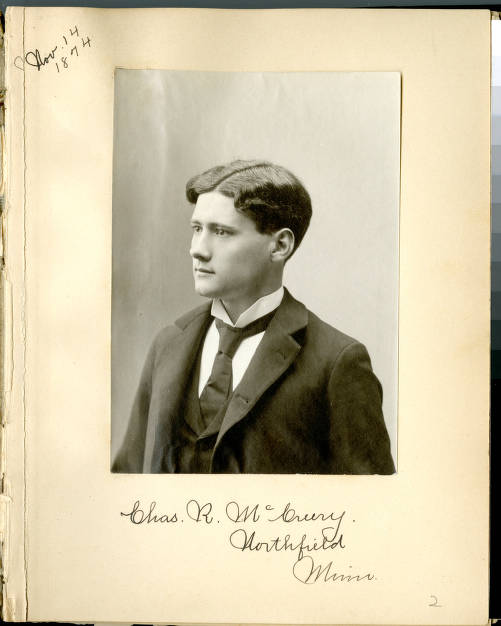
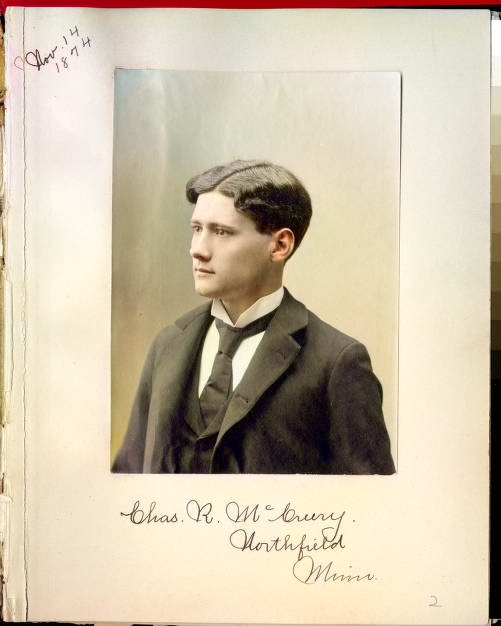
From Edith Griffith’s 1896 Student Photo Album in Carleton’s Scrapbooks and Photo Albums collection, I chose a portrait of Charles R. McCreery of Northfield, Minnesota. The corner of the page has “Nov. 14 1874” written on it, and McCreery’s name is in ink under the photo. I downloaded the full-resolution file via the archive’s IIIF link and ran it through DeOldify on DeepAI.
What the AI Added
DeOldify applied peach skin to McCreery, and converted the gray studio background to a gradient from yellow to blue. The album page was pink around the edges, too. Nothing in the archive supports those colors. “It’s ridiculous to think that black and white photos taken 100 years ago would produce color,” says Drimmer bluntly. The program guessed what a young man might have looked like in the 1890s and painted the guess over the record.
What a Second AI Observed
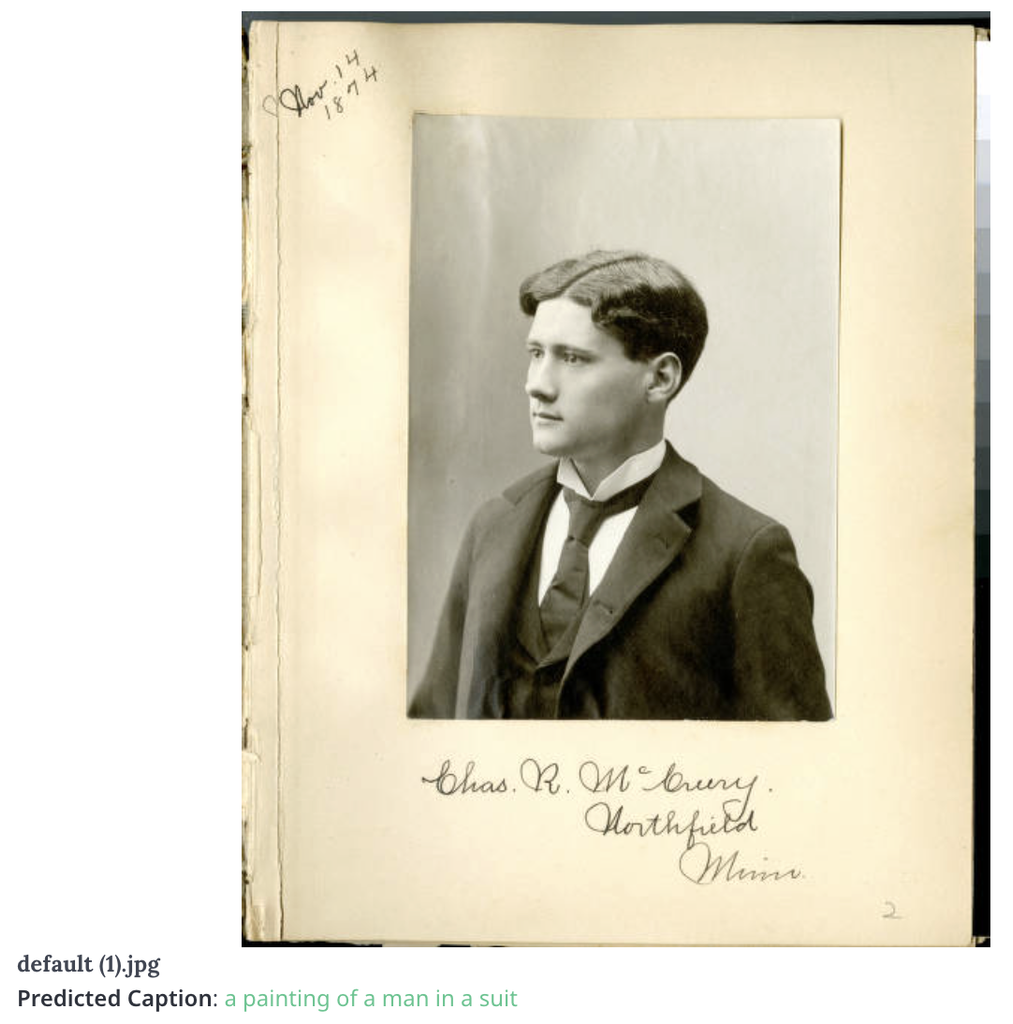
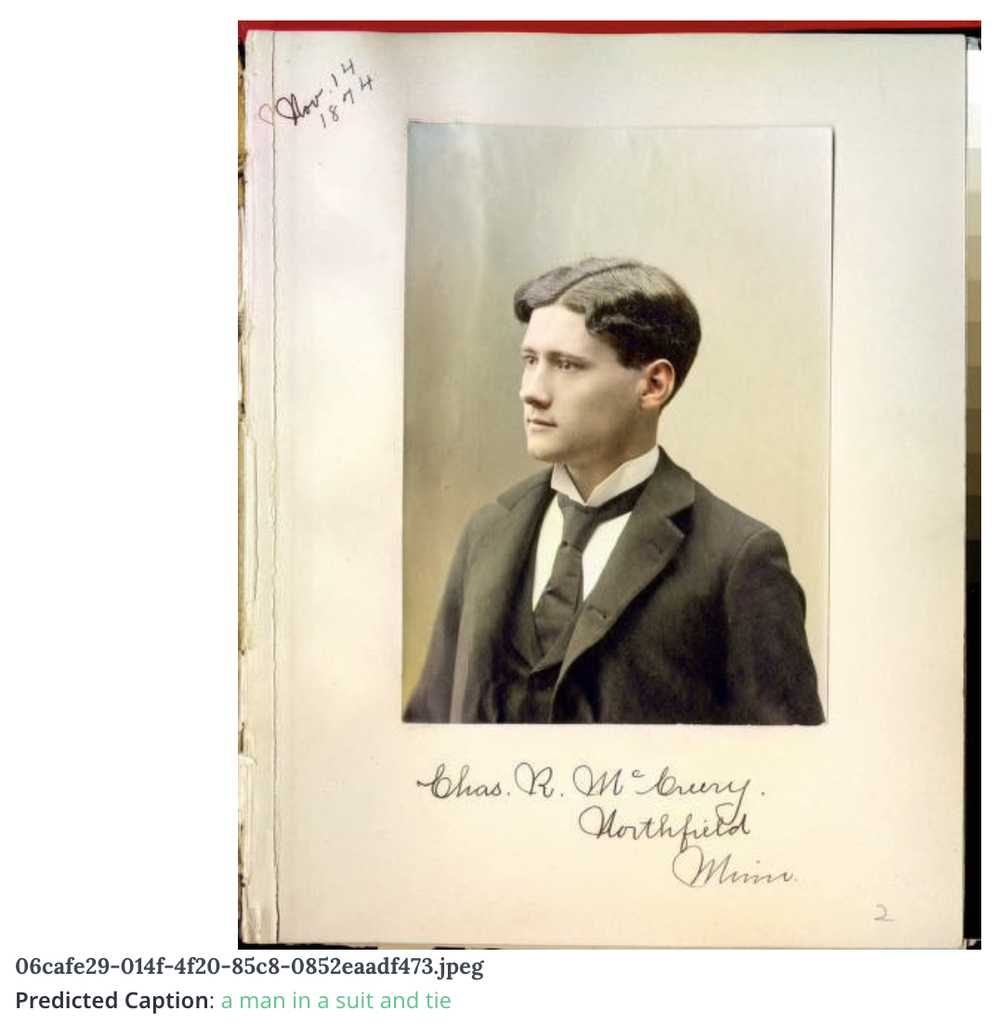
I used both versions as inputs to the Image Caption tool in Distant Viewing Explorer.
The caption model thought the real photo was a painting. DeOldify added color, and the same model saw a real person. The machine saw the false color as making the picture more real than reality. Neither caption mentions the handwriting, date, or McCreery’s name, which is what ties the photo to Carleton.
That gap is greater than my one picture. “More and more decisions about tagging, classifying, organizing, and filtering are being made by artificial intelligence that affect what sources we encounter as historians,” Tilton notes. An archive with the metadata ‘a painting of a man in a suit’ might mean a researcher looking for nineteenth-century student photographs would never find McCreery.
The Moral Problem
The danger is fake authenticity. “Adding color does not show things as they were but recreates what is already a recreation,” Drimmer writes, “a photograph, in our own image.” With a Xerox copier that swapped numbers on floor plans, Chiang makes the same point. “If the photocopier just spat out blurry copies, everyone would realize they were not accurate reproductions of the originals,” he says. The problem was that the errors looked nice. A gray photo lets you know it’s old and not finished. The colorized version hides its guesses behind a crisp picture, and as Chiang says of ChatGPT, “all you will ever get is an approximation”. Drimmer adds that projects like this mostly “create feel-good stories about AI.”
The Fix
Labels. All AI images in this post say so. The original is first. Archives that produce colorized versions should keep the gray file as the original and label the color as a guess.
I find it really interesting that DeOldify changed your person’s skin. I chose a similar image, and honestly there was very little change. It is also interesting how AI predicted the black and white photo as a painting, and the colored image as just “a man in a suit and tie.” Labels are a solid solution to this problem, and honestly there should probably be laws in place that require some sort of water mark or caption if AI has touched an image.