For this week’s lab, I decided to explore how artificial intelligence can be used to analyze literature. I chose The Odyssey by Homer from Project Gutenberg and used Google Gemini to experiment with different methods of computational text analysis. I was interested in seeing how AI could identify patterns and relationships within a lengthy text that might be difficult to recognize through just reading.
Using Gemini and following the steps from Anastasia Salter, I created three different visualizations: a bar graph showing the most frequent two- and three-word phrases, a word cloud displaying the thirty most common words, and a network graph illustrating relationships between characters. Each visualization offered a different perspective on the text. For example, the word cloud emphasized characters like Ulysses, Telemachus, and Penelope, while the bar graph highlighted frequently repeated phrases such as “wise Ulysses” and “son of Laertes.” I found the character network particularly interesting because it attempted to visualize the relationships between characters based on their interactions throughout the story.
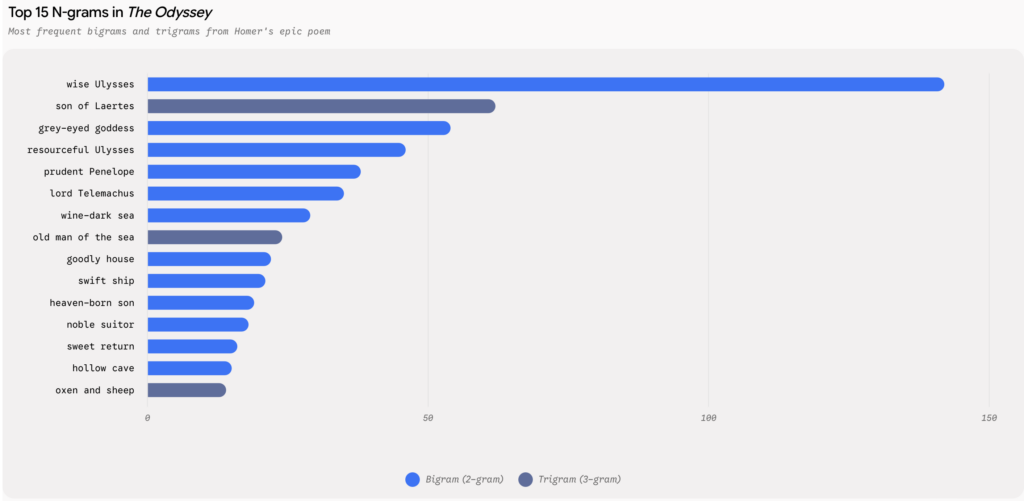
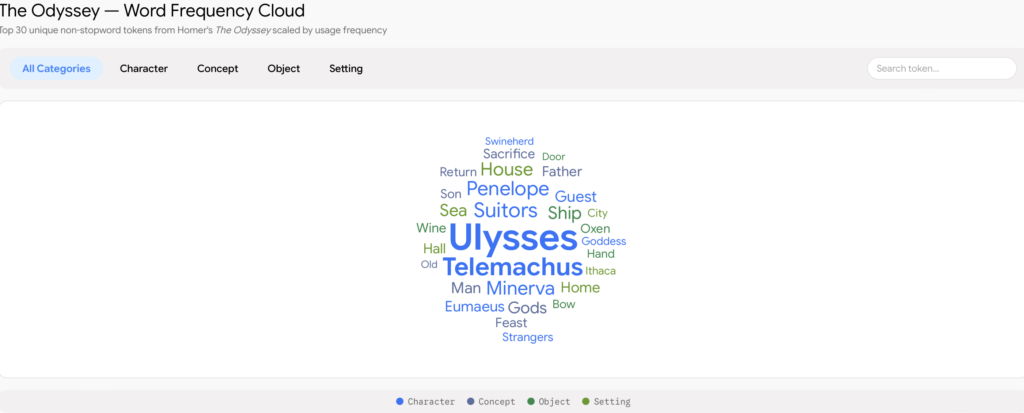
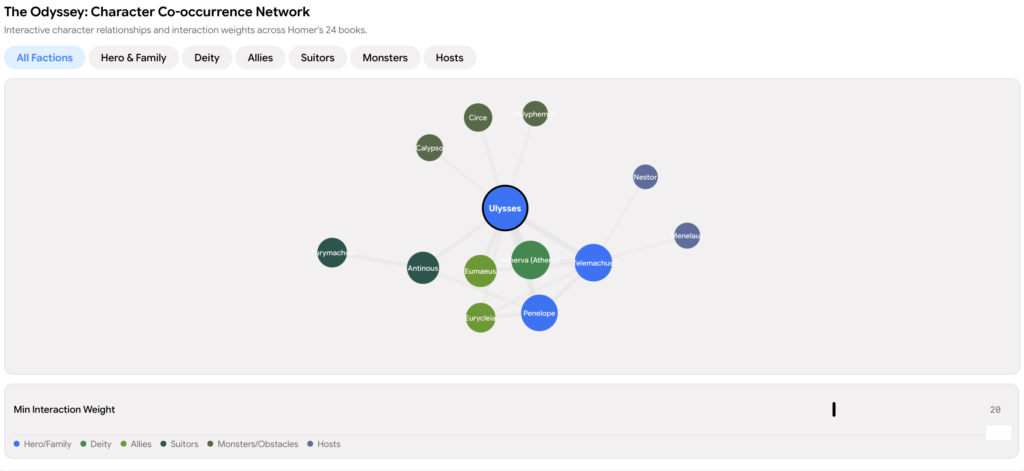
AI quickly produced these visualizations. Rather than manually writing code or sorting through the text, I could describe what I wanted, and Gemini would generate an interactive result. This made computational text analysis much more accessible, especially for someone with really basic programming experience.
This experiment also raised some concerns about using AI for academic research. Although the visualizations looked convincing, I couldn’t immediately verify whether Gemini had accurately counted the words or identified the relationships. For example, the character network depended on how Gemini defined an interaction between two characters. Different definitions could produce very different results.
I think this highlights one of the biggest concerns in the “Age of AI.” As these tools become more advanced, it becomes increasingly easy to accept their outputs without questioning really anything that they are doing. AI can make analyzing large amounts of text significantly easier, but that convenience shouldn’t replace critical thinking. Ultimately, I think these tools are most valuable when they complement traditional research rather than replace it.
Hi Myles, this is really interesting! I thought the idea to count 2-3 word phrases was smart and I like the information that it provides. I tried to do the same with the text I selected (The Great Gatsby) with Voyant Tools, but unfortunately, the phrase tool didn’t have the same stoplist as individual words, so all of the most used phrases were things like “and a” or “to the”. This might point to a benefit of AI in some ways, such that it’s much more flexible and you can ask it to do any modifications you might want/need. This supports your point about the convenience of AI for text analysis, though there are still the nuanced ethical issues around AI that you also point out.
Hi Myles, your analysis shows how AI can make large, complex texts feel more approachable, and I like how you highlight the different insights each visualization offers. At the same time, your caution about trusting these outputs too quickly is really important. The character network example makes it clear that AI decisions—like how it defines an “interaction”—can quietly shape the results in big ways. Your conclusion strikes a smart balance: AI can enhance literary analysis, but only when paired with human judgment and careful verification.