This week I chose to look at one of my favorite plays A Doll’s House by Henrik Ibsen as part of my assignment. The play deals with marriage, gender roles and personal independence. In order to find out what a computational analysis might reveal about the play, I used Voyant Tools and uploaded the text from Project Gutenberg. I was interested in seeing whether the most frequently used words would correspond with the play’s main themes.
At first glance in the word cloud it was clear that the characters’ names were the most prominent ones, “Nora” being the largest, together with “Helmer”, “Linde”, and “Krogstad” appearing frequently as well. This is reasonable since the plot revolves around Nora and her dealings with those individuals. Yet I came to the conclusion that simply counting words doesn’t help us to understand the deeper significance of the play, because it’s a play and the characters’ names are used a lot in the dialogue, which accounts for their high frequency.
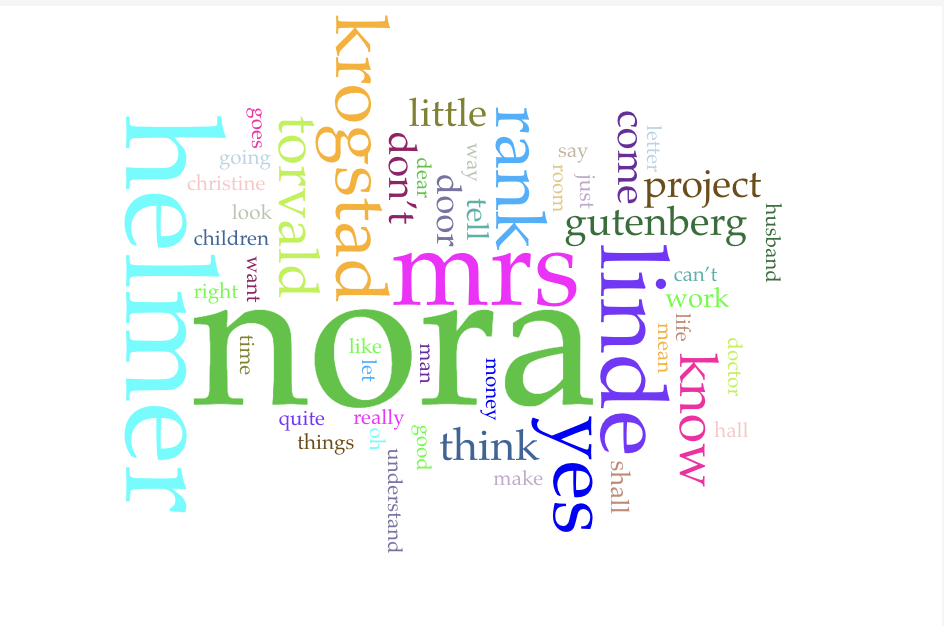
I also came across words such as ‘know’, ‘think’, and ‘yes’. They caught my attention since the play makes a considerable focus on communication, deception, and the expectations that people have in a marriage. However, it’s difficult to determine what these words actually mean unless one examines how they are used in the play. Moreover, I observed words like ‘Gutenberg’ and ‘project’, which are taken from the source text and not from the play itself. This pointed out to me just how important it is to tidy up the data prior to carrying out the analysis.
This exercise caused me to consider the increasing importance of AI in the area of text analysis. Tools such as Voyant are able to detect patterns in a matter of minutes whereas it would take a lot longer if one had to read the text themselves. More sophisticated AI might even manage to identify themes, relationships, and the way in which characters change over time.
Yet I believe there is a risk in relying too heavily on these tools since AI may identify patterns but could fail to understand their historical or literary significance, and at times its explanations may appear correct even though they aren’t. Moreover, it is difficult to find out how the AI arrives at its answers, which brings into question the issue of transparency.
Ultimately, I believe that computational analysis functions most effectively when it assists traditional reading rather than replacing it. While these tools can help us identify worthwhile questions, it is still necessary for people to determine what the patterns actually mean.