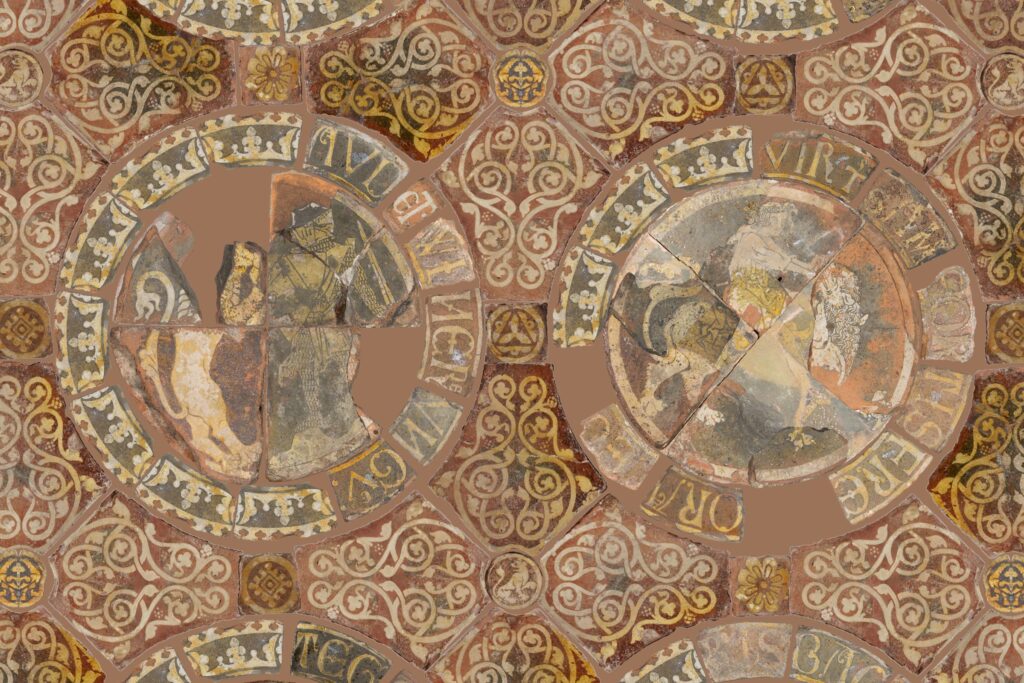
I chose to reverse-engineer Janis Desmarais’ A Digital Reconstruction of Tiles from Chertsey Abbey. It explores how digital technology can help reconstruct a medieval floor from surviving tile fragments to try to understand what the original floor may have looked like. The tiles had previously been studied through black-and-white drawings published by Elizabeth Eames in 1980. Desmarais and Luyster wanted to see whether digitally combining photographs of surviving fragments with these earlier drawings could reveal details that had been overlooked. The project did, in fact, end up revealing new information. For example, one reconstruction showed that a shield depicted on a tile had only one chevron rather than the two shown in Eames’s drawing.
Who’s the target audience?
The project appears to serve both specialists and a broader public interested in history, art, and cultural heritage. For specialists, including art historians, medievalists, archaeologists, and digital humanities researchers, the reconstructions provide a way to examine the surviving fragments and reconsider earlier scholarship. For students and educators, the visual materials make it easier to understand how fragmented objects can be reconstructed and how historical interpretations develop through the analysis of evidence.
Data and public access
Its main sources include:
- Photographs of surviving tile fragments from the British Museum and other collections.
- Digital reconstructions, including individual tile compositions and virtual floor arrangements.
- Elizabeth Eames’s published black-and-white drawings of the tiles.
All of these are available upon request, and the project itself is published under a Creative Commons Attribution 4.0 International (CC BY 4.0) license.
I think that the public would really benefit from greater access to these materials. The initial images of the tiles were obtained from the British Museum’s free image service and from the Victoria & Albert Museum, but I hope that this work is displayed as an exhibition sometime in the future. The process and the work itself are fascinating, and I truly believe that more can be learned and explored from this work. How might our understanding of medieval history change if digital reconstructions of fragmented objects were made publicly accessible in a way that allowed other researchers and members of the public to propose, compare, and document alternative reconstructions?
This raises questions about who gets to decide which reconstruction becomes the accepted version of the past. If multiple interpretations are possible, would a more collaborative and openly accessible reconstruction process allow for a richer understanding of medieval material culture? I would be interested in seeing how the project might develop if its digital materials were made more widely available and if researchers could interact with the reconstructions, test different arrangements, and document their reasoning. That possibility seems especially relevant to digital humanities because it shifts the focus from simply presenting a finished product to making the process of historical interpretation visible and open to further investigation.