THE TEXT
I chose On the Origin of Species from Project Gutenberg because I study biology but, embarrassingly enough, had never read Darwin beyond the famous lines. I analyzed the introductory chapters (Intro through Chapter VI) using Google Gemini AI to parse the text and directly generate data visualizations of its structure and vocabulary.
AI: COUNTING AND MAPPING
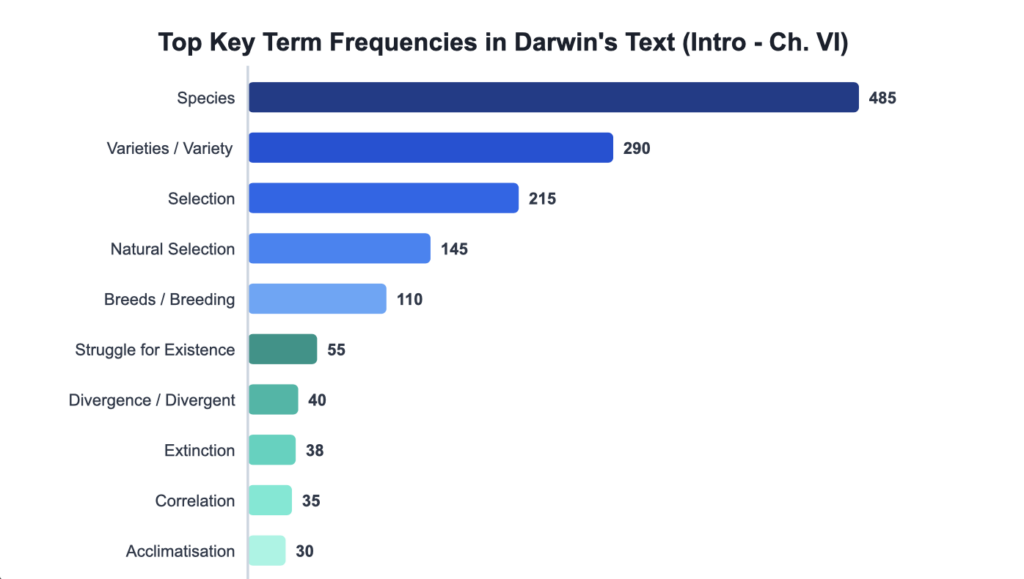
The top words were species (485), varieties (290), selection (215), natural selection (145), and breeds (110). The AI counts these keywords cleanly, though simple counts alone don’t reveal how Darwin builds his thesis across individual chapters.
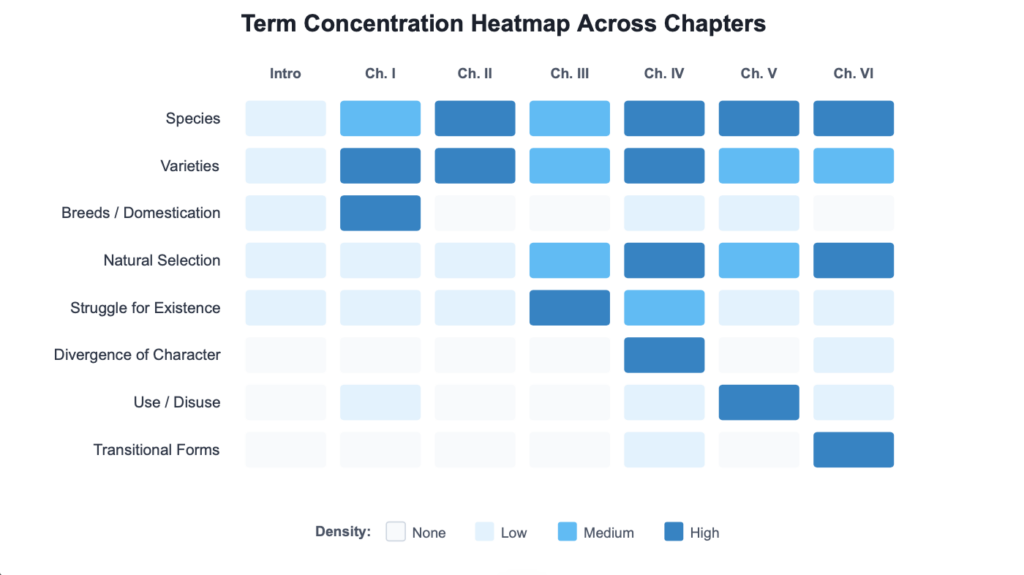
The heatmap links terms like “Breeds / Domestication” heavily to Chapter I before showing them drop off, making room for “Natural Selection” and “Struggle for Existence” in later chapters. This traces Darwin’s argument that artificial selection under domestic breeding grounds the reader before he introduces natural selection in the wild.
AI: SUMMARIZING
Gemini outlined the core argument across the chapters and quoted famous lines about the “entangled bank” and “endless forms most beautiful.” Then it admitted that the uploaded file had truncated mid-sentence in Chapter VI. Its processing tool had cut the text off after a fraction of the book. It said “entangled bank” appears in the famous conclusion (Chapter XV), but that knowledge came from its underlying training data, not from reading the file I provided. I manually checked the dataset and confirmed the file indeed ended abruptly in Chapter VI.
CONCERNS
A direct word count reads every string and exposes its method: you can inspect the exact lines behind each number. The AI read a slice of the text and filled in the remainder with what it already “knew.” In this instance, it explicitly told me. Many AI tools won’t. In the Age of AI, the primary danger is fluent answers standing in for reading. These computational tools work best when paired, using the AI to surface insights and strict text verification to check the math.
Your reflection does a great job showing how AI can be both insightful and misleading at the same time. The contrast between the precise word‑counting and the AI’s tendency to “fill in” missing text is especially sharp — it really highlights how easily these tools can blur the line between analysis and assumption. Your point about fluent summaries standing in for actual reading is spot‑on, and your emphasis on pairing AI insights with human verification feels like the right balance in an age of increasingly automated interpretation.