Even though there may information about slavery that might never be found, there is still so much history being unveiled. Given that the Transatlantic Slave Trade started over 400 years ago, one might wonder how all of these details were able to be found and condensed in The Georgetown Slavery Archive.
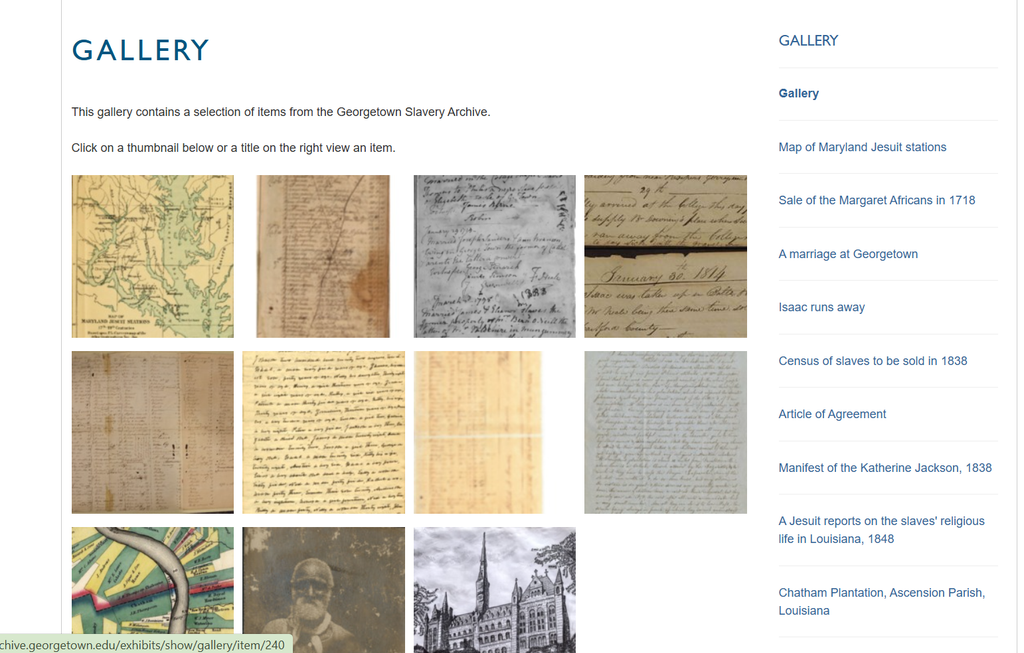
The Georgetown Slavery Archive utilized a plethora of resources; these include letters, articles, bills, journals, maps, marriage records, and so many other. These sources reveal the connections and relationships people had with each other.
Since a lot of the materials and sources are quite old, it is important that they are processed to appear more evident. The hard-copy images and documents (letters, journals, marriage records, etc.) are photographed and/or scanned. After that, they are digitized. Then, they are placed into the archives and website.
With the all of this information, The Georgetown Slavery Archive was created to present multiple types of services embedded into their online website. For images, they have a gallery with a plethora of images. There are podcasts and videos from Georgetown professors. The archive contains multiple collections spanning from “Memory & Reconciliation” to “Slavery at Georgetown College”. There is also an interactive map and it highlights key locations of where certain people were from or where certain events occurred.
Given that the archive is digital and most of the sources are hard-copy, what would happen if the website happened to crash and all the information was lost? Does Georgetown have a backup version stored elsewhere or would they have to remake the archive with the original sources?
The predominant audience the archive targets would probably be historians, but it is ultimately designed so that anyone who is interested in learning about slavery within the United States of America. It it also designed for teachers who wish to use the website for any educational purpose. This website was created by the “Georgetown University’s Slavery, Memory, and Reconciliation” initiative, which is under Georgetown University.
Something cool noted was that information about descendants’ ancestors could continuously be added to the archive. This is major reason why digital archives are unique-because information can keep being updated. This allows for more stories to be spread and told.