Introduction
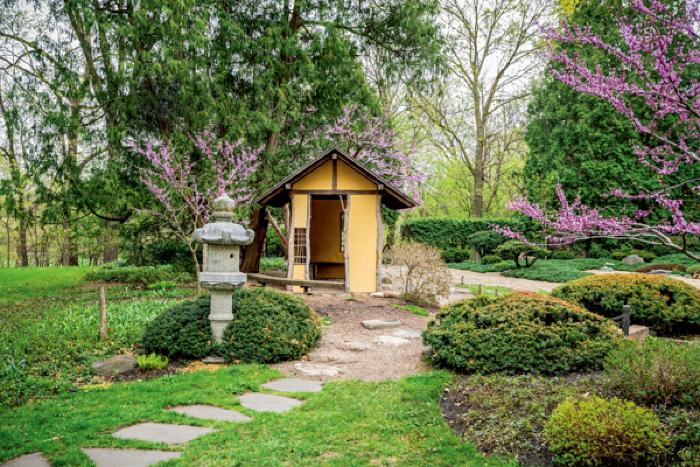
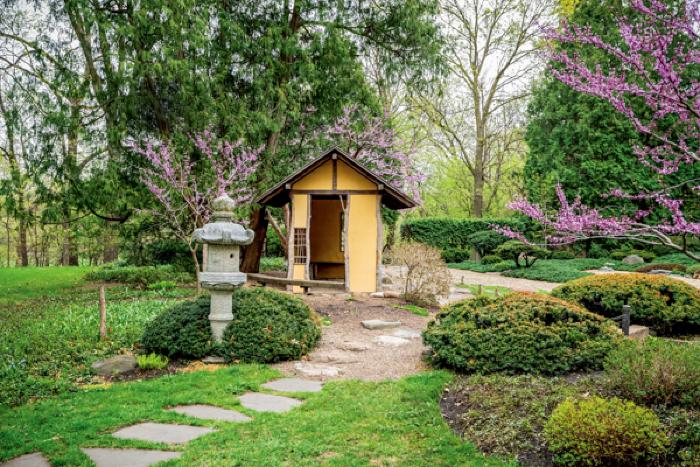
Frequently found in the foreground of photos, the Kasuga Stone Lantern can be found in Carleton’s Garden of Quiet Listening, or Jo Ryo En, behind Watson Hall. Produced in Japan and brought into the US in the 1940s, it evokes the stone garden lanterns found around traditional tea huts in its country of origin. I was not expecting its features to scan so well (shown below as a SketchFab embed), including its deer engraving and the hollow cavity inside.
Does the process of photogrammetry encourage close looking and attention to details you might otherwise have ignored?
Absolutely, it does. While I was taking the photos of this feature, I could tell that there were some reliefs in the stone on its sides, but I could not make out what they were in the harsh high noon light. However, after uploading them, it appears that there are impressions of clouds and a deer, as well as three unidentifiable rocky shapes. Its features were clarified by the scan because a rendering engine can bump up the intensity of shadows, even though we can’t do that in real life.
How does attempting to model a building compare to simply viewing one through photographs or maps?
I think all visual representations of a live feature exist on a sliding scale of stylization or artistic expression to true-to-life. Like a sample statistic describing a population, it is impossible to perfectly capture the full impression of a live feature, so we make choices about what to leave in and what to hide. In a drawing, the features are selected from a pretty side and, warped by a little human error, stylized to give the impression of the live object. A photo is a few steps above that, where the stylization cannot be in the shape of the feature itself but in what the photographer chooses to leave in and what to ignore. There are still features of a 3D object left out by a 2D image, of course, so displaying a feature in a photo still involves some stylistic choices. But a 3D model made of photos is perhaps one of the most loyal recreations of a feature possible, even if its context is removed. All sides of the feature can be displayed and it can be viewed in context from several angles, not just the one selected by the documenter.
I was surprised at how far I could zoom into the lantern without it becoming obviously blurry. In addition, your commentary on stylization within 2d images and 3d models was quite interesting to read. Some feedback though, the Sketchfab embedding is quite small, and is therefore harder to manipulate. Could you increase the height of how much space it takes up?