Samira Abdirahman, Kate Korb
During this process, our interest in the difference between perceiving an object via the photographs and reconstructing it using a 3D model has been growing. Both approaches let us see the object and perceive it differently in regard to the amount of our focus and understanding of its form.
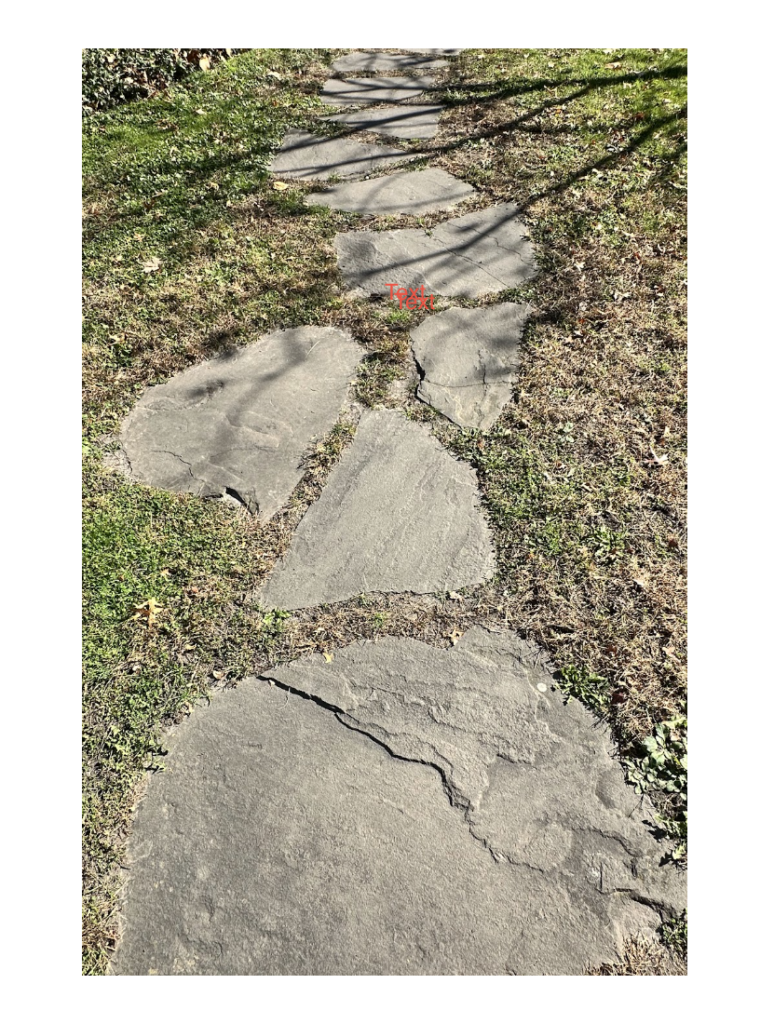
In the case of a photograph, one gets an image of the object that is taken from a certain point and perceives it without thinking much about what lies outside the photo. With a 3D model, one should consider the object as a whole including the parts that are not visible on the photo. Working with the stepping stones made us realize how many details could be left aside when an object is shown in one photograph. An image could provide some information about the look of an object, but not about the relationships of its various sides or overall shape.
For photogrammetry, one needs to make up for such shortcomings and take into account a few different images of the same object. This way, we had to pay more attention to the stepping stones and notice all the irregularities of their shapes and forms.
It was connected to our study of the models of cultural heritage as well. However, the aspect that appealed to us was that the creation of these models requires certain choices to be made about what we are willing to observe about the space. The perspectives chosen for modeling, details of attention and even those parts of the object which could remain unnoticed, all of these affect the end product. While photogrammetry is based on the reconstruction of the object, its accuracy is inevitably influenced by the choices made during the observation of the object.
In other words, this project made us think more on the connection between an object and its representation in a new way. Although at first we might consider a photo as a sufficient representation of the object, modeling has shown us that there are things which can never be seen from one perspective. Moreover, modeling made us reflect on the fact that while we were thinking about what we are able to see in an object, we could be ignoring some of its important features as well. It is also concerned with decision-making on the way that object will be displayed, thus, influencing how others will understand it.
It is interesting to see how a single picture may fail to provide all the necessary information about an object. People tend to forget how significant perspective is for comprehending what an object looks like. Another interesting thing that caught my attention was the link between 3D modeling and culture, as decisions that we make affect how others see the object.
Hi! I agree that with 3D modeling, we need to pay attention to parts that are not visible in the photo and dive deeper into hidden sections. Building 3D models gives us insights into details we might have never thought about before actually building them. I think your feature is even harder to model because the stepping stones are flat on the ground, making them tricky to capture and convert into a 3D form. I also agree that through this process, we gain valuable insights from a different perspective.
I loved reading your reflection Samira! I liked how you discussed the connections formed between the object and what it represents. I think that when you actually have a chance at “creating” the object, you can understand more of how it was created and why it was created. There’s a story to everything, so it’s quite cool that you pointed out the cultural aspects of it!
I think that your reflection provides an excellent description of the importance of 3D modeling and why it’s such a cool skill to have. A photo alone might fail to capture some of the depth that an object has, whereas a 3D model allows you to almost see an object completely. Although I think that seeing something in person is the best way to see it, 3D modeling is definitely a super cool second.
This is a fascinating reflection on the shift from passive observation to active spatial understanding. You capture a fundamental truth about photogrammetry: a single photograph offers a static frame, but 3D modeling demands a holistic engagement with form, geometry, and spatial relationships. Your insight about how capturing the irregular contours of stepping stones forces deeper focus is particularly compelling. It’s a great reminder that every digital reconstruction is shaped by human choices; deciding what to emphasize, capture, or omit directly influences how others interpret cultural heritage. Excellent work connecting technical process with perceptual philosophy!