For this blog, I used Voyant Tools to analyze F. Scott Fitzgerald’s The Great Gatsby. This novel most of us read in either high school or middle school and explores the themes of wealth, social class, relationships, and the American Dream. Voyant generates visualizations that help identify patterns in textual data. I was interested in looking at the word cloud, which displays words in different sizes based on their frequency in the text.
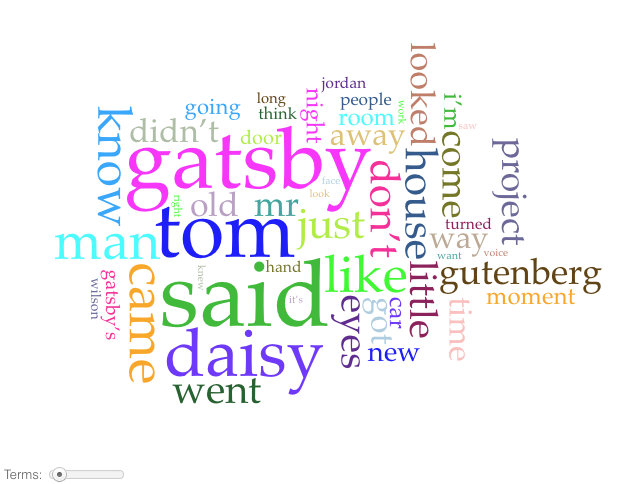
This text had 51,842 words and 6,322 unique word forms. The most prominent words in my word cloud included “Gatsby,” “said,” “Tom,” “Daisy,” “man,” and “know.” These results make sense given the novel’s focus on its central characters and their interactions. Gatsby’s name appears frequently because much of the story revolves around his identity, ambitions, and relationship with Daisy. Similarly, “said” is prominent because the novel contains extensive dialogue between characters. The frequent appearance of names such as Tom and Daisy demonstrates how word-frequency analysis can help identify the people and subjects that dominate a text.
This experiment demonstrates both the benefits and limitations of computational text analysis. Tools such as Voyant can quickly process large amounts of data and text and identify patterns. I think one drawback would be that these methods should be taken more as an additional approach to insight, rather than its only understanding of the novel. This could include examining word frequency over different sections of a novel or analyzing relationships between characters, could reveal additional insights. Other ways we could use AI to analyze novels like this would be to map relationships among the characters to show who interacts with who the most and how that might change throughout that novel.
I think there are a few things we can be concerned about in this Age of AI. This first is that AI can identify patterns in language, but it may struggle to understand the deeper meaning behind them. I also think that AI can generate explanations that sound convincing even when they are partly inaccurate or unsupported by evidence.
I liked your point that tools like Voyant are most useful as an additional way to understand a novel rather than as a replacement for close reading. The word cloud can quickly show which characters and ideas dominate the text, but it cannot really explain why those words matter in context. I also thought your idea about mapping character relationships was interesting because that could show changes in the story that simple word frequency might miss.