Model
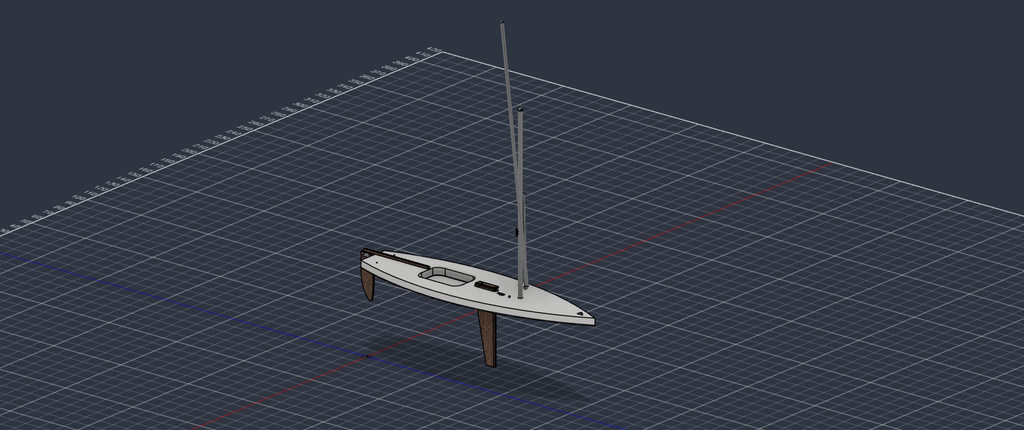
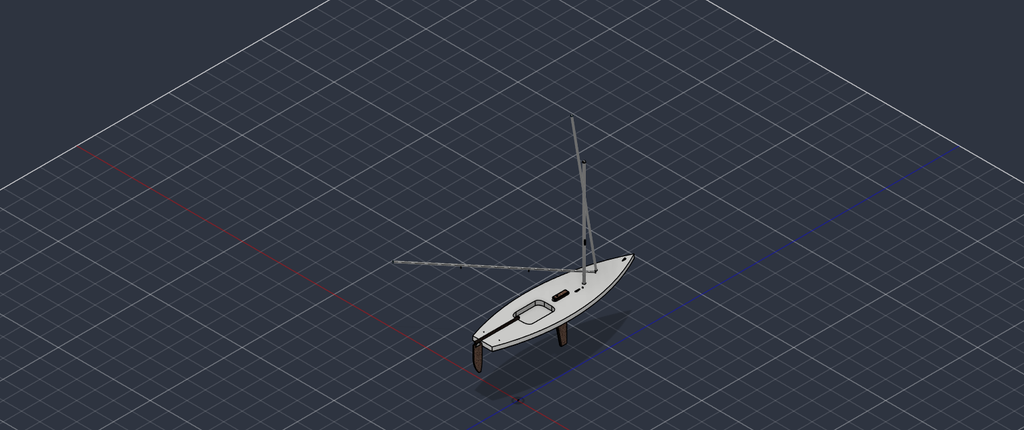
Firstly, what is a Sunfish? Depending on who you ask, it is either a type of fish or a sailboat. For this project, I’m going with the latter definition. I’ve sailed Sunfish both recreationally and competitively for a few years now and it’s one of my favorite things to do. It clears my head and they’re only about fourteen feet long, so they’re quite fast and very maneuverable. They’re also able to be righted by only one person in case they tip, which is very convenient on a hot summer day.
I had originally tried to make a duck-shaped lamp I have, but I found the round and irregular shapes to be extremely difficult to model and eventually switched to an object with simpler geometric shapes. That being said, I still found modeling the boat to be challenging. Because of how many components there are, I had to learn the hard way that each component should be made in its own Part Design and eventually combined in an Assembly Design. Once I figured that out, redid some of my work, and learned how the fillet tool works, I managed pretty well. I definitely bit off more than I could chew, but I didn’t have much homework this weekend and I really enjoyed making it.
As you might have noticed by now, however, there are no sails or lines on my sailboat. I couldn’t find a good way to model either of these without it feeling flat, so I decided to stick to the non-fabric non-rope parts of a boat. I also couldn’t smooth everything out exactly how I wanted which is why the bow (front of the boat) is too sharp and the bottom of the boat isn’t realistic. I did, however, figure out how to add screw holes with threads so the cleats I modeled have (potentially) functional screw holes.
Application
3D modeling this boat made me focus on how everything fits together in multiple dimensions. It wasn’t enough if parts lined up on the x-axis, they also had to line up on the y and z-axes. Because of this, I think 3D modeling could be a really helpful tool in teaching people about objects they can’t necessarily hold. A 2D image can provide a lot of information, but what if we took a sailboat from a 17th century painting and 3D modeled it? Guests of the museum or students could see how the boat might have looked from all angles and maybe even what the interior could have looked like.
This undoubtedly extends beyond boats and could be used to model all manner of historical and artistic objects. In research, it could be used to examine how ancient tools or buildings might have been put together without immediately building real-world models.
Tip
The most difficult part of the process was figuring out why my parts weren’t moving. It took me a long time and two deleted parts to figure it out. Basically, there are two main types of designs in Fusion: Part and Assembly. Each individual part of your design should be made in it’s own Part Design. Once all your parts are made, you can create an Assembly Design and import your previously made parts into this new workspace. This allows you to keep the parts separate, move them to the desired position, and work on them individually without messing up the rest of your design (save the Part Design and update the Assembly Design to see the changes).
I will also say that my computer had some issues running the program and the computers in the library were very helpful.
This is a great model, Lily! I appreciate your comment regarding the ways that we can use 3D modeling to understand the processes that led to the production of a certain object. It is quite exciting that 3D modeling allows us to re-engineer processes that otherwise are obscured in either 2D representations, or the original objects themselves.
Lily, you say this is simpler, but this still looks ambitious to me. Despite that, you did a fantastic job! I also think the screw holes are a neat touch. Thank you for the tip about using Part and Assembly Designs, as I’m sure it makes it a lot easier and allows you to move things without worrying about messing up the dimensions of other parts. I also definitely agree with using 3D models to allow people to get a better sense of what things they have never seen before actually look like.
Your advice for creating a more intricate object as a whole (with individual part creation before assembly) is revolutionary news to me. Though I have not tried this process out for myself yet, I assume it shall go much faster than if I drag each body into place on one file. I quite agree with your take on 3D modeling, though I wonder if learning the program will be a greater barrier to entry than learning to draw on a pen and paper. While physically sketching may more often be less detailed than 3D modeling, it can perhaps be a faster way of communicating a simple idea. So I ask: what circumstances can you imagine 3D modeling being applicable in fast-paced environments? I also appreciate your compromises of no sail or strings — it may have been the right call to make. In my experience, Fusion does not handle cloth textures extremely easily.