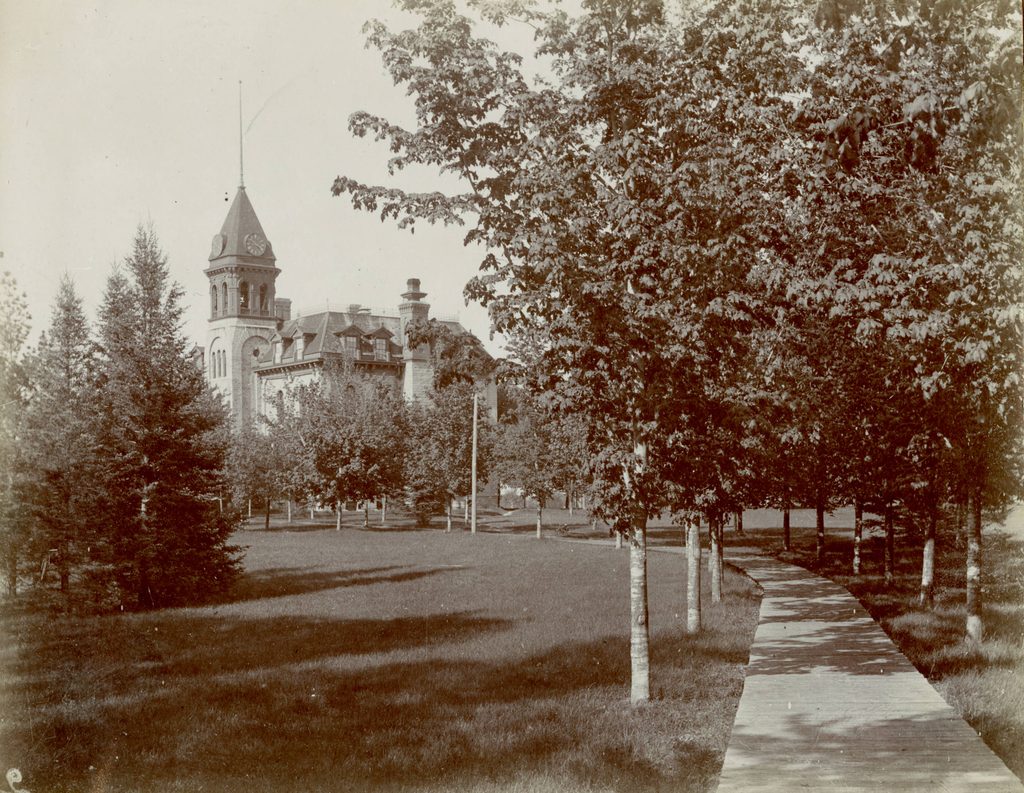
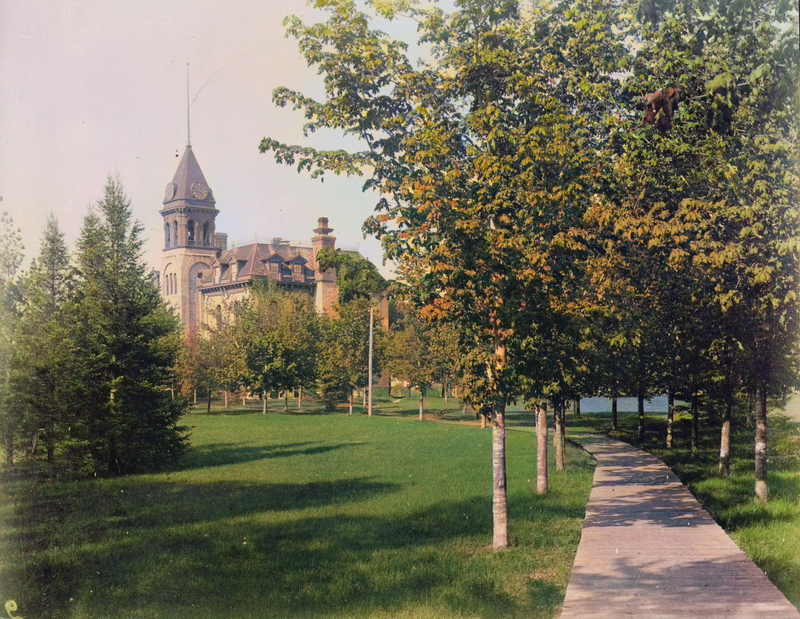
For this lab, I took an 1899 photograph of Willis Hall from Carleton’s Digital Collections and colorized it using DeepAI’s DeOldify tool. All I had to do was upload my image, press a button, and suddenly, the image was made colorful; anyone could colorize an image without much or any background in navigating digital tools. However, while this looked impressive at first, a more careful examination would reveal various inconsistencies that made me wonder: how much of the colorized image is accurate, and might that be misleading for future audiences?
For instance, after taking a closer look at my AI enhanced Willis Hall image, I noticed the ambiguity of the season; some of the leaves on the trees are orange, but others are green. While this could be a sign of early fall, there are no leaves on the ground, suggesting summer or spring. Meanwhile, the sky is almost completely colorless, leaving no clues there. So really, what are we learning from the AI color enhancement?
Sonja Drimmer’s article, “How AI is Hijacking Art History,” sums it up nicely: “these recreations don’t teach us anything we didn’t know.” More than that, they could potentially be misleading. The AI version of my image includes a section of opaque blue toward the end of the path on the right—looking at the original makes clear that this is simply a section of grass the AI misinterpreted. As well, after running the image through Lauren Tilton and Taylor Arnold’s Distant Viewing Explorer‘s image classification tool, the program matched it with multiple categories it obviously doesn’t fit with—according to the tool, the image is a 78.84% match with “honeycomb.” In this case, it’s easy to discredit this information as we have the image right in front of us, but what if these categories were used to write captions or image descriptions for people who might not?
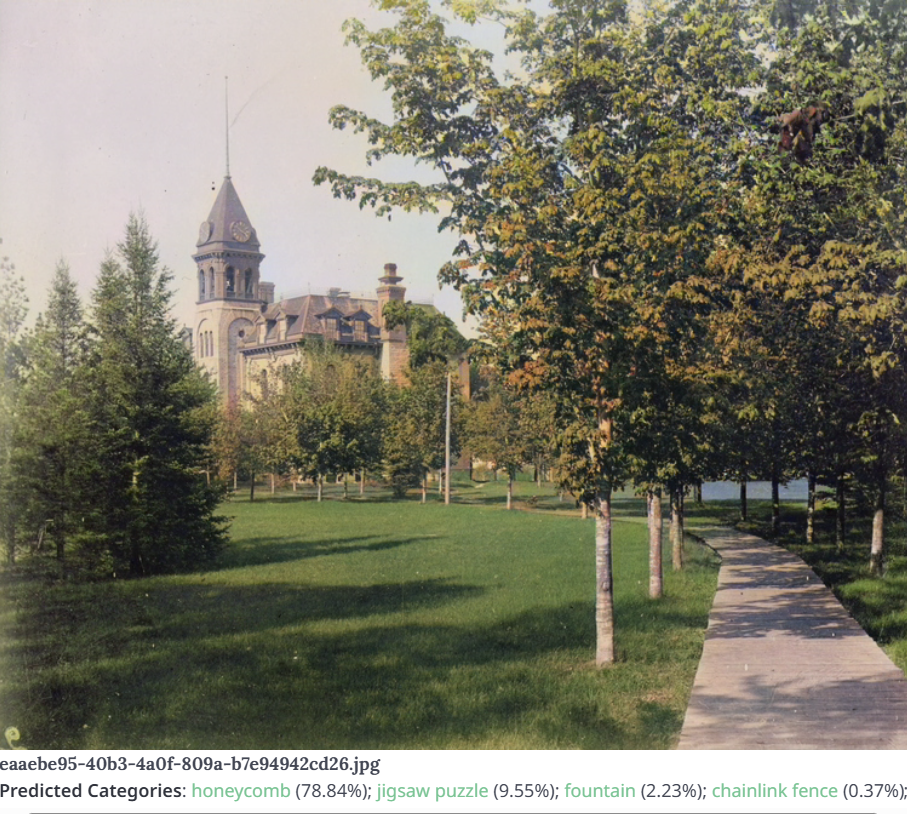
As Ted Chiang writes in his New Yorker article, “ChatGPT is a Blurry JPEG of the Web,” “we should expect that significant portions of what [AI] generates will be entirely fabricated.” This doesn’t mean we can’t use it at all, but we should take its outputs with a grain of salt, especially when presenting these outputs to a larger audience. Any AI images—or information—that could be misleading or incorrect should be labeled as such, or omitted from a project altogether.