Before I went through the HTML Dog tutorials, I had almost no experience with coding. In middle and elementary school, I did a few games in science classes where we would connect code blocks together to make simple video games, but if you were to ask me what HTML or CSS meant, I would not have been able to tell you; I didn’t even know they were types of codes to begin with. However, after doing some work with them and even creating a little web page of my own, I can honestly say that there is a lot of value in understanding these web languages, even if it’s just the basics. In fact, all students should learn the essentials of web language, development, and the history of the internet, especially in this age during which digital progression so relevant to daily life.
Learning web languages would give students the necessary ability to navigate the internet with a clearer perspective; rather than blindly clicking through web pages, they would have a better comprehension of the behind-the-scenes picture. They would have the toolkits to grasp how a web page might have been made, to inspect a page and comprehend the codes constructing it. For instance, this code I wrote earlier
body {
	font-family: arial, helvetica, sans-serif;
	font-size: 14px;
	color: black;
	background-color: #ffc;
	margin: 20px;
	padding: 0;
}
would make perfect sense to them — they would easily recognize that this is the CSS code required for designing the body text of a web page, which would not only help them understand the rhetoric of the page itself, but also give them the means to study it proactively and even create their own projects like I just did.
Burdick et al., in Digital Humanities, writes that digital expansion “means embracing new skill-sets that are not associated with traditional humanistic training: design, programming, statistical analysis, data visualization, and data-mining.” This means that in order to provide the next generations with the experience they need to become literate in the humanities, as well as creators themselves, we need to incorporate new fundamental ideas into our classrooms, such as coding. After all, despite my struggles with learning HTML and CSS — don’t ask how long I spent trying to get a table to turn out right — I feel that I now have a much better understanding of the web overall, and that’s only after barely scratching the surface. If we teach these skills to students as part of their baseline education, they will be much more equipped to navigate the World Wide Web going forward.
<h2>What is this?</h2>
<p style="color: red">A simple page put together using HTML. <em>I said a simple page put together using HTML.</em> A simple page put together using HTML for HACKING THE HUMANITIES!!! </p>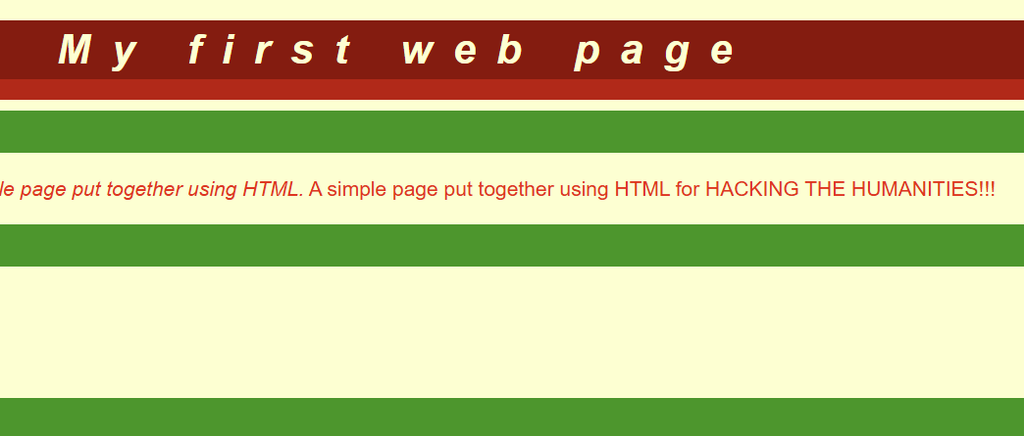
Hi Lily!
I also had essentially no experience with coding before completing this lab. I agree with you that students should understand at least the basics of web languages, as it would give them lots of advantages in the digital age that we live in. I like how the banner you created for your web page looks, the red and green color scheme goes well together! I also appreciated how you integrated the code you made to use as an example to prove your point, that was really well done.
Hi Lily! I agree that it’s important for students to know the basics because of how relevant technology and digital progression is in our daily lives. I also agree that there’s some merit to understanding how the internet works and not just blindly interacting with it and taking access to it as a given.