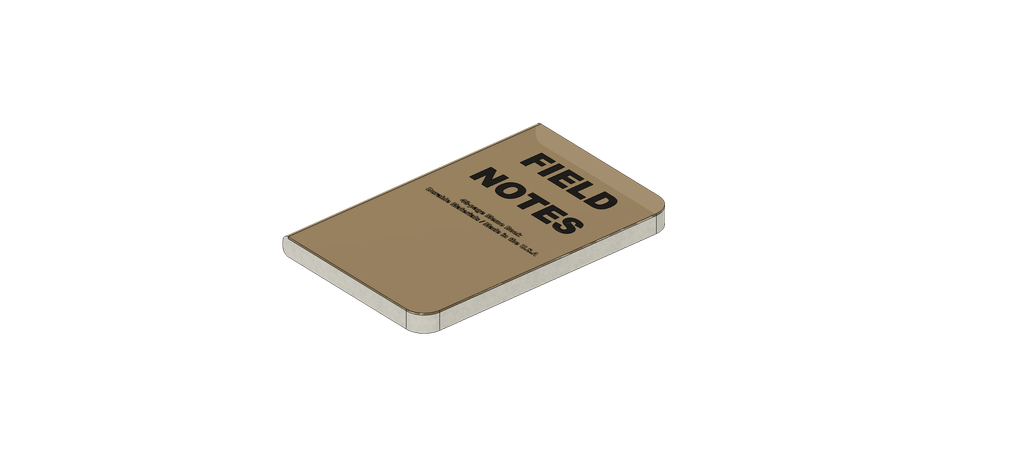
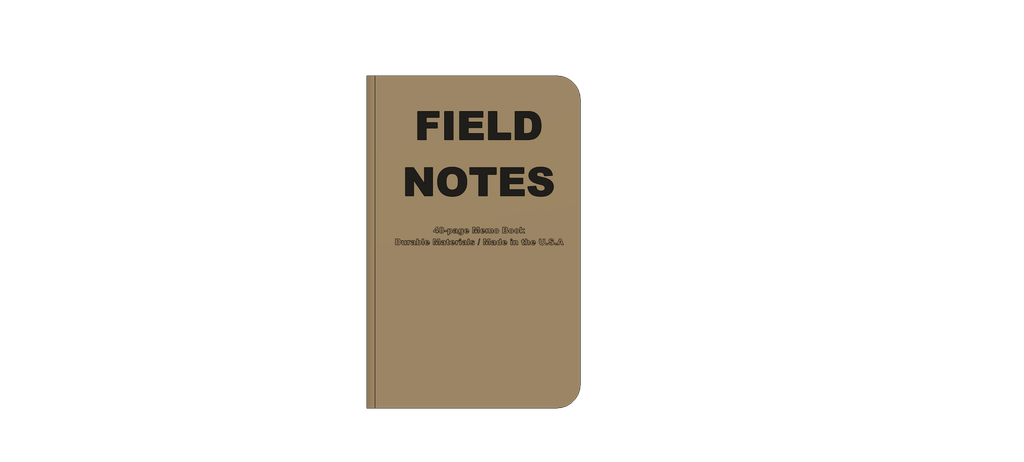
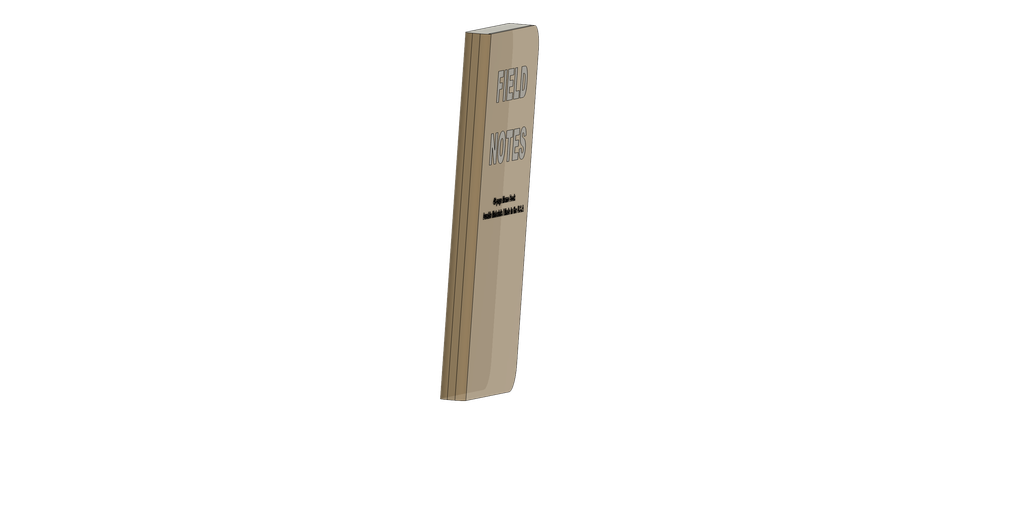
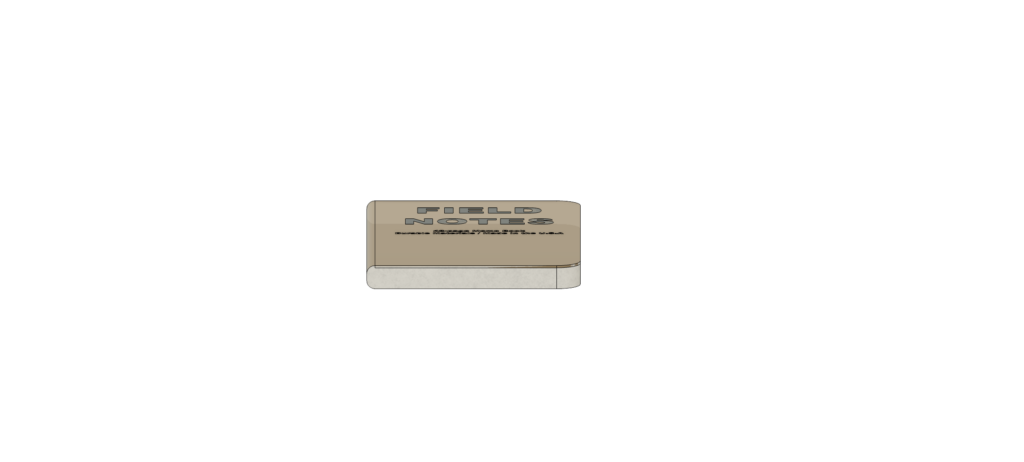
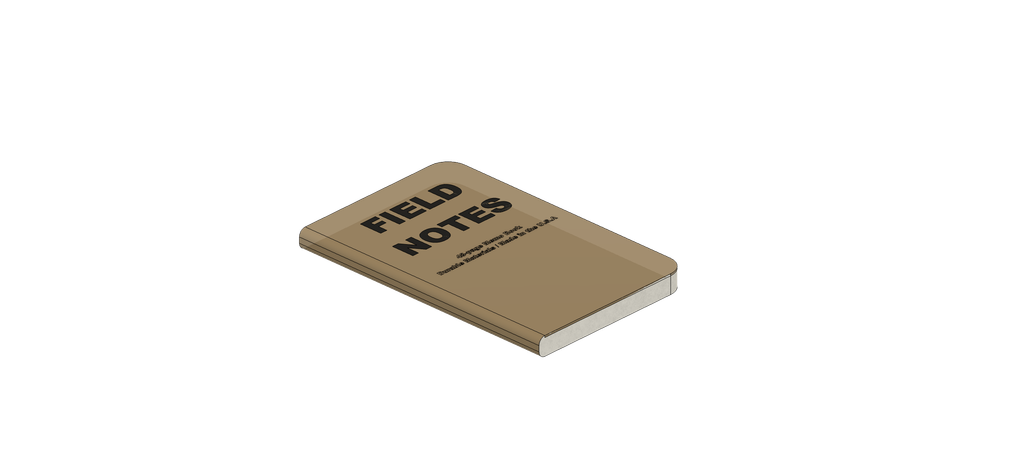
For this week’s assignment, I modeled my Field Notes notebook. Often kept in my back pocket, I use these notebooks for everything whether that be to-do lists, grocery lists, questions for professors, or thoughts I’d like to remember.
Modeling Process & Challenges
Overall, I found making the model to be fairly straightforward. As far as objects go, its geometry and design is quite simple, so there were not too many components to model in the project. That being said, Fusion 360 is a powerful application with a wide variety of tools to use. While this allows you to refine your design, as a beginner it was challenging to find what I actually needed to use on the first or second pass through making the model.
The most challenging component to this project was making the lettering on the front of the notebook. Fusion 360 does not have a single-step process for placing and coloring lettering on an object that you have designed. In turn, I had to create an inlay which could then be colored black while also preserving the tan coloring on the outside of the notebook. This tutorial by Kennedy DIY was very helpful in explaining the process, but it was also quite time intensive when I was implementing it into my model.
While I was able to to model the notebook fairly close to its appearance in real life, I had to compromise on the materials I used for its appearance. For example, Fusion lacks a “cardboard” appearance option, so I had to settle for a general, matte tan for the cover. Additionally, I was not able to get the font to match the typeface on the actual notebooks.
3D Modeling in the Humanities
There are a wide variety of applications for 3D modeling in the humanities. As an archaeology student, I am always thinking of the importance of material culture, both as a subject of research but also its power in the classroom. Often these materials are kept in museum collections that are not accessible to the general public. 3D modeling has the potential to allow researchers and teachers to model their own replicas of these objects, either for academic study or for use in a classroom. 3D models can be printed for hands-on use, or they can be shared via the internet, allowing for greater inspection than simply looking at a 2D representation in publications. This hands-on use can be very transformative in educational settings, allowing students to get a much deeper sense for what people and communities would have been interacting with in the past. Moreover, given that these models are digital, we can circulate them among crowds that would be interested, but otherwise lack institutional access to get their hands on the actual object. In addition, 3D modeling can be used as a preservation tool. As sites or materials are threatened or begin to degrade, creating a model can help preserve our understanding of the object, allowing for study to continue in the future.
Quick Tip
If you are hoping to make your own model, use the “Split Face” tool if you want to assign multiple colors to the same base object. Doing this allows you to select the specific face you want to alter. This allowed me to assign a “paper” appearance to the notebook edges while also keeping the tan covers and spine.
Hi Jesse, I liked your comment about the importance of 3D modeling as a preservation tool. I understand that some objects can be extremely fragile and sensitive to the environment in which it is stored and so this seems like a good and also accessible way of preserving objects.
Accessibility can also be a major barrier for students who can’t travel or visit specific museums and so I like your comment about 3D modeling as a way of increasing accessibility in the classroom.
Hi Jesse, I found your 3D model to be quite impressive, specifically the lettering! Additionally, I appreciated what you have to say about the importance of material culture. Being able to access archival material from Carleton’s collection is something I’ve greatly appreciated in various courses; I feel like it strengthens my connection to what we learn about. However, those experiences can be limited when it comes to fragile materials or materials outside of Carleton’s collection, so as you say, being able to use 3D models of those materials provides more accessibility to a valuable resource. Great point!