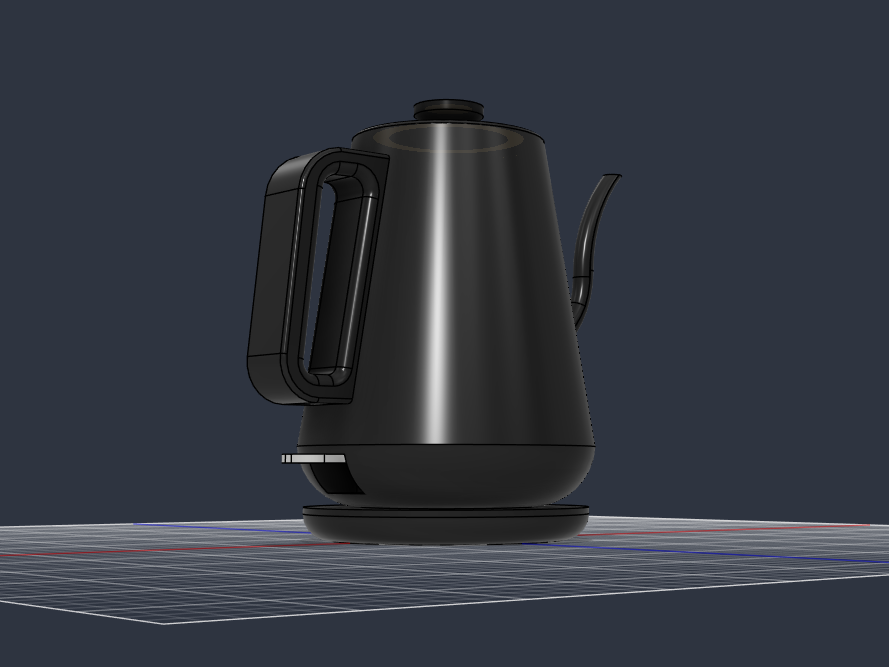
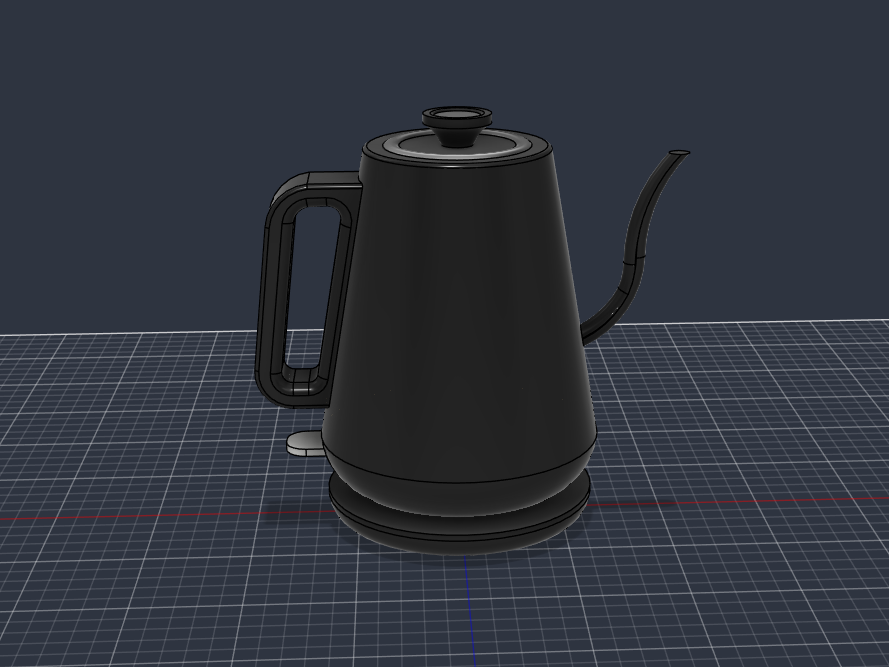
For the first lab assignment, I decided to model the kettle on my desk. I figured that it was mostly different kinds of circles, and it wouldn’t be difficult. I was kind of wrong. The middle itself wasn’t too hard to make, but I underestimated how difficult it would be to shape the handle and spout. The handle wasn’t terrible, but I couldn’t figure out how to make it a uniform thickness throughout, so I just had to eyeball it.
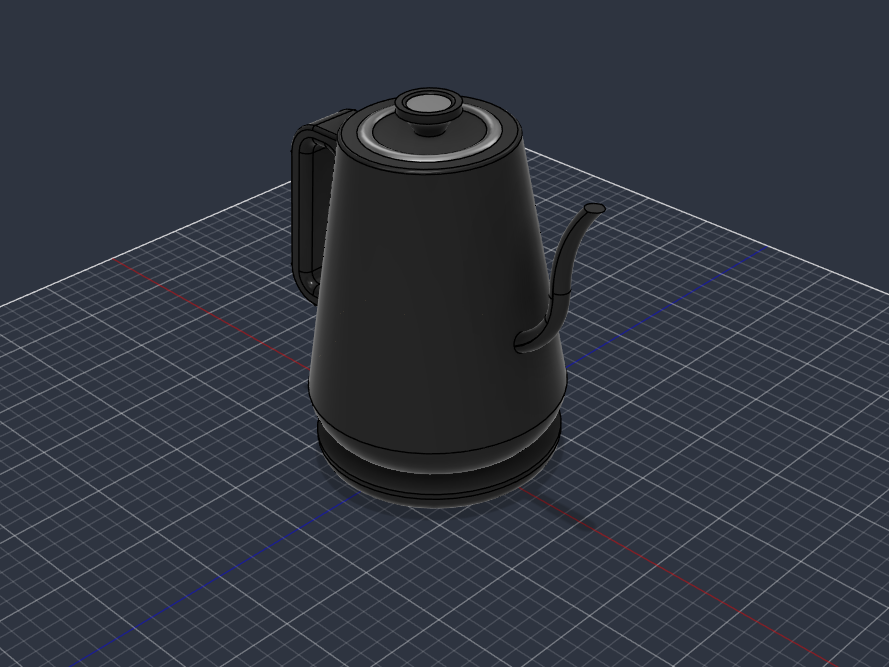
The element that bogged me down the most was the spout. I wasn’t sure how to approach it, as I didn’t know what tool could be used to make a curvy tube, nor did I know how to hollow said tube out. I still don’t. I ended up compromising by drawing a side profile of the tube and extruding it symmetrically until the “tube” looked square-ish, and using the fillet tool to round the edges enough to make it look circular. It’s nowhere near perfect, but I think it gets the job done.
As someone who really likes sculpture and museums, the use case for 3D modeling that immediately comes to mind is to make models of what broken statues looked like when they were in one piece. People debate whether the missing pieces of statues should be “restored” with replicas (such as the right wing of the Winged Victory of Samothrace being a copy made of plaster) or if they should be left as is. 3D modeling could be the middle ground, allowing people to see a version of a statue as it once was without permanently altering it. These models would also be an easier way to show a wider range of people statues and expand their understanding of ancient art.
While I wouldn’t say I’m qualified to be giving out 3D modeling tips, I will say that being able to extrude something symmetrically instead of only being able to expand it in one direction at a time was massively helpful in modeling both the handle and the spout of the kettle. Also, I occasionally found it easier to get the shape I was looking for by cutting off parts of the model instead of adding more on.
Hello Sabrina,
Your model looks awesome. Museums were also what I thought of when doing this assignment. I’ve always had issues with restoring ancient art because in my opinion, you’re losing much of the history that makes it so special, but 3D modeling would take that issue away. I think there is something really important and historically informative about being able to see cracks in paint or wear marks in a tool.
I really found this model to be pretty realistic and overall really nice Sabrina! I loved how detailed you got with components like the on/off button and the heating surface. I appreciated how you mentioned cutting parts off because I find that it can save time, but also provide a more accurate presentation of the figure.
This looks so incredible! From reading some other posts and my own project, it feels like we all struggled with hollowing things out. I think the curves of the spout would make that especially difficult. Props to you for making something super easily recognizable; I knew exactly what type of kettle it was from first glance!