Digital capabilities have challenged the humanist to make explicit many
Burdick et al. “One: From Humanities to Digital Humanities,” in Digital_Humanities (Cambridge, MA: MIT Press, 2012), 4.
of the premises on which those understandings are based in order to make them operative in computational environments.
If you know how to read a book written in English, then you are already aware of where to begin. That is, you must direct your eyes to the top left of the current page to be read1 and slide your gaze across in a rightward motion, taking note of any footnotes2, until you come to the end of the text on that line. Then you shift your eyes down slightly to where the content begins again, and repeat the whole process, until you reach the end of the page. Then you once again direct your eyes to the top left of the next page… then eventually, you end whatever you are reading.
1. But below any header text, spacing at the top, paragraph indentation, or page numbering that may be present.
2. Which may be an asterisk, number, letter sword, pilcrow, dagger, double dagger, or other non-standard indicator.A few centuries ago, unless you were the one making the literature, that was enough read all meaningful literature.
But now..
We can’t always assume such nice
typographical standards.It was certainly possible, back then, to fashion a stencil of some sort to replicate the exact font I used (Comic Sans MS), then do some math to figure out what angle to align the stencil against the protractor to match the skewed “But now…” (36.23 gradians, which is equal to 32.607 degrees). It would take you a long time, and wouldn’t be very fun, especially if you made a mistake.
The quote above elegantly captures what is special about the digital humanities. Authors can play with how science and art is presented without resorting to hours or days of wasted labor.
| Extremely Involved Task in the Past | What is Possible Today |
| Aligning/justifying graphs and tables with text | With the know-how, an author can quickly display data however they want. |
| Proper font variations and weights | Deciding on the fly what is important. (Or not important) |
| Learning the correct way to print special symbols | Typing Unicode Characters ∀t Will🙂 |
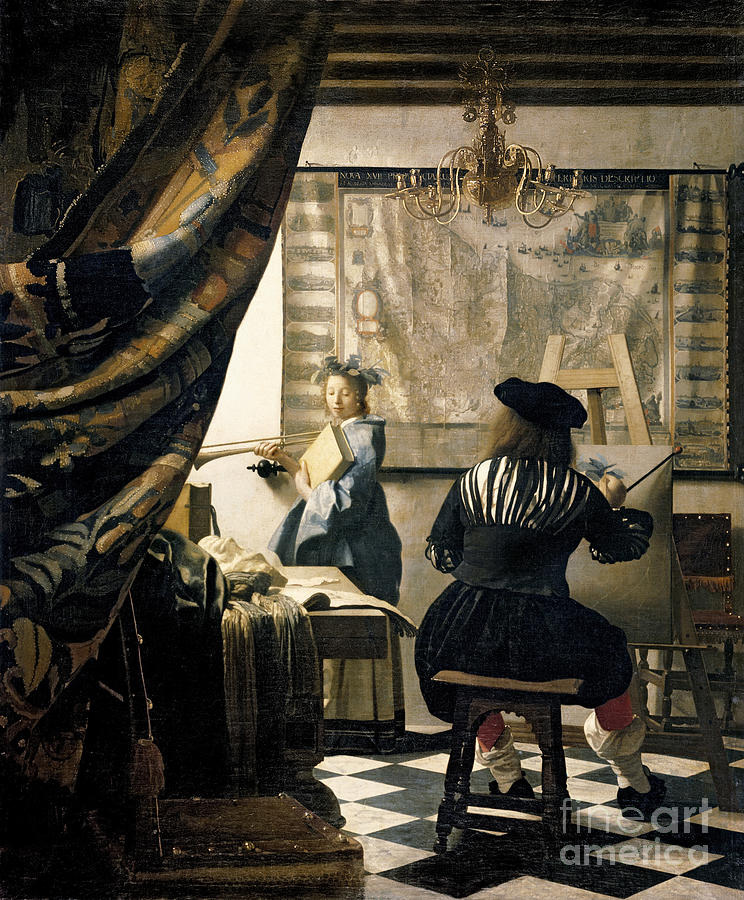
When reading the above quote, I thought back to when I used to paint. I had control over every stroke, every color, and decided when to reset by dipping my brush into water. Digital Humanities is the art of giving a writer a canvas to paint on.
Before computers, the standard book format was extremely streamlined because creating literature was an involved process that was costly to mess up. Now, it is out of convenience and derived from we see other people on the internet. The natural style of a webpage is layers upon layers of defaults and set configurations. All defaults can be explicitly overridden, and configurations exist to be changed. Today, we can find countless examples of unique and creative ways to explicitly change norms.
This is why I seek to explore Digital Humanities. Playing with different ways of presenting text, telling a story, incorporating different datasets and maps, and using networks are all areas I’m excited about exploring. Allons-y!