Movieglaxies is a digital project that allows users to explore movies through the relationships between their characters. Rather than experiencing a movie only as a story, Moviegalaxies turns characters into nodes and their interactions into connections, creating a visual network of the movie. The website currently includes 772 movies, 28,039 characters, and 149,339 connections. Below is an example of one of these networks from one of my favorite movies, Memento.
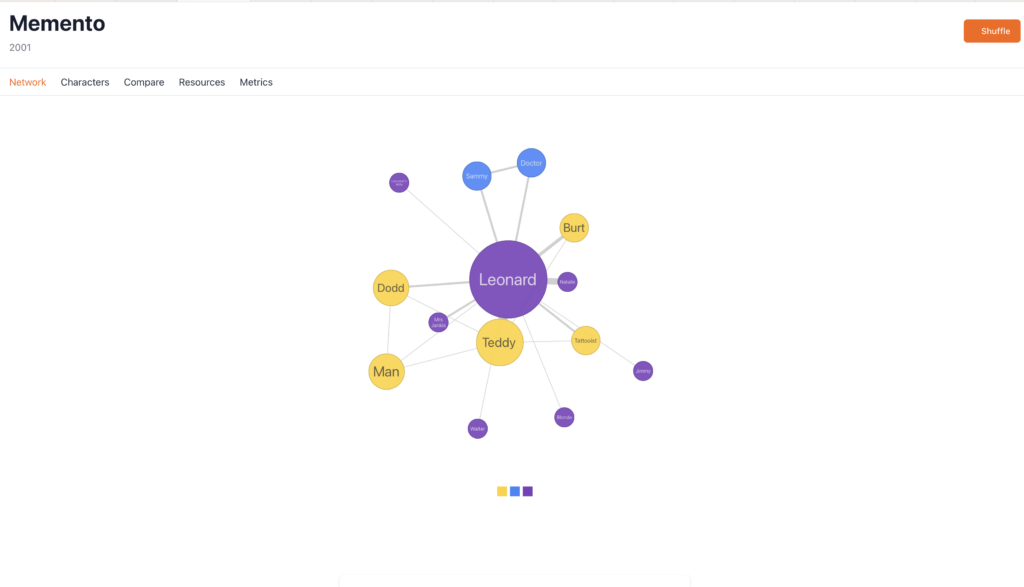
The sources, or assets, come from movies and series, including their characters, scenes, dialogue, genres, and other information. The website’s statistics show that it has analyzed more than 20 million words from over 234,000 scenes. The process involves taking this information and turning character interactions into networks that can be measured and visualized. I would classify this process as turning multimedia into data visualization. Users can then explore these networks and compare movies using measurements such as the number of characters, connections, density, diameter, and clustering. The presentation is the interactive data visualization on the website itself, which allows users to search for movies, filter them by genre, and explore their different network structures.
The goal of Moviegalaxies seems to be giving people a new way to understand and experience movies. The website describes itself as a place to discover “the character interaction network in films and series” and to experience familiar movies in a new way. This connects directly to our class discussion about what digital projects allow us to do. Moviegalaxies takes information that already exists in movies and reorganizes it so that users can identify patterns that might be difficult to see while simply watching the film.
I also think the project is designed for a broader public. The site is easy to navigate, allows users to search for familiar movies, and organizes films into recognizable genres. At the same time, its statistical measurements could make it useful for researchers or students interested in film, networks, or data analysis.
One new question I have is: How does changing the way we categorize a movie change what we notice about it? Looking at a film as a network emphasizes relationships and structure, but may leave out the “classic” elements like acting, cinematography, and music. This shows how digital projects can do more than just present information. They change the way we frame our understanding.