For this lab assignment I found a photo of an old dorm room from the late 1800s. started by visiting Carleton’s Digital Collections website and browsing through the historical photographs until I found an image of a room with a rocking chair, bookshelf, and small table. I then opened the image and used Safari’s Developer Tools to access the Network tab and locate the image’s URL. After finding the correct URL, I used the IIIF Image Inspector website to access the full-resolution version of the photograph. Finally, I uploaded the image to an online colorization tool, which generated a colorized version of the original black-and-white photograph.
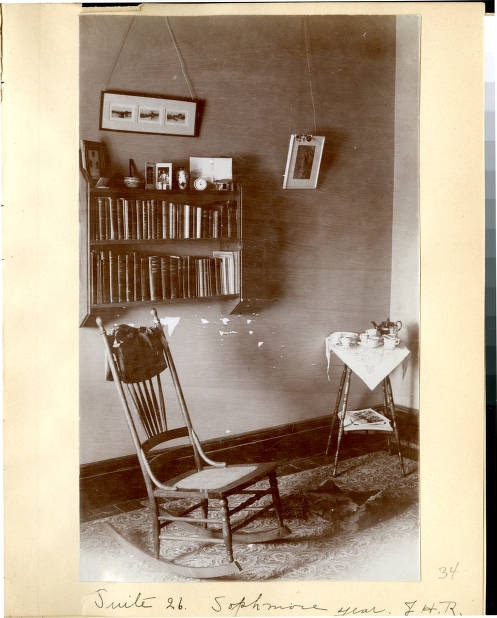
Suite 26 Sophomore year from the Edith Griffith, 1896 Student Photo Album. https://cdm17227.contentdm.oclc.org/digital/iiif/Scrapbooks/1641/full/498,/0/default.jpg

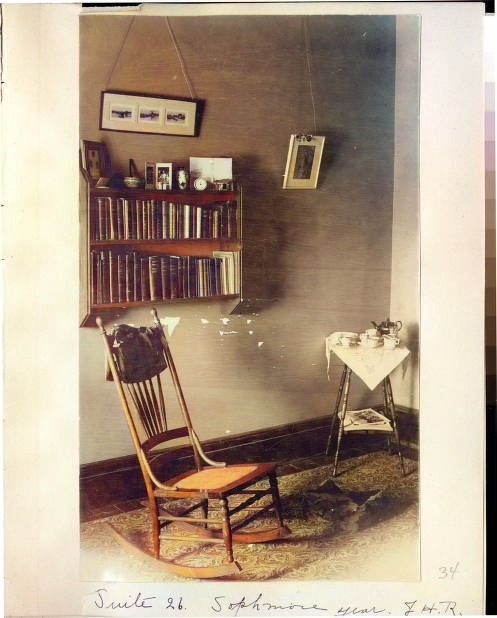
The biggest difference between the images is that the colorized version makes the room feel more realistic and easier to imagine as an actual living space. The rocking chair has reddish-brown wood, the bookshelf appears darker, and the walls have a warmer tone. These colors make the photograph more visually interesting and help bring attention to individual objects.
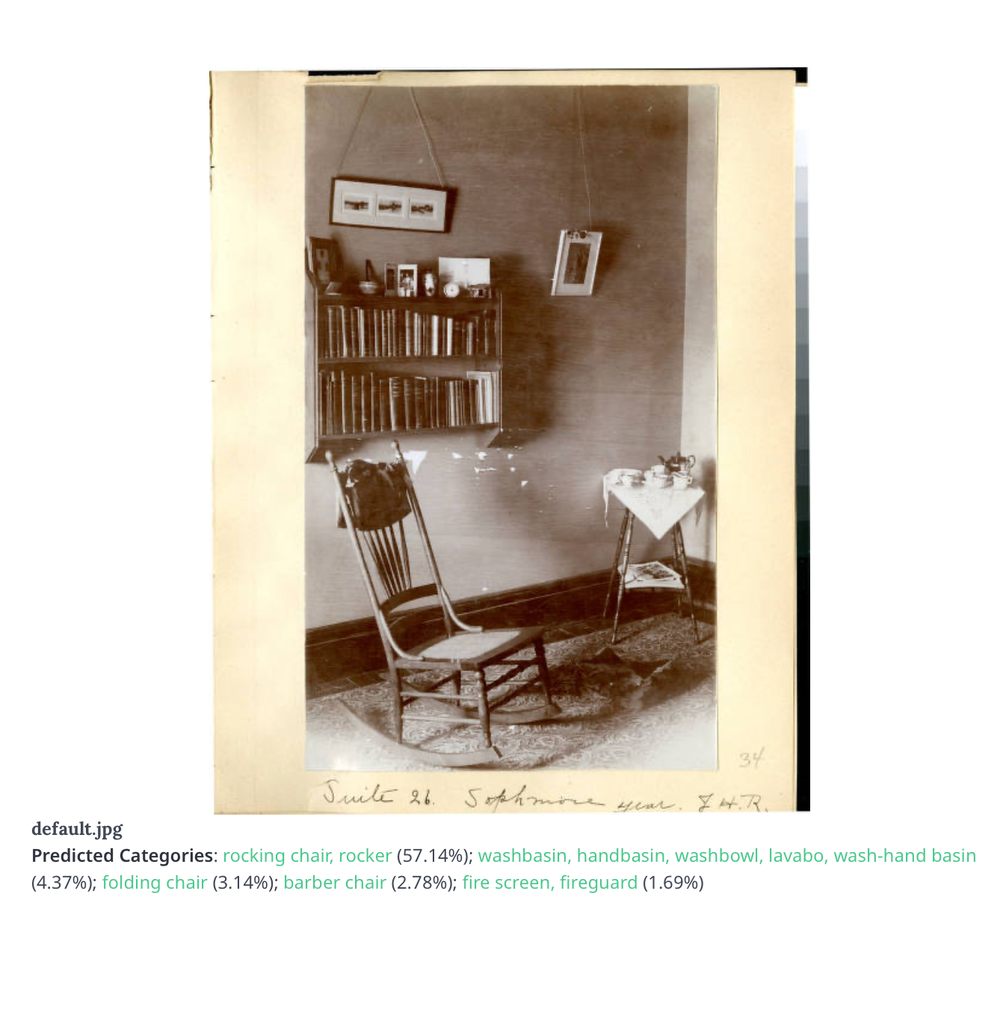
Next, I used the Distant Viewing Explorer website and selected its Image Classification tool. I loaded the photograph and allowed the AI model to analyze it. The model identified the rocking chair as its strongest prediction, with a confidence score of 57.14%. It also suggested objects such as a washbasin, folding chair, and barber chair. This showed me that AI can recognize objects in historical photographs, but its predictions are not always accurate.
One ethical issue with combining AI and image manipulation is that people might mistake an AI-generated image for an accurate representation of history. In my project, the colorized photograph looked more realistic, but the colors were generated by AI and may not reflect the room’s actual appearance.
In “How AI Is Hijacking Art History,” Sonja Drimmer writes that AI projects “have not, in actuality, revealed one secret or solved a single mystery.” I think this is important because AI can make images look impressive without necessarily providing new historical information.Drimmer also warns about “art and history becoming toys in the sandboxes of scientists with no training in the humanities.” I agree that historical context matters just as much as technology. AI can make historical photographs more engaging, but viewers should be told when images have been altered so they do not confuse AI-generated details with historical facts.