For this weeks lab assignment I chose a studio portrait of Henry H. Riggs, shout out Henry Ruggs III. This photo was a part of the 1896 Student Photo Album from the Carleton College Archives Photos Northfield History Collaborative. I first retrieved a high-resolution version of the photograph using the IIIF Image Inspector. I then used two different AI tools to explore how artificial intelligence can change the way we view and interpret historical images.
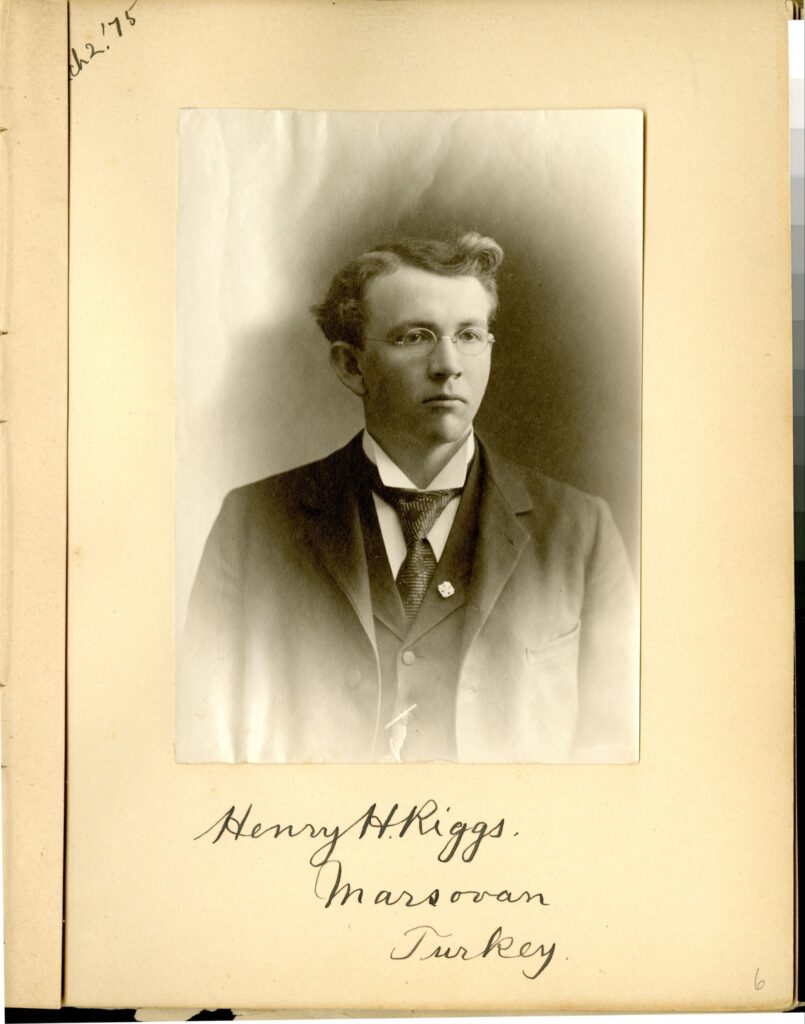
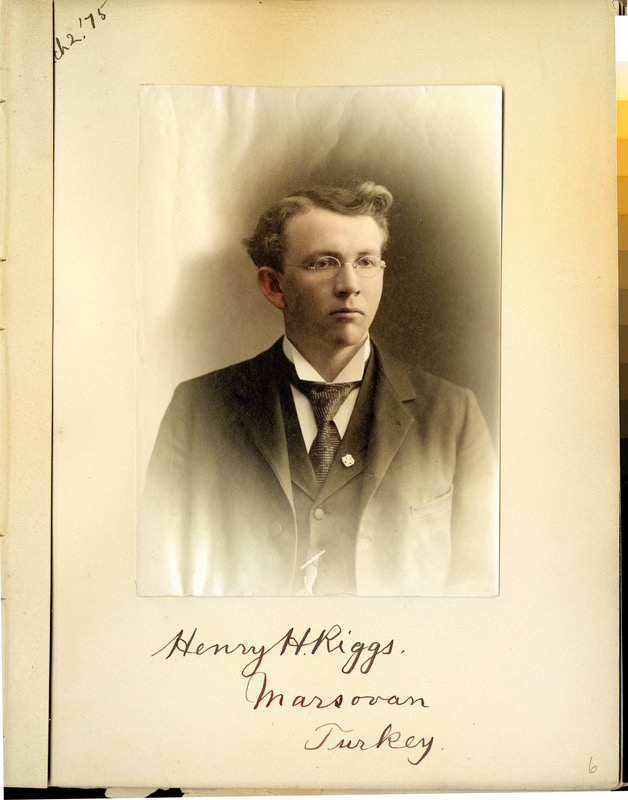
The first tool I used was an AI image colorizer through DeepAI. I uploaded the original photograph and received a colorized version. I thought this version was interesting. My thought before the image appeared was going to be more colored towards a real life colored picture, and looks like it was found somewhere in the middle between looking more colored like a current photo and looking like the old photo. The AI model made it very simple to do this, which was pretty cool. I saw something similar to this on my reels one time with old photos, so it was cool to do it myself.
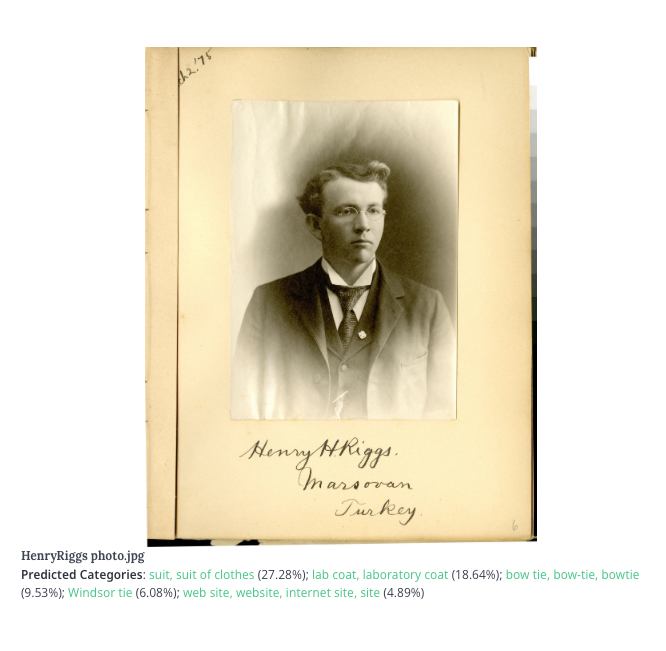
I next uploaded the original photograph to Distant Viewing Explorer and used its Image Classification tool. The image classification model identified several features of Henry H. Riggs’s portrait, including his suit, bow tie, and Windsor tie. However, it also assigned an 18.64% probability to the image containing a lab coat, showing that AI predictions are not always accurate. This demonstrates a limitation of using AI to analyze historical photographs: the model identifies visual similarities rather than understanding the historical context of the image. Its predictions can be useful, but they should not be treated as definitive facts.
One ethical issue I noticed while completing this exercise is that AI can make historical photographs look more realistic without making them more historically accurate. When I used DeepAI to colorize Henry H. Riggs’s portrait, the result gave me a different way to imagine what the photograph might have looked like originally. However, the AI had no direct evidence of the actual colors of his clothing, skin, or the scrapbook page.
This concern relates to Sonja Drimmer’s article, “How AI Is Hijacking Art History.” https://theconversation.com/how-ai-is-hijacking-art-history-170691 Drimmer writes that
Adding color does not show things as they were but recreates what is already a recreation – a photograph – in our own image
This relates directly to my project because the AI-generated colorized portrait of Henry H. Riggs looks more realistic, but its colors are interpretations rather than verified historical facts.
Another quote,
A computer algorithm cannot perform these functions
Referring to the work art historians do to understand how art reflects the world in which it was created and how it influences later generations. This quotation made me think about the difference between recognizing visual patterns and understanding historical meaning.
I liked your comparison of the colorization tool with distant viewing explorer to show the pros and cons of AI use. I found your observation on AI detecting visual patterns not knowing anything about their historical context pretty interesting. This raises the question about the responsibilities that historians have towards verifying conclusions reached by AI before using them in digital history studies.
It was interesting to see how you utilized two distinct AI software to examine a particular historical picture. That the Distant Viewing Explorer detected a lab coat with 18.64% probability is a perfect example of how AI could get things wrong when dealing with pictures. Your point on colorization making photographs look like the real deal but not necessarily historically correct is a valid observation. It makes one wonder if people seeing AI colored pictures of history realize that what they are seeing is basically a prediction of the past.