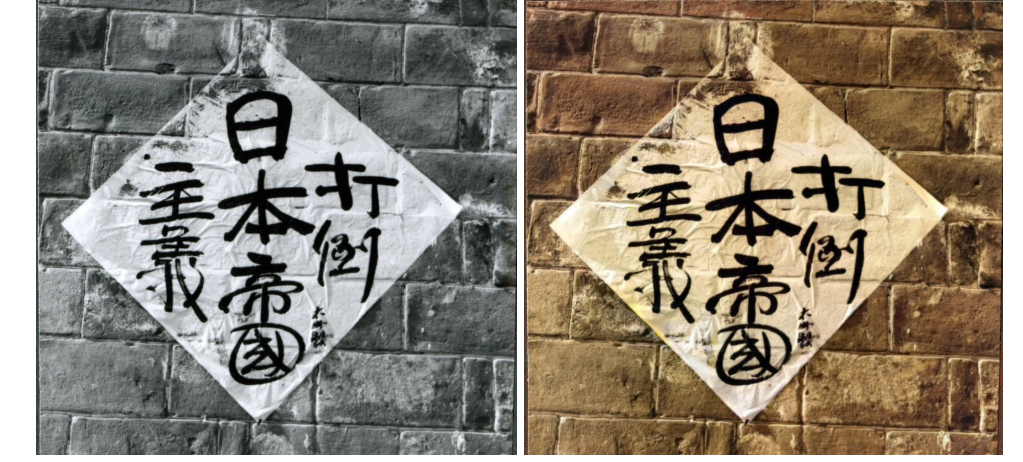
In the photo colorize exercise, what I chose was a slogan stuck on the wall. The output I got is posted at the top of this blog. After the colorization, the photo seems to be more vivid and real, while the details, like textures, are well preserved. By barely looking at the very colorized photo, it may be hard to tell if it is made by artificial intelligence. As Chuang emphasized that “These hallucinations are compression artifacts, but—like the incorrect labels generated by the Xerox photocopier—they are plausible enough that identifying them requires comparing them against the originals” Without looking at both of the images, people can hardly tell whether the colorized one is real or not. As I already know that it was AI generated, I tried to figure out the flaw made by it: When I zoom in to the photo, I can realize some unrealistic color lumps that are blurring the image. Therefore, for now, it is somehow possible to tell whether an image is AI colorized or not. However, what about the future? If we can’t recognize AI generated things, will it be problematic for us to discover the “truth”. As Ted Chiang said that “The problem was that the photocopiers were degrading the image in a subtle way, in which the compression artifacts weren’t immediately recognizable.” AI colorization can potentially introduce unverified colors, which leads to misunderstanding of historical fact.
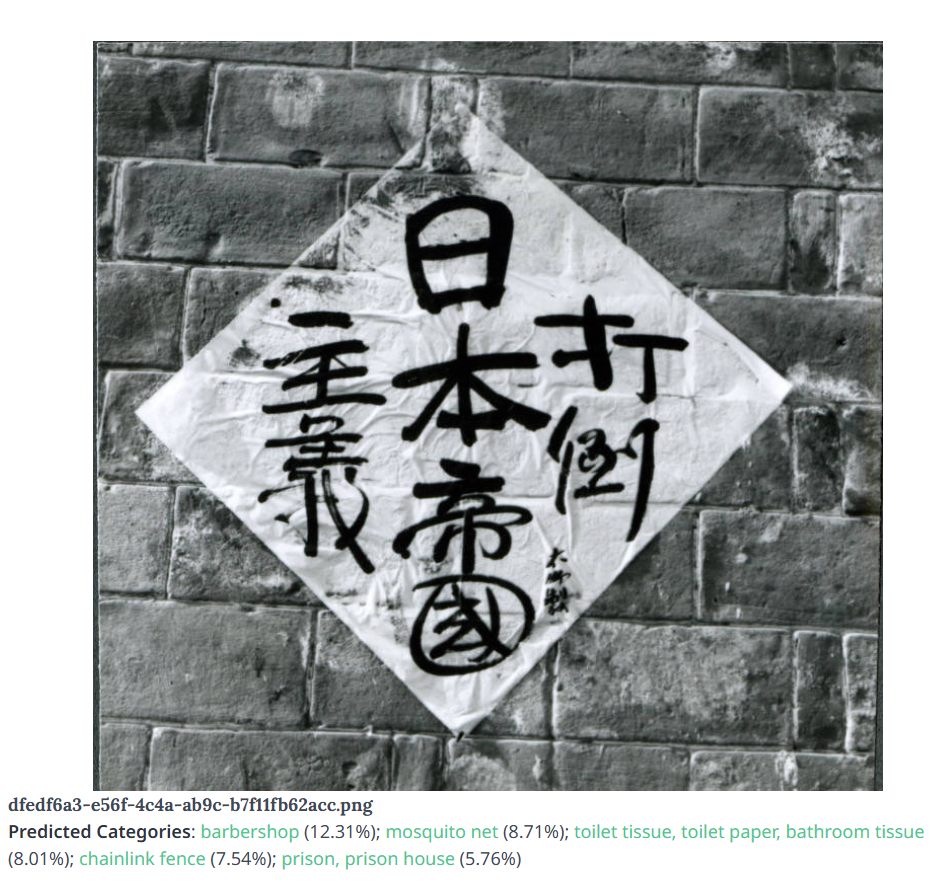
To further explore the image, I used a distant viewing explorer to classify the elements in the photo, and it was quite interesting. The top five categories were: barbershop (12.31%); mosquito net (8.71%); toilet tissue, toilet paper bathroom tissue (8.01%); chainlink fence (7.54%); prison, prison house (5.76%). AI failed to make the right categorization, which is quite interesting. Next time, I may try some other image and see whether it will provide the right categorization.
Hello Peter,
I like how you pointed out that recognizing AI-generated content may be problematic in the future. However, I think that as AI develops, AI detectors will also develop at the same time. I think it is hard for us to recognize AI-generated content primarily because we currently don’t have a perfect management system for the use of AI. I think the government will definitely introduce new policies to make sure that the use of AI stays healthy. At the same time, I can understand your worries, and I have to admit that AI is almost too powerful for each one of us.
Hi Peter! I totally agree with your point that AI colorization can make historical photos look more realistic while potentially introducing inaccurate details. As AI technology continues to improve, it may become harder to distinguish AI-generated colors from authentic historical evidence. Therefore, I think we should always compare colorized images with the originals and critically evaluate AI outputs rather than blindly trusting them.