Working with Voyant
Working with Voyant is great, allowing for quick data processing in pre-programmed tools. All that is required is a .txt file and you are off to the races. For example, it took a few minutes to create the trend graph below. I did notice, however, that there are not many options for detailed customization across the program, especially in terms cleaning up visualizations. Nevertheless, the tool is methodologically effective in its ability to examine how words are co-located, the ways in which certain words are linked with others in a network, and what common phrases are present, just to name a few. In turn, these analyses provide insights into the data and open up meaningful avenues for research.
Working with Gemini
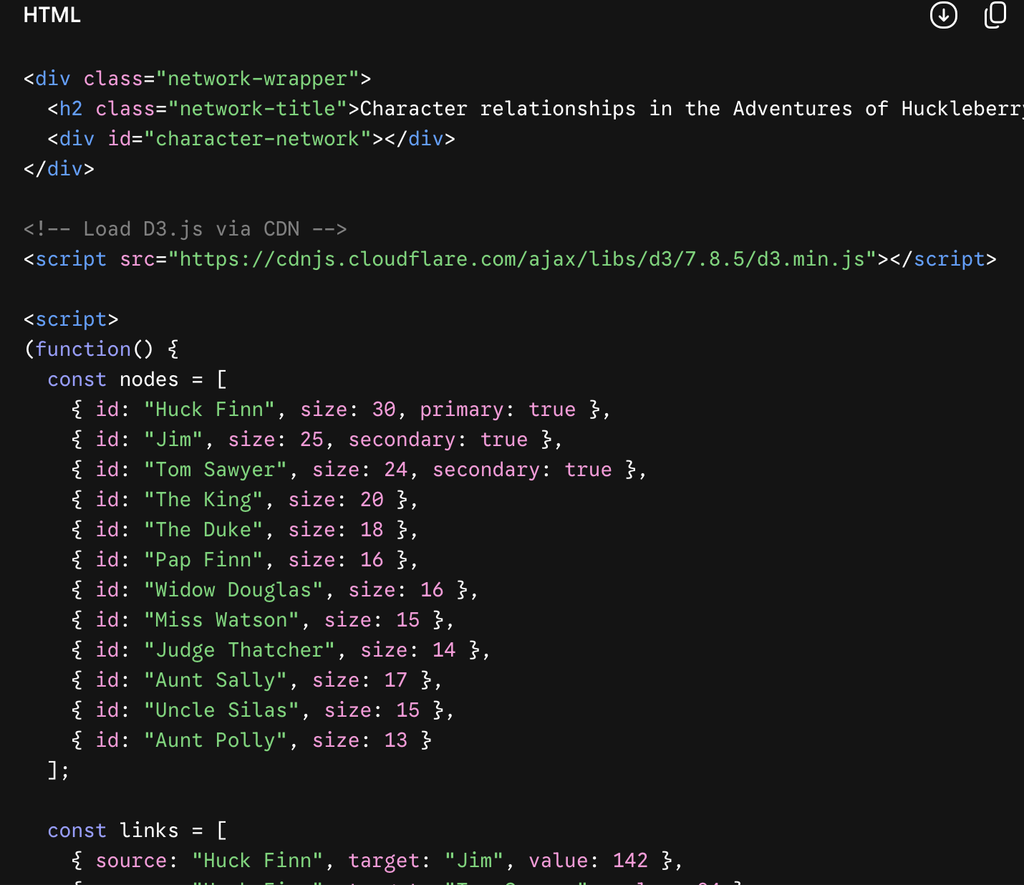
Gemini was effective at both analyzing text and creating visualizations. Mostly, the program was able to easily carry out the prompts designed by Anastasia Salter in her tutorial. Gemini intuitively preprocessed the data to remove stopwords, something that can be done in Voyant, but is more labor intensive. Moreover, it is easy to customize your analyses. For example, I was able to alter the graphic below to make each of the nodes in the network movable. To do this I said, “Visualize the relationships between characters in this text. Provide me with the html code to embed it in a WordPress. Make each circle movable.” As someone without the coding experience to do this, but who had knowledge of the book, Gemini made it possible easily analyze research questions that I was interested in.
Character Relationships in the Adventures of Huckleberry Finn
Concerns with AI?
It is clear that AI makes it easy to quickly analyze texts. For example, after asking “Using the bag of words and the cleaned text, make some determinations about the genre of this work and the themes,” the tool returned a detailed account, grounding its analysis in the frequency and collocation of specific tokens. While this is helpful, the user is disconnected from the internal calculations. While we receive an answer, there are few ways to assure that it is correct and we lack the context to assess the program’s determinations. This may lead to an increased amount of computational mistakes. Additionally, using AI requires the user to be more familiar with the ways in which text or network analyses actually work. In turn, this might limit creativity and/or lead to incorrect applications.