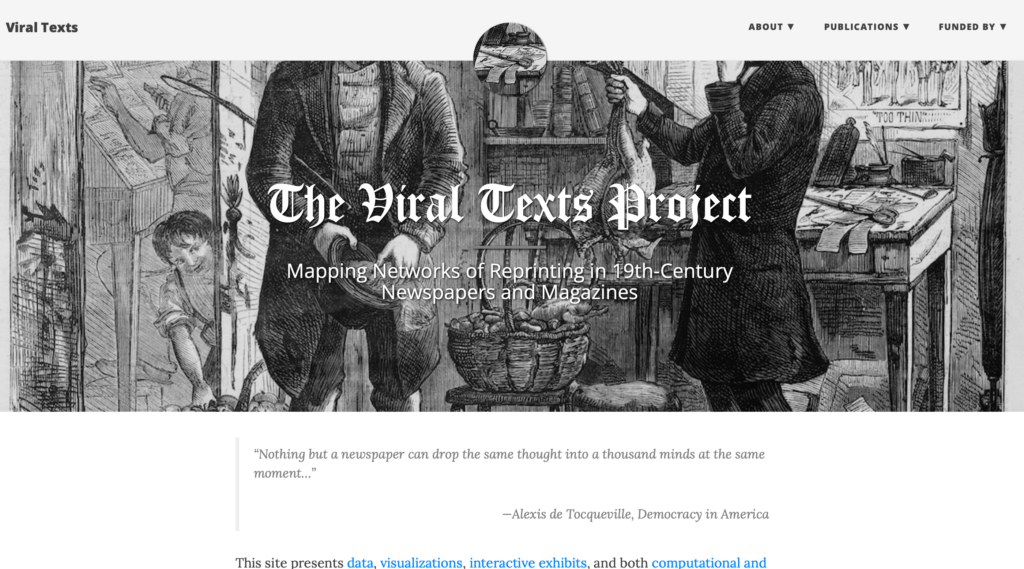
The website I chose to explore was the Viral Texts project. This project analyzes and shows what elements in news articles, short fiction, and other media in newspapers, magazines, and other articles would cause reprinting, or make it “go viral”. It uses certain digital tools to explore why different texts were reprinted, why they were circulated, and the methods that were used to spread them.
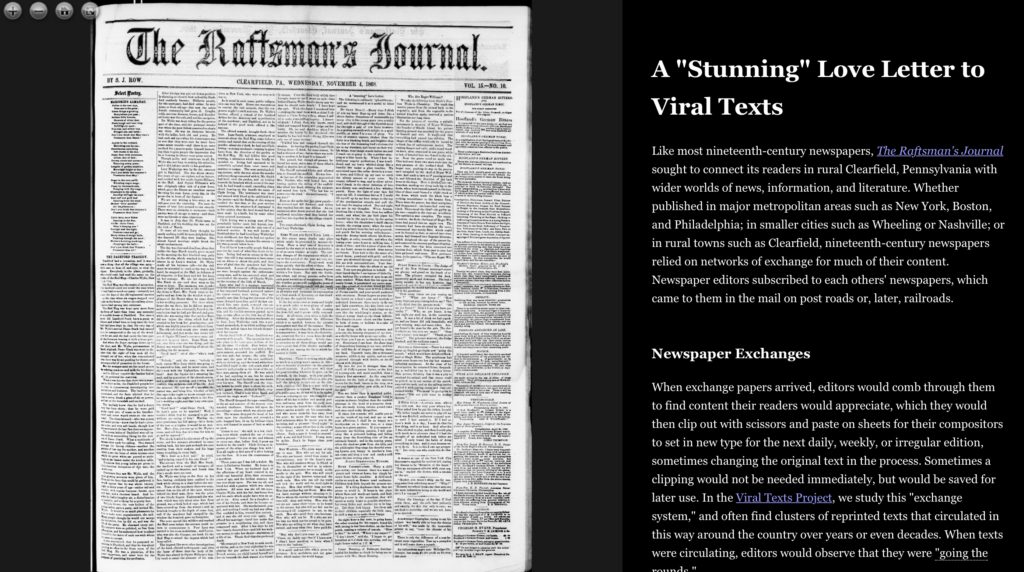
the black box of the site
Sources: This project utilizes an array of digitized newspaper articles and magazines as the primary source for its database. They pulled these publications from multiple different libraries and catalogues in order to gather all of the articles they need. This gave them a large sample size to draw from.
Process: They utilize multiple different tools such as a text reuse detector to find similar stories and passages across different publications. This allows them to detect stories that were reprinted even when the wording was slightly different or the publication was different from the original writers. This allows them to identify exactly what would be reprinted over and over again and then further break down what was common throughout the texts that were reprinted more often.
Presentation: They present the information through multiple outputs. They utilize digital exhibits, graphs, and maps, as well as searchable databases where you can see the sources. This allows the user of the site to go through and see the connections for themselves. To be specific, a user can access a specific text, see how it originally appeared, then see how it appeared throughout different publications. It also utilizes graphs and charts to simplify republication data from a large amount of time into a simple pattern that any user can see clearly. This is crucial because it makes the information accessible and gets the point across in a clear and simple way to all.
Questions
What is the goal of this project?
The goal of this website is to help understand how text spread through early newspapers and magazines. Viral Texts uses digital tools to track how different texts were reprinted as opposed to just looking at them as singular texts. It doesn’t view the individual stories; instead, it looks at the stories as a group, collecting all the reprinted versions. It allows us to see how a piece of writing and media from the past could spread across different publications and even different regions. It shows us what it meant to go viral before going viral was even a thing.
Which academic fields do you see this project in conversation with?
The fields I see this project working with most are History and literature. It connects with both history and literature due to it being an analysis of old historic articles and newspapers. The project itself gives historians an idea of what was a topic of discussion at the time and what the pressing matters were. It also gives literature scholars an idea as to what writing strategies were being utilized at the time as well as what kind of narratives and stories were being utilized in popular writings. This also can give them insight into what writers were popular and the time by looking at who’s stories got reprinted more often.
My Question
I want to know how the results of this might change if we add more text and broaden the spectrum of time that they’re looking at. I wonder if the patterns that they saw from the original sample would continue to hold up as they expanded the scope.