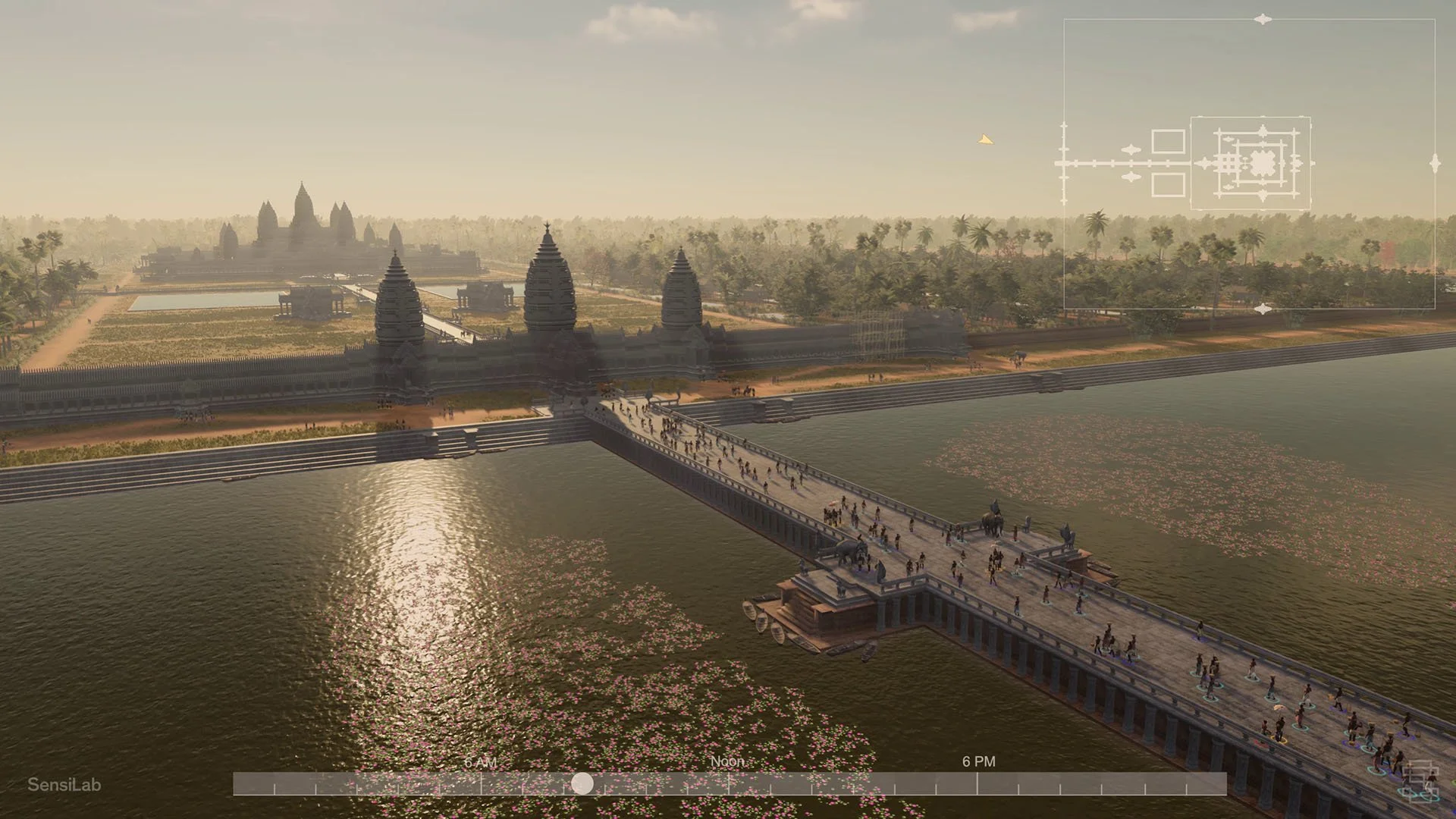
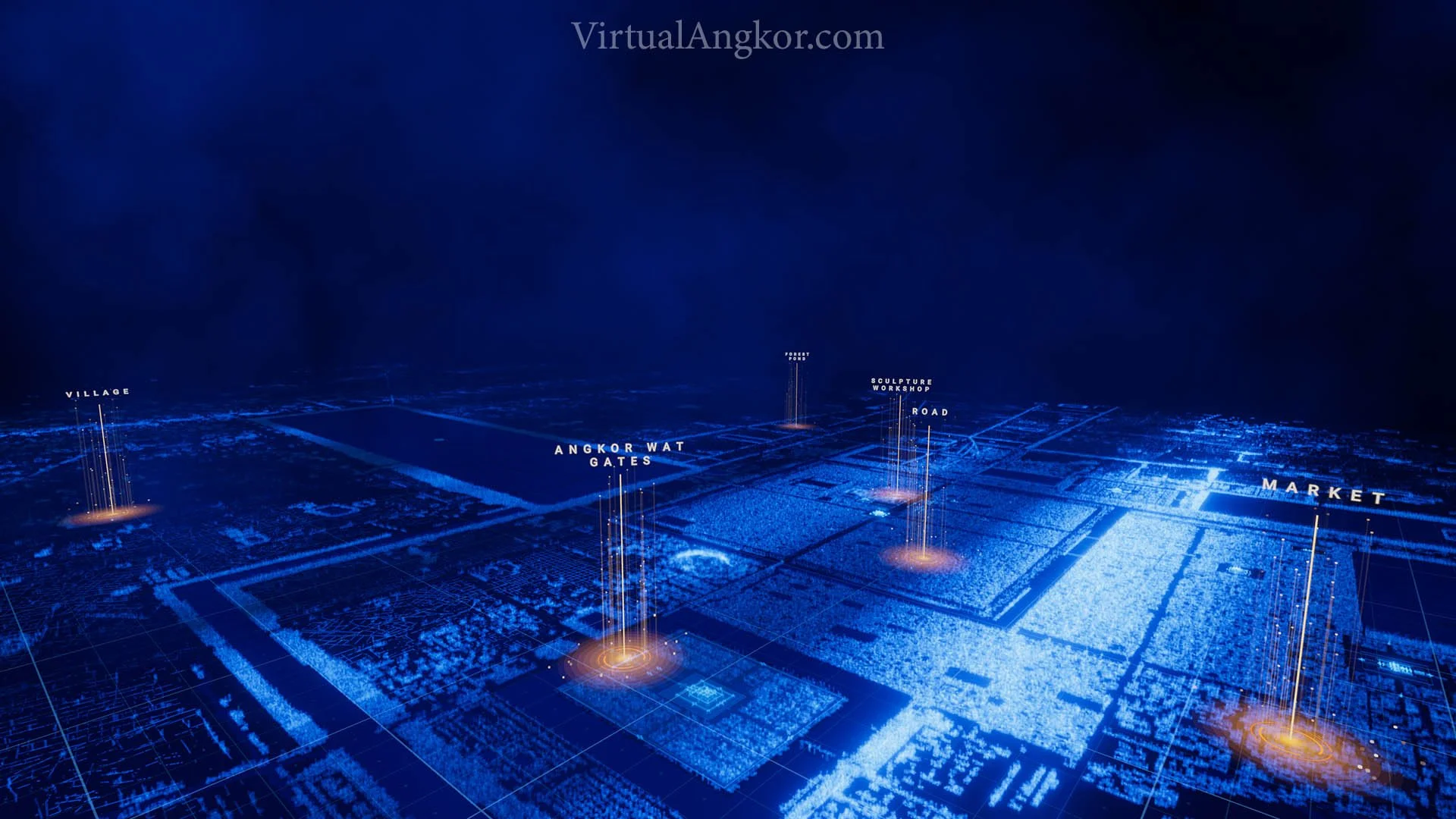
Virtual Angkor is a part-3D imaging, part-mapping project created by a team of scholars from Monash University, University of Texas at Austin, Flinders University, and the University of California, Los Angeles. The goal of Virtual Angkor is given directly in the home page of the site: the project “aims to recreate the sprawling Cambodian metropolis of Angkor at the height of the Khmer empire’s power and influence” (Virtual Angkor) through a 3D rendering of the city. Though Virtual Angkor is a software which allows for virtual reality capabilities, only a few of the videos on the website appear to support a VR headset. This intractable map (Image 2 shown below) does not seem to be available for the public to download; one may have to contact a SensiLab representative in order to gain access to this program.
Sources
The Virtual Angkor program’s assets are all either scans, digital recreations, and interpretive 3D models made from hundreds of artifacts, ancient inscriptions, nineteenth century accounts, and modern archeological research surveys — such as “airborne surveys and the extensive mapping of Angkor carried out by the École français d’Extrême-Orient” (Virtual Angkor). The website cites an extensive volume of works in their source tab, most if not all of which have contributed to the creators’ design choices and understanding when constructing the city and animated inhabitants.
Processes
To create a digital ‘world’ of this scale the team between Sensilab and the university scholars designed the characters of the world first, referring to these animated bodies as ‘agents.’ These agents are divided among societal class rankings and are algorithmically guided through their daily routines based upon their social standing — elites may have a different path to take than workers. Using “LiDAR data, digital elevation (DEM) files, and GIS mapping layers” (Virtual Angkor) the creation team was able to build and simulate an interactive map which spans over 3500 square kilometers. A geospatial repository of Angkor Wat collected by the University of Sydney and the EFEO was also crucial in the construction of this map. The SensiLab team structured the VR experience around navigating this interactive map and stylized the experience to look similar to the LIDAR imaging process (as seen in image 2).
Presentation
The website for the project has several tabs which allow the user to read more about the history of Angkor Wat, the process behind recreating the city, what the project is about, and what sources were used in the project’s life. The creators of the site differentiate the ‘game ai’ which the character models use for animations and pathfinding from generative AI — ensuring the users that “the virtual environment has been painstakingly crafted by hand, grounded in years of rigorous research and expert analysis” (Virtual Angkor). Besides videos and the virtual reality capabilities, the website also has a gallery of photos taken in various parts of the recreated city — all of which means to provoke insight and interest in the history of Cambodia’s ancient city.
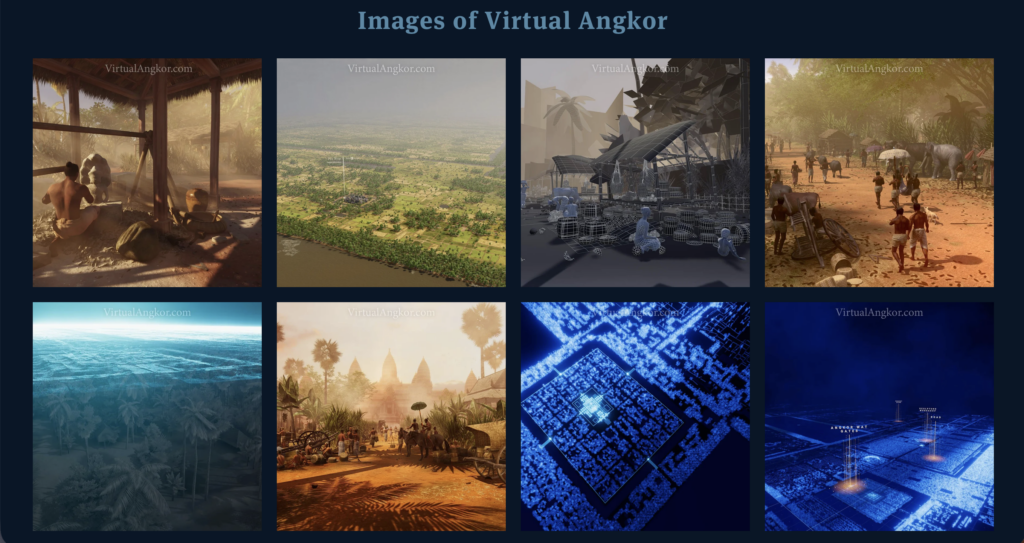
Though the website may be available to the public, the teaching modules and interactive world of Virtual Angkor seem geared towards teachers, students, and researchers — the ‘game-like’ environment aims to make learning approachable, fun, and immersive. The project is also in communication with several different fields from archeology and history to anthropology and computer science (regarding the game ai, at least). A few questions came to me as I was searching about the page: for one, why are the creators keeping the scale of the program so vague? We are given several images and videos of the interactive map, but we never see the full extent of all of their hard work. Secondly, why does the website have a whole section and several interactive images dedicated to the differences between generative AI and their project? It seems as though the scholars are trying to prove their authenticity to users by differentiating their work from AI. Are all digital humanities scholars now expected to prove that their work is more than artificial nonsense?
Sources:
Monash University, et al. Virtual Angkor. https://www.virtualangkor.com. Accessed Sep. 23, 2026.