By: Jesse, Mallory, & Anahita
For our lab this week, we documented the Kasuga Stone Lantern located in the Carleton’s Japanese Garden. Situated at the entrance of the garden, the lantern was originally built in Japan, making its way to the US in the 1940s. This style of lantern was initially used in religious spaces, though in the 1500s they began to be used in the areas surrounding tea huts. Over the course of the week, we employed a variety of modeling techniques to capture the object and its surroundings in 3D.
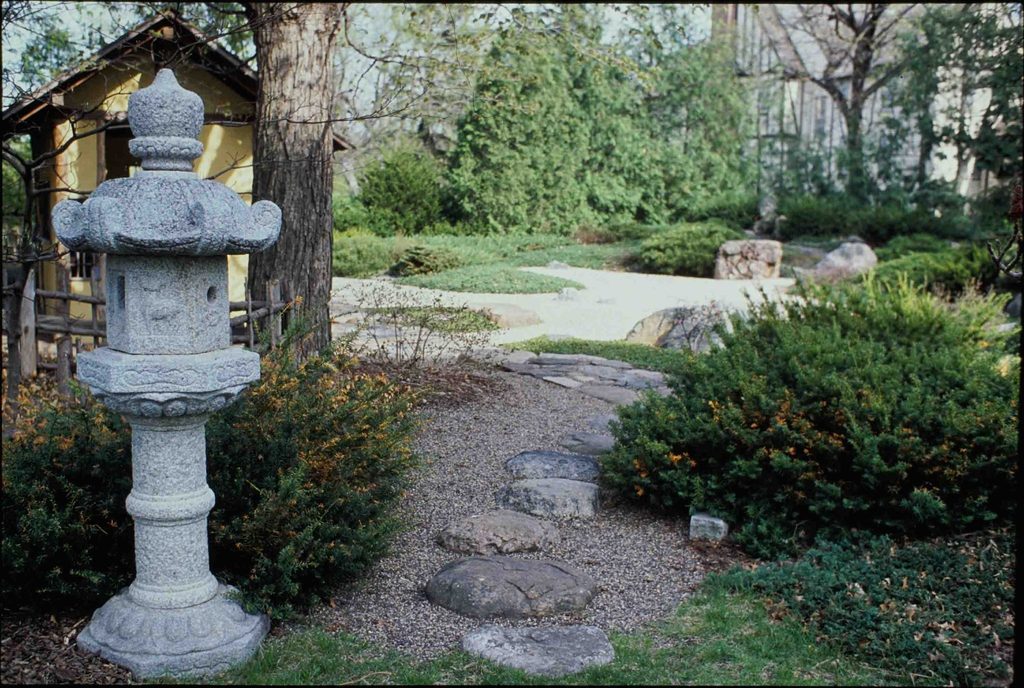
The image is accessible here in the Carleton Digital Archives.
On the whole, modeling an object helped us develop a better understanding of it than you would if you were just looking at a photograph or mapping it. When looking at static images or maps, your understanding of an object is reduced to one view. While you can still glean a lot of information from these mediums, it will inevitably be a partial understanding. Modeling, on the other hand, allows you to spend much more time with the object. When modeling, you are working to capture every aspect of the object. Thus, you end up spending time examining the smaller details and the parts of the object that are not apparent at first glance. This, in many ways, allows the modeler to build a much better understanding of the object as a whole as opposed to only examining it from one perspective.
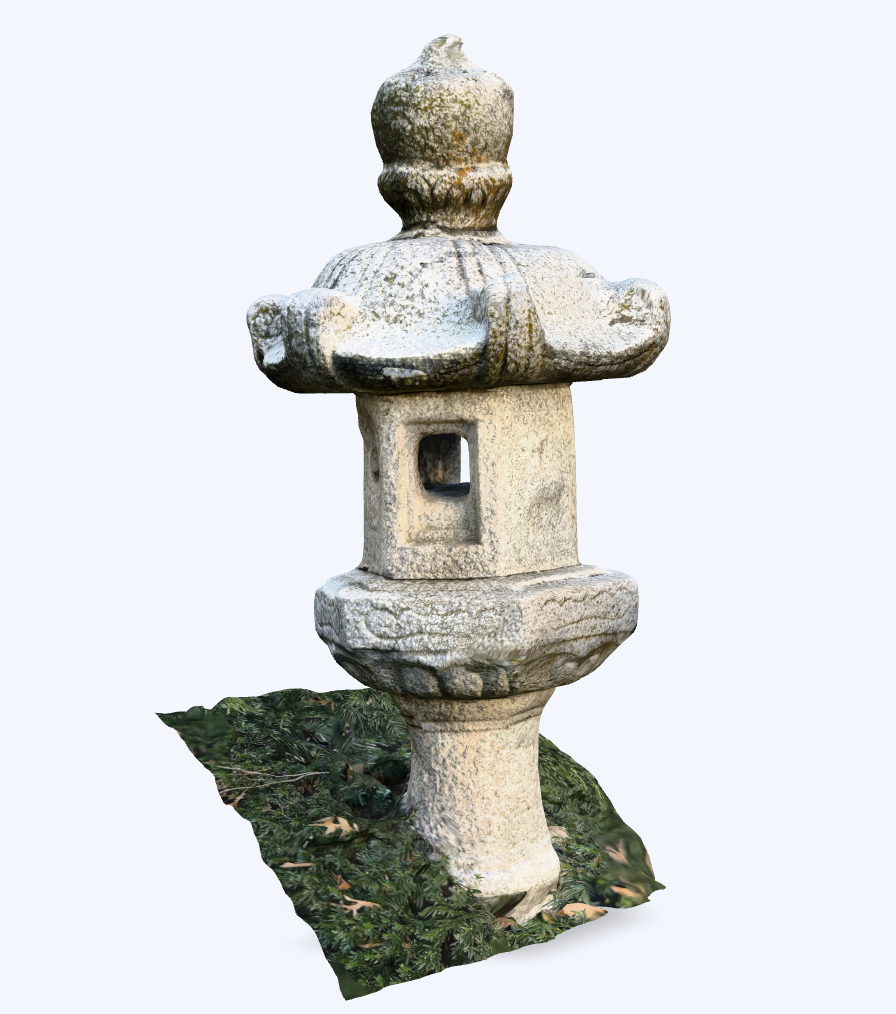
You can click on the image above or follow the link here to interact with the model!
In the same way that 3D modeling helps us better understand the lantern, and objects in general, we can also participate more actively in the history of our campus. 3D models timelessly preserve a physical object, and creating them feels very immersive. We as Carleton students are able to interact with places and artifacts like the Japanese Garden regularly, but being able to communicate these experiences to outside sources is extremely valuable for both ends of the interaction. We get to build something and re-experience something we might otherwise take for granted, and those who get to observe and interact with the 3D model also get to learn and experience something new.
Your model turned out very nice! Did you find that you had a preference on which program/app you used? My group found that Metashape took an extremely long time to load and despite taking a lot of images of our object, the model still had a lot of issues.
Personally, I think Scaniverse is best for speed and efficiency and especially for people not needing a perfect model while Metashape has the advantage of being able to be tweaked.
I liked how you said spending time modeling an object helps you understand the object as a whole; I also think it allows you to consider each detail in context, giving you a more nuanced understanding of each of the object’s features. This, like you said, gives you a lot more perspective than you would if you simply looked at a map or a flat image! This is part of why I think 3D models could be so helpful for education—think of how students or community members could engage with 3D models to learn about different places or objects!
I liked your point that 3D modeling creates a more complete understanding of an object than a single photograph can. The idea that the process makes you notice smaller details that you might otherwise ignore really stood out to me. I also thought your discussion of preservation was interesting, especially how a 3D model can let people outside Carleton interact with something they may never see in person. It shows how digital tools can make local history more accessible.