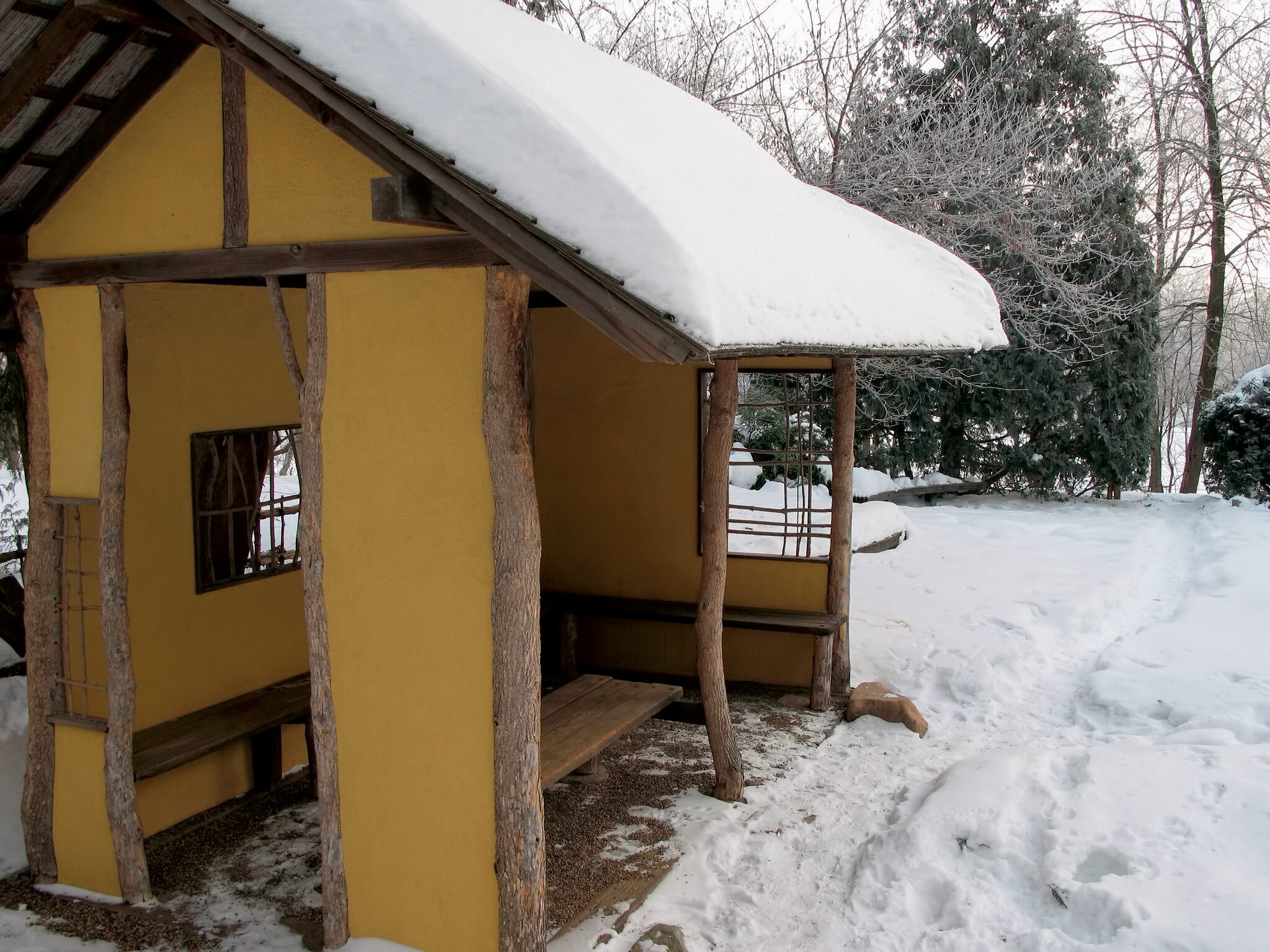
In a garden such as this one, the shelter is the central place from which to view one’s surroundings, including all of the other features in the garden. This particular shelter is modeled after one that would commonly be found in a tea garden. This likeness is the reason for our shelters’ stucco walls, wooden frame and bench, and thatched roof. Perhaps the best way we were able to portray this structure was via a mesh model on the Scaniverse app. We also made a map layer for the shelter!
The process of photogrammetry certainly encourages one to closely examine the object being modeled, and to pay attention to details that may have otherwise been ignored. In the case of the mesh model, for instance, there are so many angles that need to be carefully captured as photos that one is essentially forced to become intimately acquainted with every angle of a structure. In a slightly different way, the process of capturing the 360 degree panorama required careful concentration on the way the shelter appears in its spatial context, because it is such a touchy process.
Moving from being a passive observer to an active modeler certainly changed my thinking on communicating about campus, lived experience and history to various publics. Firstly, it gave me an insight into just how much work goes into creating these digital experiences, and that any larger project would be a really staggering undertaking. In turn, it made me realize just how mindful and specific one could likely get with the level or type of detail being displayed in the digital model of an object such as the viewing shelter, which could vary greatly depending on the task at hand. It seems that the more intricate a digital humanities project is, while there is an increased danger of incompleteness, there is also more importantly more room for intentionality.
I would agree with your point about the amount of work that goes into these digital creations, it can sometimes be difficult to capture everything from a real world object and convert it into a model or other item. I like the look of your model so far, I am curious about how many photos you have taken from the interior of the shelter. Did you decide to use Recap or Metashape for the photogrammetry process? I can understand how that tree towards the back of the shelter could have impacted the scan, our own structure was partially obscured by a bush that we had to work around. I am curious to see your photogrammetry model after your description of the process.