The photograph that I used for my lab work is the “Room 19, Spring 1897” photograph. This is a historic photograph from the scrapbooks collection at Carleton College. The picture features a room with a bed, a rocking chair, and some decorative items. I got the image via the IIIF Image Inspector. After that, I tried out different AI technologies on the photo.
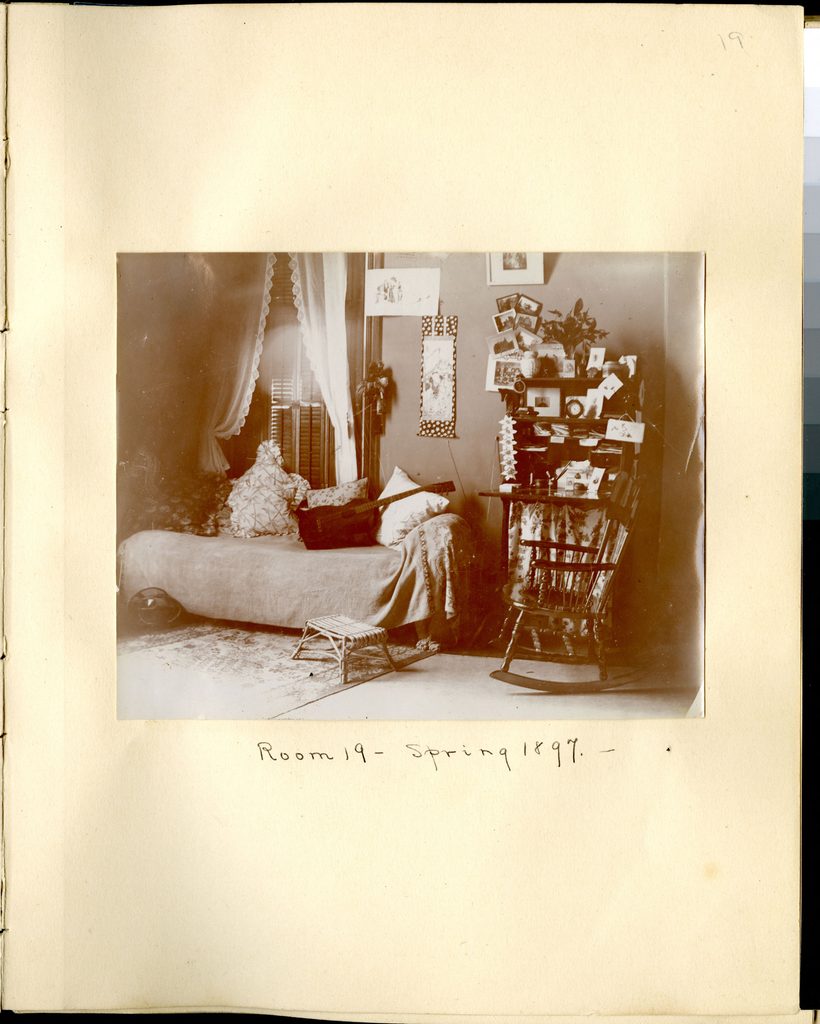
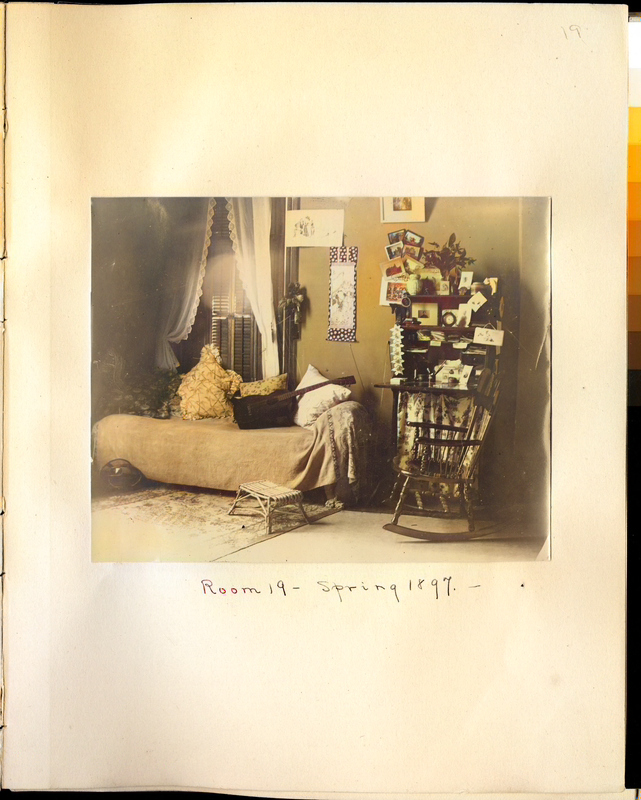
First, I utilized an AI image colorizer tool to try it out on my photo. Since the image I have is black and white, I wanted to find out what would AI think about the colors of the room that was depicted in the photo shot over a hundred years ago. That was intriguing since there is no way to know the real color of the room in this photo.
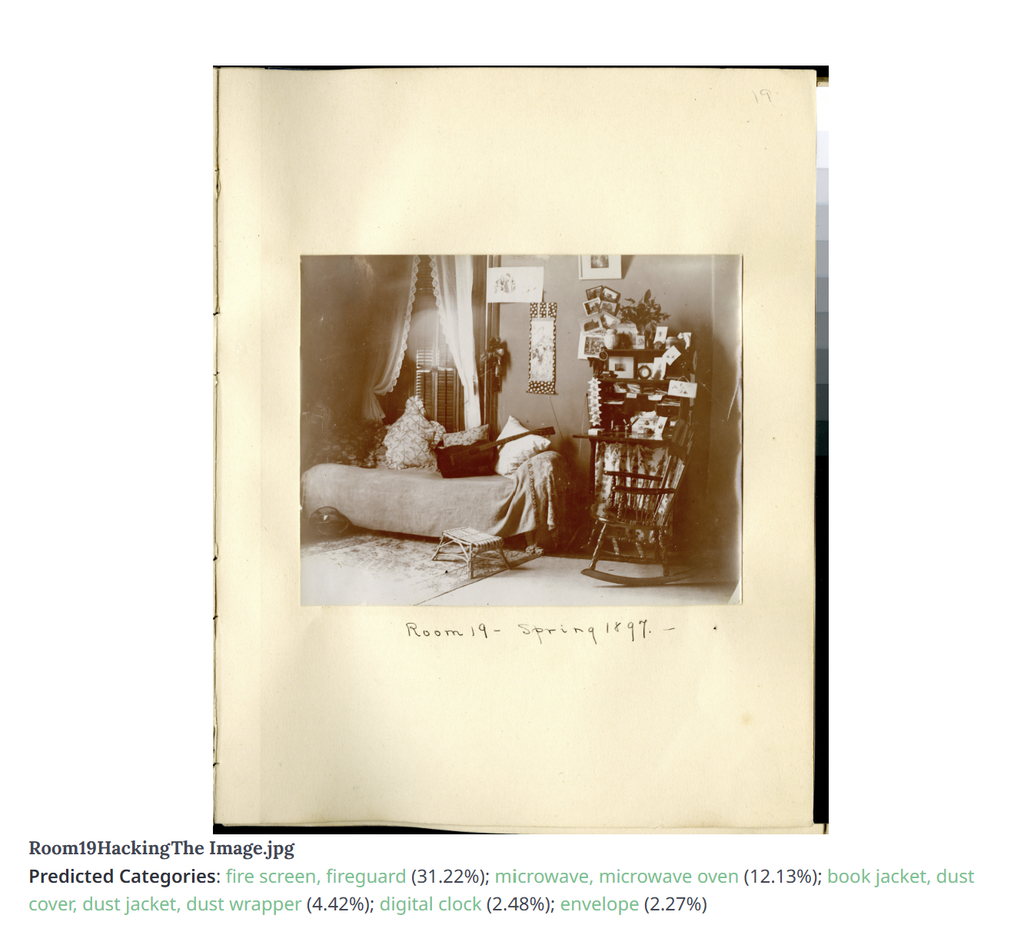
Then I uploaded the image of the original photograph on Distant Viewing Explorer and used their Image Classification feature. What was quite interesting about it is that there were many things that the model could not identify correctly in the picture. The model assumed that the photograph depicted a fire screen with the probability of 31.22%, microwave with 12.13%, and a digital clock with 2.48%. Given the fact that the picture was captured in 1897, one can conclude that some of those assumptions were absurd.
The first ethical dilemma I have found during this exercise is that AI has the ability to make the old photos look more life-like without increasing their accuracy. While this can be useful in helping us imagine what the past looks like, the AI does not know the exact colors of furniture, walls, or any other decoration in the room.
This concern relates to Sonja Drimmer’s article, How AI Is Hijacking Art History. Drimmer writes:
Adding color does not show things as they were but recreates what is already a recreation
The quote relates to my project since the colors generated by AI are not historical but interpretations. Just because a photo looks more realistic does not make it more historically accurate.
Another reading that connects to this exercise is Lauren Tilton’s article, Relating to Historical Sources. Tilton writes:
Artificial intelligence is increasingly behind tagging, classifying, organizing, and filtering decisions that shape which sources historians encounter.
This is similar to my own experience using Distant Viewing Explorer as the AI system misclassified objects present in a historical photograph. These classifications can confuse researchers or cause them to miss out on potential sources for their work. Even though AI can help make research on historical subjects simpler, one must remain skeptical and interpret the results of such systems accordingly.
This assignment allowed me to understand that it is very easy to alter historical photographs with the help of AI systems. While these systems can make historical photographs more appealing and understandable, it is important to differentiate between AI interpretation and historical information.
Stefan, the changes in your photo is really interesting. It does make it look more realistic, although you also wonder how accurate it is. Your example of the AI misidentifying objects shows how these tools can misinterpret historical information. It raises an important question about how we can use AI to better understand the past without accidentally changing how we view it.
Stefan, I think you chose an excellent photo for this exercise. The colors definitely add some life to the image, but like you said, there is no way to know what the room truly looked like. I also thought it was funny that AI predicted there could be a microwave or digital clock, proving that we cannot take these revitalized images too seriously.
One thing I found quite interesting about the application of AI to the historic photo was that it would increase its realism but could decrease its accuracy. The concept of the AI recognizing items such as microwaves and digital clocks instead of historical things is an good demonstration of how technology can change historical evidence. Should colorization by AI be used for digital history projects if it is clear that it is interpretation and not reality?
I found the image you used for this to be quite interesting, Stefan! When it comes to AI models colorizing older images, there is so much uncertainty about what should be certain colors. I’m kind of intrigued as to why more modern inventions are being incorporated into an older piece of work. I think that’s a testament to AI’s faults in this area.
I thought your point about AI making historical photos look more realistic without actually making them more accurate was really interesting. The Distant Viewing results also show that problem in a different way, especially when it identified things like a microwave or a digital clock in a photo from 1897. I like how you connected both examples to the readings because it shows that AI can be useful for exploring historical sources, but we still have to question what it produces instead of treating it as fact.
Stefan, everyone has pointed out the microwave, but in my opinion, the 31% confidence on “fire screen” says even more. The model was unsure of its own top guess and still gave an answer. Did you run the colorized version through the classifier too? When I tried that with my portrait, the caption tool called the gray original “a painting” and the colorized one “a man,” so the color seemed to make the AI more confident without making it more accurate.