For this weeks lab, I chose an old image from the Digital Collections/Scrapbook for Carleton College, looking at the campus from 1899. The image I selected was a shot of Willis hall from what might be now known as the Bald Spot on todays campus. I used IIIF Image Inspector to generate an image of what the scenery might’ve looked like if the photo was taken with color, and the comparison is below.


One thing i noticed was that certain things were easier to predict or contrast and generate bigger differences. Previous images I chose that were photos within buildings showed little difference compared to their original versions, while photos taken outside with plants/grass like shown above seem to have the AI perform better.
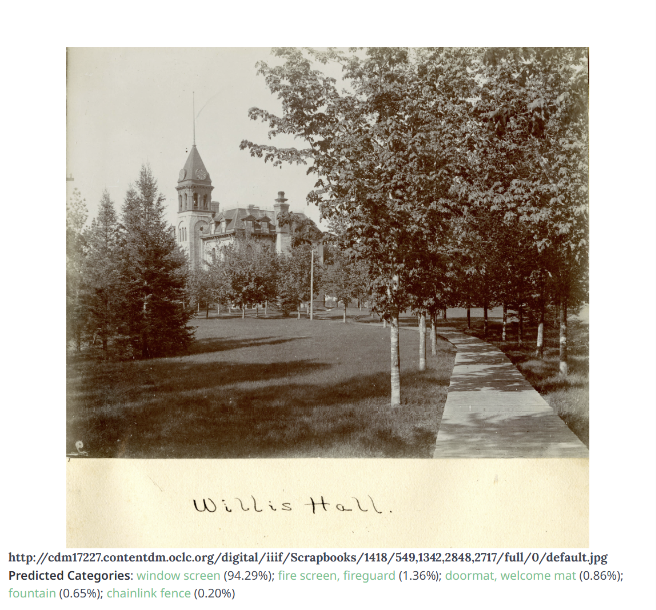
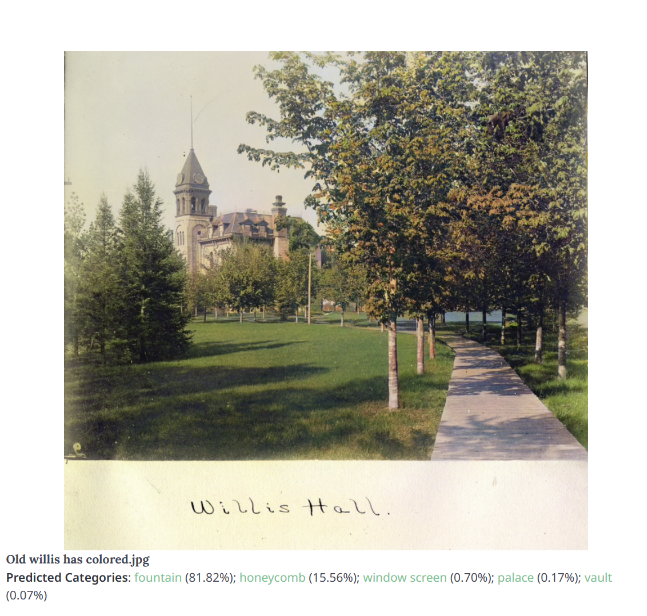
I also threw both images into Distant Viewing Explorer, to test the differences in image classification for both images. However both results were completely wrong in their predictions of what was in the image. The version with AI alteration did manage to get ‘palace’ which I wouldn’t say is wrong considering the building within the background, but overall everything else was still incorrect.
I think the main ethical issue I can see with tools like these are the potential corruption of ‘antique’ things. from the readings these points were also touched upon “Digital tools can reveal patterns, but they can also obscure or distort the very artifacts we hope to understand.” (Thedatasittersclub) This quote also holds a similar meaning: “appropriation is dangerous… the theoretical and philosophical caveats often get lost when the methodology gets translated.”(Journalofdigitalhumanities). If things are constantly being restored to look new, it almost feels like they were never apart of the past and mixes the past with current reality. However I still find the concept pretty nice and think it could be interesting to see famous images regenerated with color.
Hi Michael! I find it very interesting that you tested both photos indoors and outdoors, and AI tends to perform better in outdoor pictures with trees and grass. This might also be because these features are easier to identify and detect. I completely agree with your point about the corruption of antique things, where making old photos look new blurs the line between the past and present.