Having misread the instructions for the Blog assignment, I already posted the colorized version of my photograph, the results from Distant Viewing Explorer, and briefly described the process. I will repost the photograph and results here, but will focus chiefly on the issues I see with Artificial Intelligence image generation/enhancement.
the start of AI image generation
I am old enough to remember when AI was still in its infancy and creating blurry, distorted, obviously computer generated images. As a writer, I found the prospect of creating settings, objects, and characters for my projects fascinating. I used a website I have long since forgotten the name of and learned quickly how to generate the images I wanted. While working on my large piece of writing, I generated images of each of my characters, their pets, and the places they lived.
It wasn’t until maybe a year and a half later when I began hearing people talk about the issues with AI and started to seriously examine my relationship with it. It didn’t take long for me to stop using the website, delete my account, and swear off AI image generation and text editors like Grammarly.
I no longer have a spelling detector in Google Docs (mostly because it doesn’t like when I name imaginary countries), but also because I found that relying on technology to catch my mistakes for me led to more mistakes in the future. I’ve always had excellent spelling, and by ignoring the mistakes I made because a computer could fix them for me, my spelling worsened dramatically.
I am not suggesting complete abstinence from technology. I write on a computer, I’ve played around with digital art, and I do not want to write my stories in the dirt with a stick (and one could argue that using a stick as a tool is still a kind of technology). I am instead asking that we examine if technology, and now AI, is making our lives easier for the better, or ultimately hindering future growth.
To Colorize or not to colorize
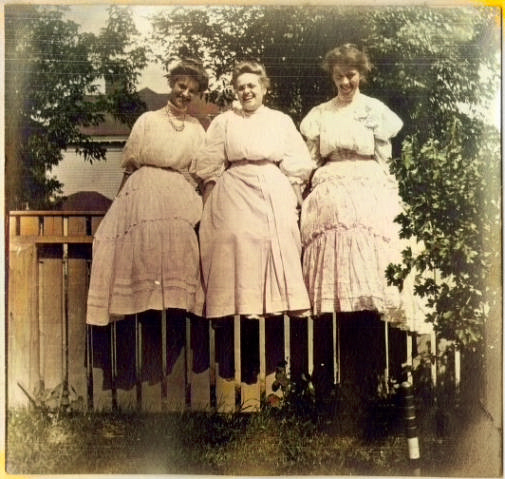
For this assignment I chose the following photograph from Carleton’s Digital Collections and then colorized it using DeepAI. As our class discussion brought up, there is no way to know if the colors are accurate, and even if we could assure that they were, it still begs the question why we feel the need to “modernize” history.
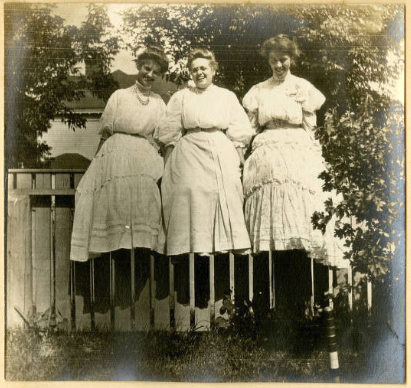
Original photograph
Photograph colorized using DeepAI
In her article How AI is hijacking art history, Sonja Drimmer comments briefly on colorizing images and the legitimacy and helpfulness of it.
This effort to “bring events back to life” routinely mistakes representations for reality. Adding color does not show things as they were…
Sonja Drimmer, How AI is hijacking art history
Drimmer points to the issue succinctly. Colorizing old photographs does not make them more real. It in fact makes them less real. Colorized images show a computer’s approximation (guess) at what the colors could be. Grass is often green, so it makes the grass green. Fences are often wooden, so it makes the fence wooden. Dresses can be white, so it makes the dresses white. There is no way to fact check any of this. The dresses could be yellow. The fence could be a different wood. The grass and leaves could be giving way to fall.
But why are AI companies pushing products people don’t need? We know what grass looks like, after all.
Because they need the public involved, or their company dies. Think about AI as a series of social media trends: often silly, light-hearted, unimportant, and transient. Social media trends do very little for anyone outside of being fun. Like these trends, AI is constantly promoted as fun. It is a social activity. Colorizing old family photos is fun. It’s really cool to see what your ancestors might have looked like, what their world might have looked like.
And, at the same time, it means nothing. It is my belief that colorizing images, at least, will faze out eventually unless the AI’s used become much better and historically accurate.
As Drimmer said,
Outside of flexing the prowess of AI, is there any value – artistically, historically – to what the company is doing?
Sonja Drimmer, How AI is hijacking art history
What else can ai do?
For the second part of this lab, I put both the colorized and original photograph into Distant Viewing Explorer’s Image Classification. Unlike DeepAI, it is very immediately clear that the results are wrong.
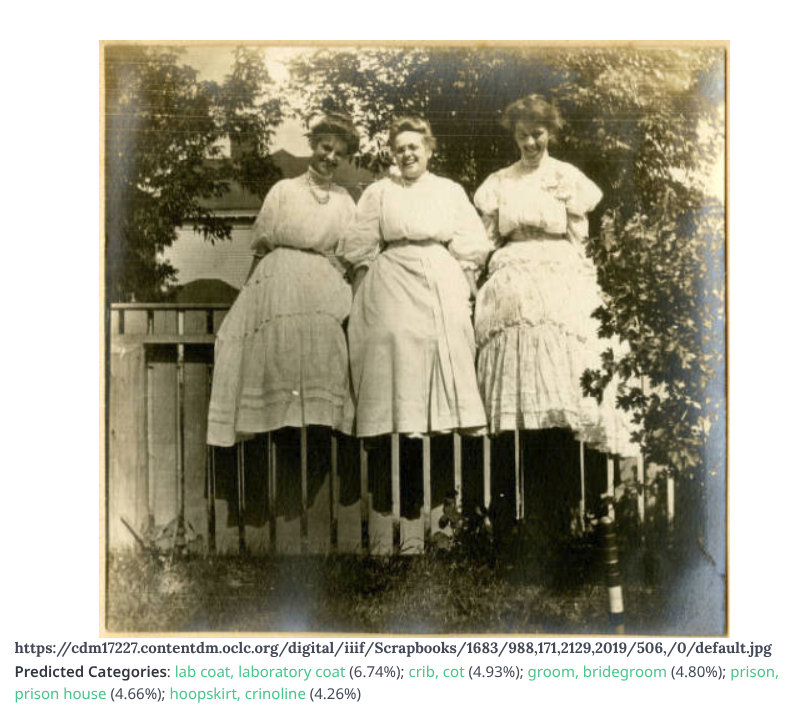
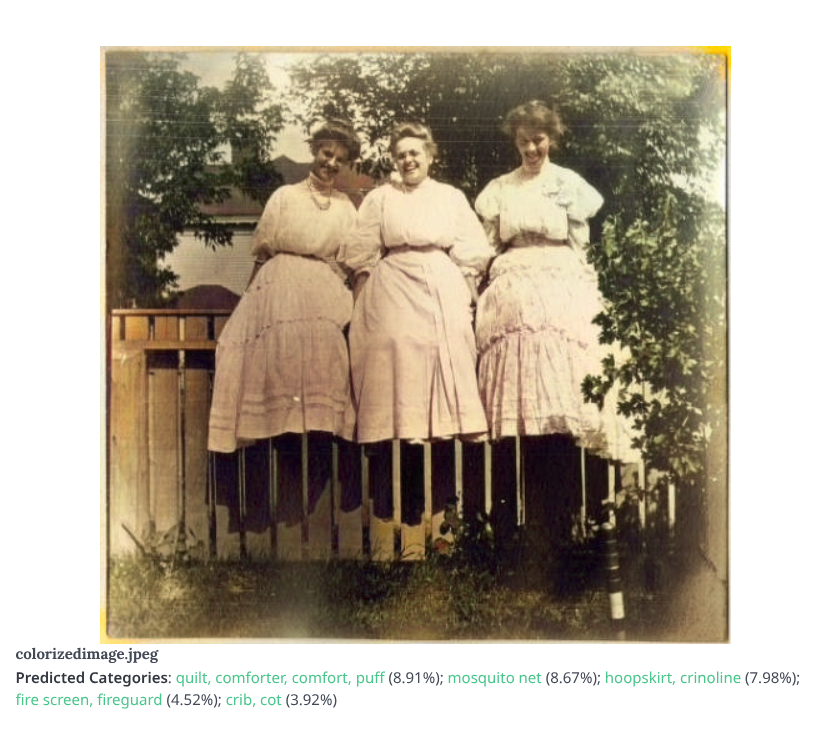
For the original photograph, Distant Viewing Exploring got nothing correct (I am assuming that they are not wearing hoopskirts). For the colorized image, the results seem closer to reality, but still too far away to be at all useful. As a human I can accurately list what I see in a very short amount of time and someone with more knowledge of fashion could tell me whether or not hoopskirts were worn during the time when the photograph was taken.
So, AI should be abandoned…
No. AI has shown that it can be extremely helpful in some fields. I am not proposing that we strip AI from medicine, science, or math, but attempting to apply it to a field (whether that is history, art, or writing) that does not function on the basis of data is, as Drimmer says, a grab for attention by the companies and a distraction from the worries AI causes.
Deep fakes, porn, surveillance, and manipulation on both personal and government levels are all possibilities with the AI tools we experimented with for this lab. With Flock, we see the advanced version of Distant Viewing Explorer’s Object Detection. With Grok, we see what AI companies aren’t doing to stop the sexual exploitation of victims. Within our own government, the president is posting AI generated images.
The tools we used for this lab are the infant versions of what companies and governments currently have access to.
AI is here to stay which means that it’s time to write some laws.
Hi Lily! I agree: there should definitely be regulations for AI tools. I really liked your point about AI colorization making the photographs “less real;” I hadn’t thought about it like that! I also talked about how AI results are often incorrect or ambiguous. Its outputs aren’t really doing much for us, especially if we aren’t even sure if they’re accurate. I wonder what kinds of laws would work against harmful AI usage; like you said, AI is here to stay, so where do we draw the line?
Hi Lily, I liked what you said about the colorization of photos being done in order to make it more “real” because although we can make educated guesses, it’s often going to be impossible to fact check. I’m also impressed by your dedication to stop using a spelling detector and I think it’s great you were able to recognize that something that was created to help was actually harming you instead.