For my Week 2 post, I chose to look into Linked Jazz, a research project from the Pratt Institute’s School of Information. The project uses Linked Open Data to map relationships between jazz musicians, drawing mainly on oral history interviews. It has two main goals: to uncover connections in the personal and professional lives of jazz artists, and to build Linked Open Data tools that other projects can reuse.
The sources are more than 50 oral history transcripts from archives including the Smithsonian, Rutgers, and Hamilton College, with interviewees such as Mary Lou Williams, Count Basie, and Dave Brubeck. The team also started from a list of about 9,300 jazz musicians pulled from DBpedia and matched them against library name records from the Library of Congress and VIAF.
The processing is where most of the work happens. A Transcript Analyzer splits each interview into question-and-answer blocks and identifies every musician mentioned, on the assumption that if an interviewee names someone, they at least know of that person. Each mention becomes a small three-part statement, such as “Clark Terry knows of Ella Fitzgerald.” Volunteers then use a crowdsourcing tool called 52nd Street to read interview excerpts and label the relationship more specifically, as a friend, mentor, bandmate, or influence.
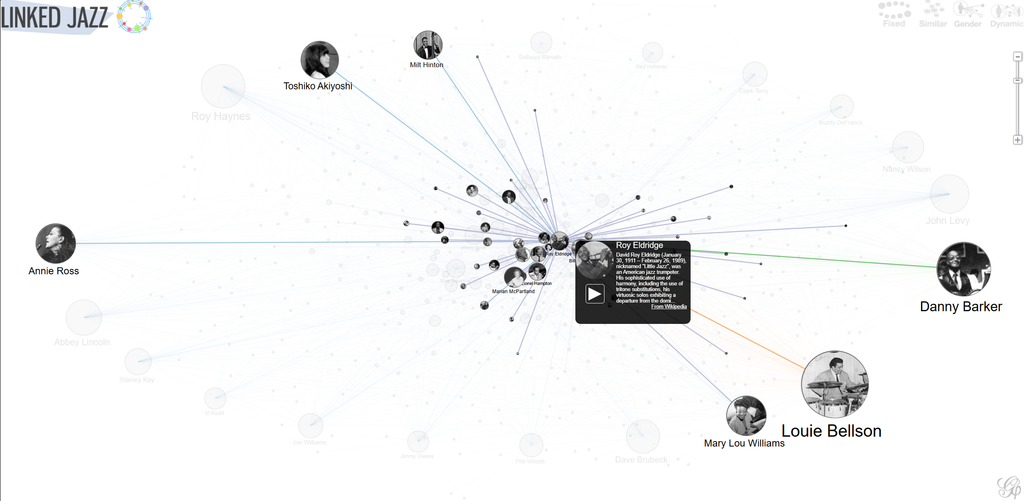
The presentation is an interactive network visualization where each musician is a node, sized by how often they are mentioned across the transcripts, with images and short biographies attached. The data is also openly available through downloads and an API, and the code for the original tools is on GitHub. The project is aimed at both a curious general public and researchers who want to reuse the data. It’s in conversation mainly with library and information science, along with jazz history and oral history.
Breaking the project down left me with a question tied to last week’s post. Nearly every tool on the site is now labeled “legacy,” and many team members were graduate students who have since moved on. Who maintains a project like this once the grant ends and the original team leaves?