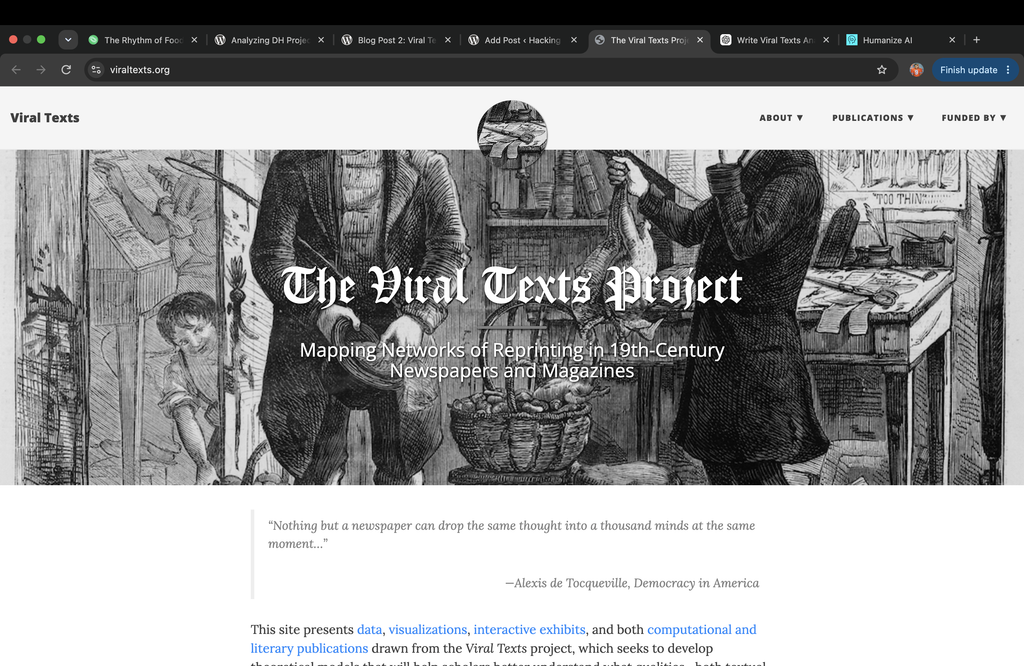
Today, I investigated the Viral Texts Project, which is a digital humanities research project analyzing the distribution of texts through nineteenth century newspapers. The project is able to identify texts which have been reprinted in various newspapers, indicating how information spread even before the existence of the internet. Through the use of Miriam Posner’s sources processes presentations model, I analyzed the project.
Sources
The source material in the project consists of digitized newspapers and magazines from the nineteenth century stored in sources like Chronicling America or the Internet Archive. Such historical materials represent primary sources that are the basis of any research. The project utilizes machine readable text, which is created via optical character recognition. That is, it is obtained by scanning pages of the newspaper and transforming images into text.
Processes
The process of identifying similarities between passages of texts is conducted with the help of computer programs analyzing thousands of newspaper publications. They cluster those passages of text that match each other or resemble each other to a significant extent. This helps researchers to know in what newspapers the material was reproduced and how many times it was done. Nevertheless, computers cannot replace humans.
Presentation
According to the website of Viral Texts, the project and itsa research are explained on this site. Its database lets the visitors explore reprinted texts as groups and access the original newspapers when they exist. This presentation helps the visitors to study historical patterns and connect them to their sources through digital presentation.
It has been learned that digital humanities projects consist of much more than just placing information on the internet. Viral Texts is a combination of historical records, computations, and an interactive database to find out patterns that otherwise would be hard to detect. In addition, it has become clear that viral information is not only specific to the Internet age.
My question regarding the project was: What difference would it make if the researchers had access to every nineteenth century newspaper?
Questions
- What is the aim of the project, and what are the academic disciplines related to it?
The aim of the Viral Texts Project is to determine how texts circulated in the nineteenth century newspapers. The disciplines related to this project include history, literature and computational linguistics. Analyzing how the texts were reprinted, the project analyzes how people exchanged information without the Internet.
- What are the methods employed by the project, and who is its target audience?
The methods utilized by the project include digitization of newspaper articles, OCR, and computational text analysis to find texts appearing in different publications. The target audience includes historians, literary scholars, students and the general public interested in history and information exchange.
The Viral Texts Project illustrates the role technology can play in historical research. Through the use of digital archives and computing, it shows how news was shared in the nineteenth century. Despite its shortcomings, the Viral Texts Project is a new approach to researching the history of communication and the dissemination of information.