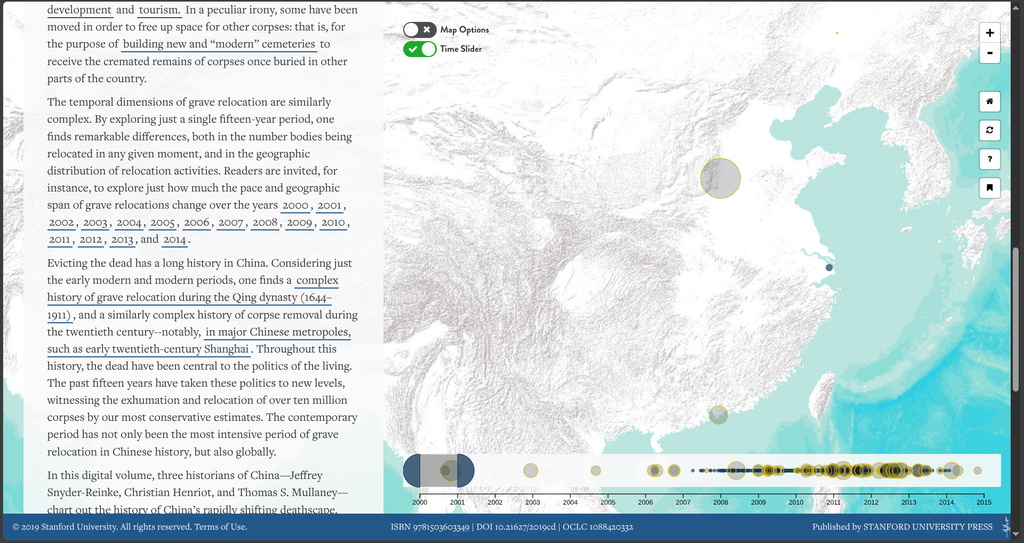
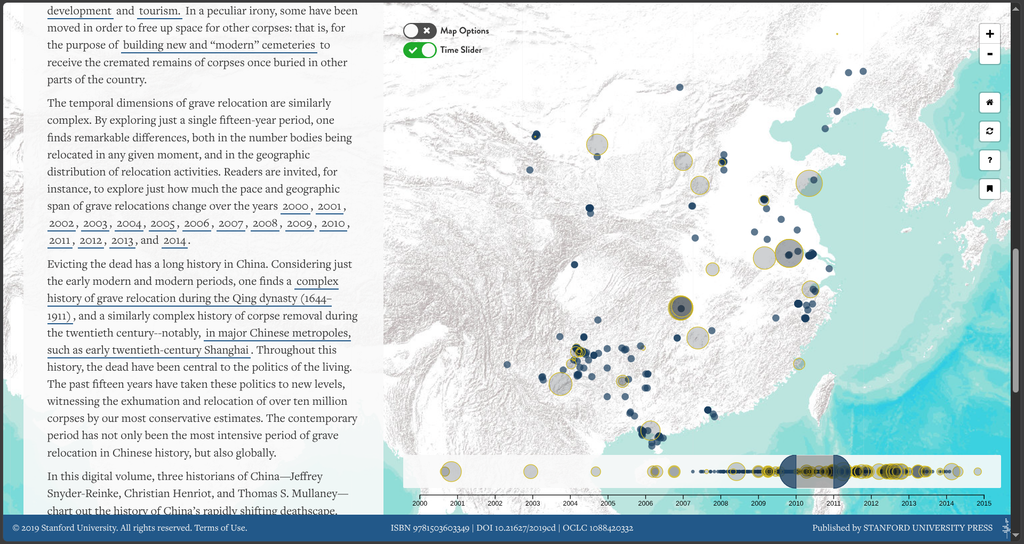
The Chinese Deathscape was published primarily by three Chinese History professors and two platform developers. It contains three main essays that sit beside an interactive map showing grave relocations in China.
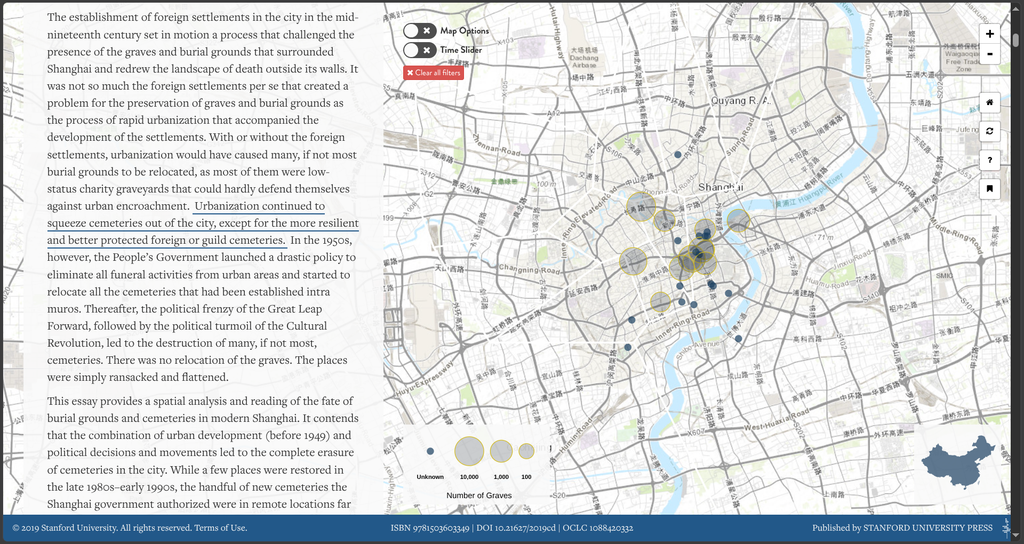
Three datasets were used in order to create this project, all of which are available to download on the site’s Data page. There is also a clear list of People that contributed, with Stanford University appearing to have been heavily involved in the project.
The essay Colophon explains how the team processed this data. The historians wrote the essays planned to accompany the maps and the developers created their own interface, named Grapl, to serve this project and support both the essays and map. They wanted these elements seamlessly connected to each other so that users could avoid traveling to different pages in order to interact with them separately. To do this, they wrapped chosen sections of text in HTML tags that Grapl reads and links to a place/time setting on the map. When users click on these sections of chosen text, the map moves to the linked setting.
This led to a very good presentation of the data on an easy-to-traverse site.
I now want to look at three questions.
One, which academic fields is the project in conversation with?
And two, what kinds of data is being used? Is the data available for broader use? Would you want it to be?
This digital humanities project is clearly history based, but it also deals with politics, anthropology, and economics since most of these graves have been exhumed to make room for China’s rapidly growing population and economy.
Three publicly available data sets containing burial records were used. I absolutely think that this data should remain available. Not only does the data apply to real ongoing political concerns, but it documents important parts of Chinese history.
My third and final question is: How could Grapl be used to make a political impact? Could it be used to show citizen death rates during wars or how gas prices have risen within the US? I think there are many promising applications and it seems like the creators of this project want their work to be used, not simply appreciated.
I definitely agree that the creators would want this to be used. The presentation is very neat and easy to understand, making it a great way to spread information. To kind of answer your third question, I think the only thing missing from this project is marketing. It’s a great tool with many applications, as you said, but unfortunately all the accessibility in the world is not enough if no one knows it exists. Overall, I definitely agree that this a great project and the data should be used, and I hope to see Grapl or something like it become more mainstream.