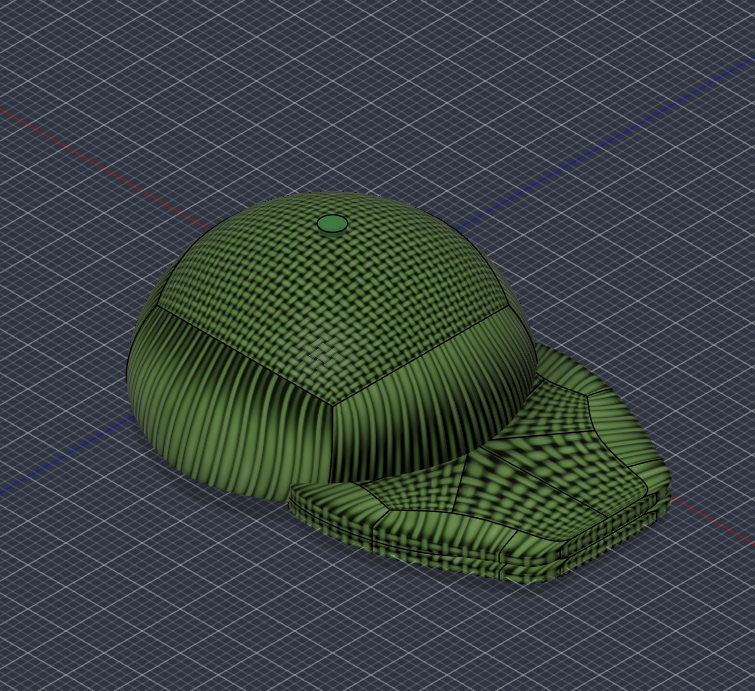
Some of my neighboring classmates may have noticed that I bring in a green baseball cap. This is my attempt to recreate that hat. While my efforts have not gone as well as I initially hoped, I have learned a few things about the Fusion modeling system in the process.
When just playing around with sketching and extruding, it was not all too difficult for me to build some simple cylinders and spheres. Moving individual objects around and using the orbit featuring more naturally came with time, though these skills were, at first, very difficult to grasp. The largest portion of my frustration came with trying to decipher whether or not the program was running slowly on my Mac or not: rotating the camera happened very, very slowly at some points and at others ran quite smoothly. I enjoyed myself most when I started to experiment with forms rather than sketching and extruding. I was able to make the dome and bill of the cap through form creation — through modifying a sphere and free-hand sketching a form, respectively.
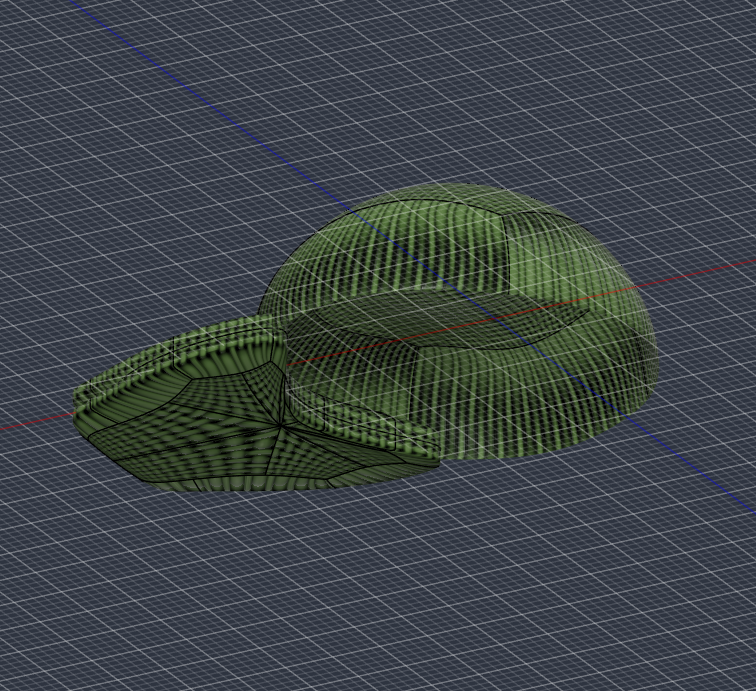
This said, I believe the appearance of the cap has suffered somewhat due to my choice of applied texture and the nature of the form’s faces. I chose the cloth texture, which has a very strange way of wrapping around particular faces. I theorize that the texture looks a little uncanny due to the small simulated scale of the model, but I have not tested a change of scale to support this.
The largest compromise came with making the bill, wherein the bottom half of the bill appeared in a ‘selection-style’ orange. Looking to the bodies tab, I saw that the body icon was orange and not a complete cylinder like the others. This made me think that the body was somehow made incomplete in my process of creating, extruding, and filleting it. Thus, I decided to mirror the bill on the underside, and that somehow finished the body because the icon now displayed a grey, complete cylinder. The bill is a little thicker as a result, but I would rather have a completed body than overtly incomplete textures.
I envision (and have seen) 3D modeling being put to great use in many different realms. Though the most prominent of these occurrences may happen in areas of mechanical engineering, I especially appreciate what this can do for both medical and cosplay purposes. 3D modeling can act as a form of pedagogical learning for newcomers in these fields. The interactive capabilities and utility of programs such as Fusion make it possible to better realize theoretical and real objects seamlessly. The only barrier to entry would be learning the basics of whatever software the teacher, instructor, or creator wishes to use.
As for a piece of advice, I would highly recommend playing around with form creation (which is shown as a pinkish rounded cube in the toolbar). There are many way of creating the basic shapes using sketching and extrusion, but experimenting with forms allowed me to build complex bodies (such as a half-sphere) with more dimension than extrusion or a pull tool could get me. I would also encourage readers to look up and watch videos about fusion on YouTube; the most basic tutorial videos have greatly helped me understand where to go for the right ‘sculpting’ tools in this process.
Hi Max! Your hat looks so cool! Adding the cloth texture was a great idea, since it gives your hat a sense of realism and depth. This is the part that I did not figure out how to apply to my own project. Really creative work and impressive attention to detail! I also agree that this 3D modeling technique is useful for medical and cosplay purposes; actually, I have already seen people print out outfits for activities! Great job working on your hat!
It’s really cool how you tackled an organic, fabric object like a baseball cap. Your realization about using the Form workspace for the dome is spot-on. It’s definitely the best tool for sculpted, non-geometric shapes. Regarding the uncanny cloth texture, your scale theory is right on the money. Fusion 360 allows you to double-click an applied appearance in the in-document menu to open its properties, where you can adjust the texture’s Scale slider to make the weave look much more realistic. Also, that orange body icon issue usually means an open surface body instead of a solid. Given how well Form mode worked for the hat, are you planning to stick with T-Splines for future projects, or try mixing forms and parametric sketches together?
Despite the compromises you had to make, I think this hat is really exciting, as it is the most complex item I have seen anyone in our class attempt to make so far! I am impressed with how thoroughly you have obviously reflected on the difficulties and shortcomings of this particular project, as in this way attempting to model something so challenging will surely translate to equally impressive learning. I wish I had realized the capabilities of the form creation tool so I could have made my model more interesting!
This is my new comment. It is a test.