I have been playing chess since I was little, so when thinking of something simple to 3D model, I naturally decided to model a chess piece: the pawn. While a pawn seems simple, translating its classic proportions into 3D software proved to be an insightful and challenging process.
Working in the web browser version of Fusion 360 had several performance hurdles. The user interface felt sluggish and unresponsive, making precision work frustrating. Even though I used a dedicated keyboard and mouse setup, navigating and adjusting the controls remained clumsy. Having prior experience with software like Blender, which I find far more intuitive, highlighted how steep the learning curve and UI differences in 3D softwares can be. I have yet to test the desktop version of Fusion 360, but I think dedicated local hardware will deliver a smoother experience.
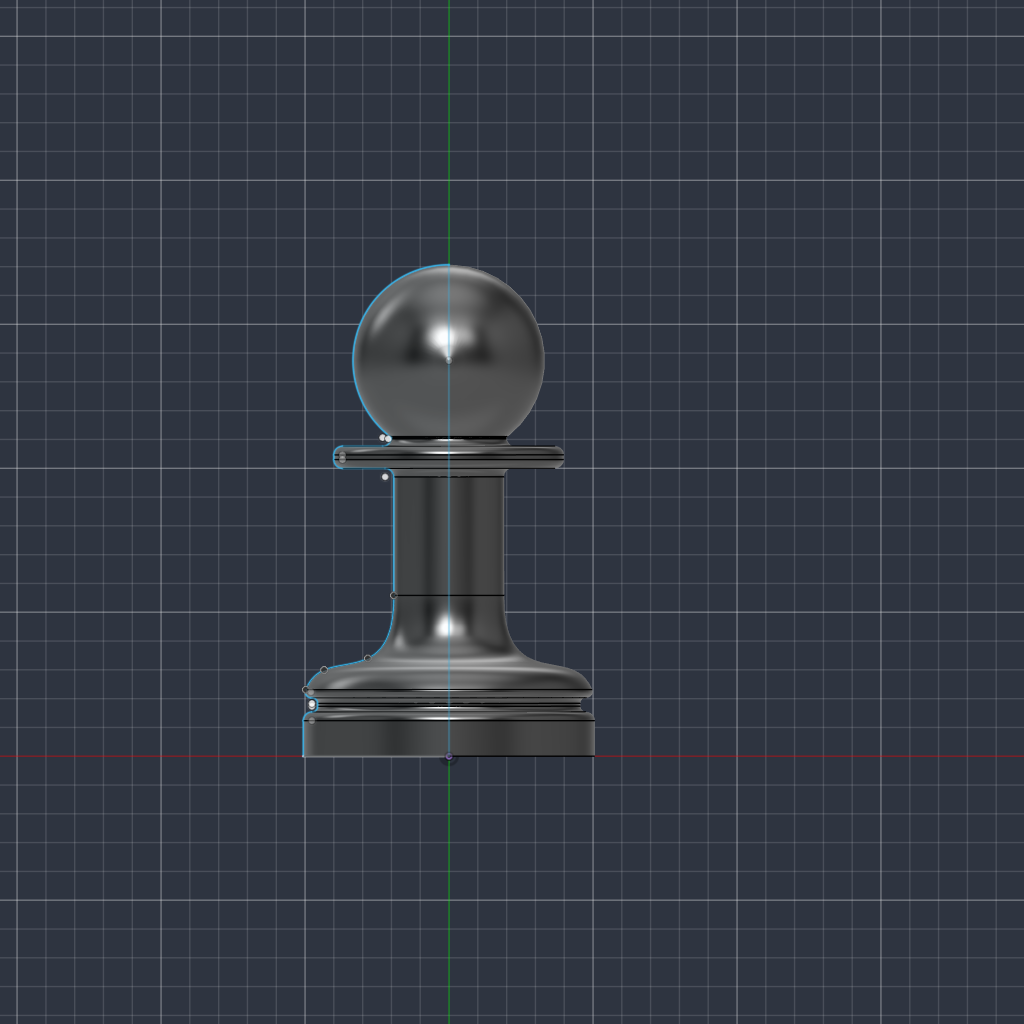
The primary aesthetic hurdle occurred during the sketching phase. I had to make a compromise on the overall silhouette of the pawn because I couldn’t figure out how to transform established straight line segments into continuous, subtle curves. As a result, the geometry didn’t match my ideal vision, but it forced me to adapt within the constraints of the software.
Tip for Users: If you are running into severe lag on the browser app, head into the software settings and switch your graphics display preset to “Performance”. This tweak slightly improved viewport responsiveness and reduced render stuttering for me.
Beyond technical hurdles, this process highlights the potential of 3D modeling within humanistic research and teaching. 3D modeling lets researchers take abstract historical, architectural, or material concepts and turn them into tangible physical prototypes for further analysis and public engagement. Recreating objects; whether ancient game pieces or historic artifacts, gives us a deeper appreciation for their geometric design, structural constraints, and tactile history.
Great job with the chess piece! I am very impressed with how you seamlessly arranged different shapes to create the full pawn. I will keep your tip in mind; I had some trouble with the browser app lagging as well. I also liked what you said about using 3D modeling tools to recreate historic objects — I didn’t think about that! That would be a very useful way to gain insight about different people and time periods in history using modern technology.
The chess piece modeling was perfect. I can hardly find its difference with a real one. You should really print it out using a 3D printer in maker space. The tips were really helpful, my online app has much lower frame rate than a software does, and changing the setting actually helps a lot.
Hi Joshua! Your chess piece is super fantastic!! I love the smooth transition of the edges, and your chess piece is so well detailed! Brilliant work processing all the details, the connections, and the chess piece as a whole. Thank you for your advice on the Performer mode; I will definitely try it out. Again, I really think you are a pro at this, and all the details of the chess are so well processed. I love it!