Modeling My Carleton Mug
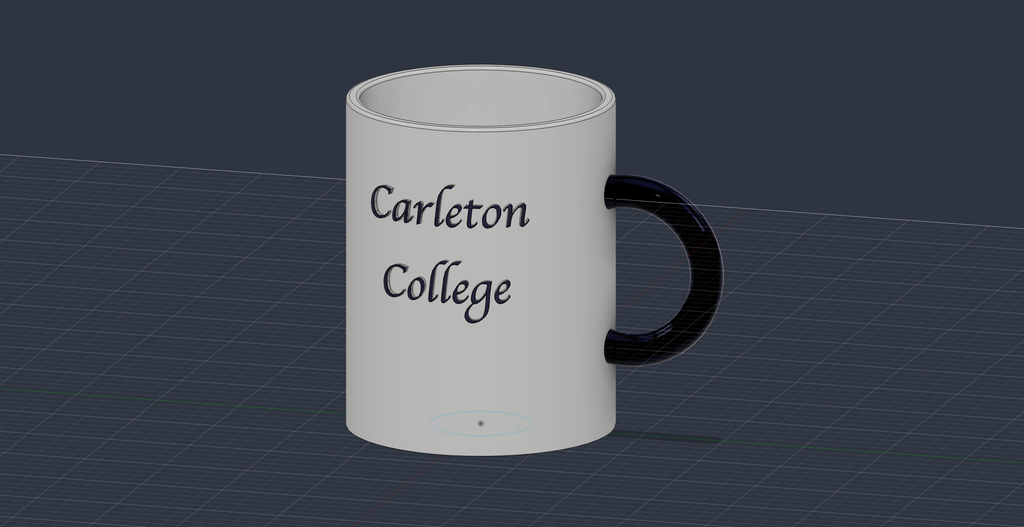
For this lab, I modeled one of my most-used mugs: the white Carleton College mug with a navy handle and cursive lettering on the front. It sits on my desk, so recreating it in Fusion 360 meant studying an object I normally never look at closely.
The Process
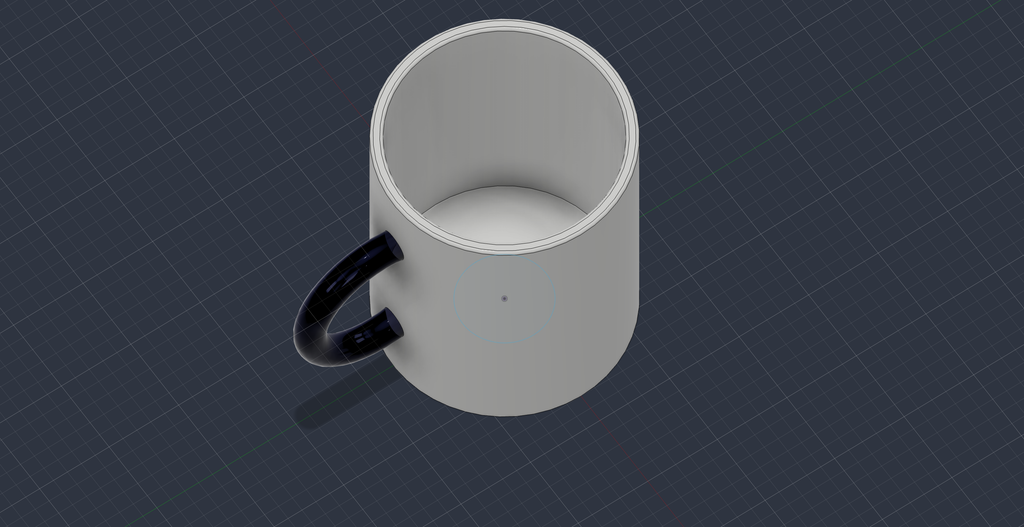
The cylinder body went fast. I set a diameter, extruded, and shelled it for wall thickness.
The handle is where I got stuck. It has to attach to a curved surface at a specific angle, and Fusion’s default tools don’t make that obvious. I built a tangent plane off the edge of the cylinder, sketched the handle’s curve on that plane with a three-point arc, then swept a small circle along the arc to turn it into a solid. Getting the plane oriented so the arc touched the mug body, rather than hovering off it or cutting through it, took several tries.
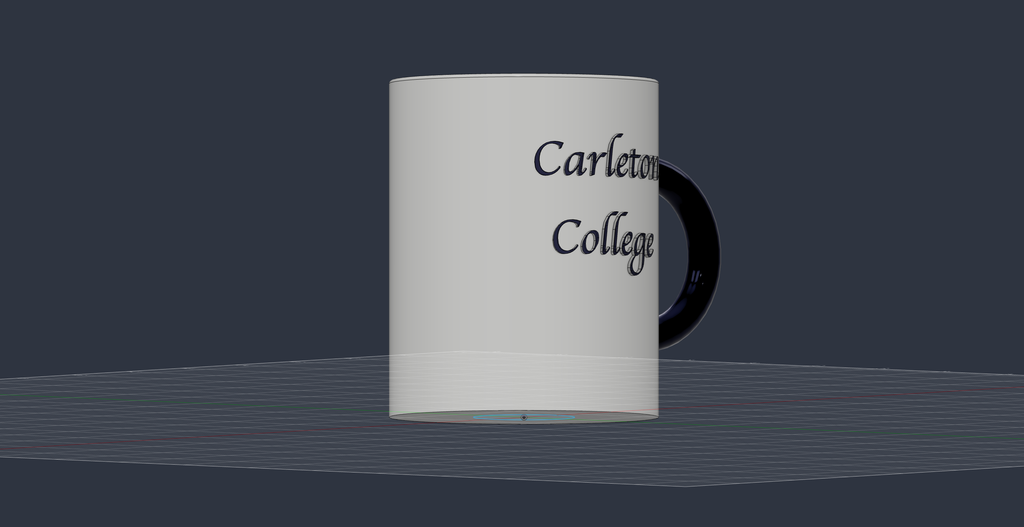
The text caused a second problem. “Carleton College” needed to sit on a rounded surface without looking pasted on top, and text in Fusion doesn’t wrap to a curve by default. I dug through menus until I found the setting that projects text onto a cylindrical face. Once I applied it, the lettering sat flush against the curve.
My compromise was material. The real mug is matte ceramic; Fusion’s default finishes lean glossy, so mine reads more like painted metal. I didn’t chase exact realism here, since the lab was testing structure, not surface accuracy.
Where this goes beyond the mug
The most useful thing this exercise taught me had nothing to do with mugs specifically. Building an object in 3D forces you to solve problems a photograph never asks you to solve. For example, how does this piece actually connect to that one, what’s hollow versus solid, what holds weight and what doesn’t. A 2D image of an artifact lets you look at it. A model allows you to understand its every aspect.
I believe that difference matters for humanities work with physical objects. Archives and museums hold artifacts that are too fragile to handle, too far away to visit, or, in some cases, no longer intact at all, reconstructed only from fragments or historical description. A 3D model lets a researcher or a student examine the structure of something they could never touch. A digitized artifact can sit in an online exhibit, get studied by someone on another continent, or get compared side by side with a similar object held in a different collection. For teaching, it replaces a flat picture in a textbook with something a student can rotate and actually interrogate, which is a different kind of learning than looking at a caption underneath a photo.
My Tip
Find the text-wrap-to-surface setting before you touch any lettering. I assumed text would curve automatically once it hit the cylinder. It doesn’t. Finding that setting turned a twenty-minute fight into a two-minute fix.
I thought your mug turned out really well, especially the handle and the lettering. I definitely related to your struggles with text because I was trying to add “CARLETON” vertically onto my goal post, and getting the size, spacing, placement, and color right took me way longer than I expected. I also could not figure out how to change the text color separately. Your tip about wrapping text onto a curved surface would have been really helpful.
I really like the way that you related the process of creating the mug to analyzing physical artifacts within the humanities. It appears as though the handle and curved writing presented particularly difficult challenges. I definitely agree that three dimensional models give much more insight into an object than photographs do.
I really like your point that building a 3D model makes you think about an object in ways that a photograph cannot. I also relate to the frustration with Fusion 360, especially when working with curved surfaces. Your example of using 3D models for fragile or inaccessible artifacts shows how useful this technology can be for the humanities.