Report
URL to Mesh Model: https://drive.google.com/file/d/1CrBDkzdtEG7ycf3Ok4haYRC13Ib8f0Y4/view?usp=share_link
URL to image: https://archive.carleton.edu/Detail/collections/77830
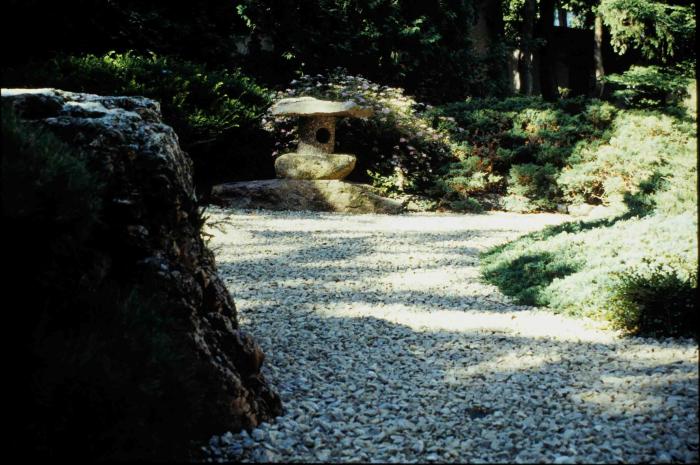
For my part, I used Scaniverse to create a 3D mesh model of the white gravel “water” in the Japanese garden. Since the white gravel covers a relatively large area, I decided to scan only a portion of it. After completing the scan, I uploaded the model to the software and cropped out the unnecessary parts to focus on the section I wanted to present. For the lab, I also found photographs of the garden in the archive.
One of the most important things I learned from this project was how 3D modeling encourages us to look more closely at objects that we might otherwise overlook. In the Japanese garden, the white gravel represents a lake, while the surrounding rocks represent islands. When I first looked at the garden, I mostly paid attention to its overall appearance. However, when I began scanning the gravel, I started noticing smaller details, such as its texture, and how they helped create the impression of water. I think this process helped me appreciate how much thought went into the garden’s design.
Another interesting part of this project was how it changed my understanding of presenting physical spaces through digital technology. I realized that creating a digital model requires us to make choices about what to include and what to leave out. Since I only scanned a small section of the gravel, my model could not fully represent the larger garden or its symbolic meaning. I think this is an important limitation to recognize when using digital tools to study historical and cultural spaces. In the end, I want to say that this project made me more interested in how 3D modeling can help us interpret physical environments in a new perspective.
I think that the choice of what to include and what to leave out is such an interesting one when it comes to 3D modeling. By leaving something out, you are keeping something from the viewer; yet, you can’t put everything in because it’s just simply not possible. I think that as creators, we have to look at these questions very carefully, and it’s definitely a good discussion point. Your 3D model is awesome!
Fascinating project! I love how scanning the white gravel made you look into tiny textures you missed at first glance. I align with your point about the inherent limits of 3D digital models. I had a similar experience doing the scan as well. The progress of scanning really requires a closer look at the feature in order to make a nice 3D model.