Team members: Lily Adler, Maina Abe, and Sabrina Mansour
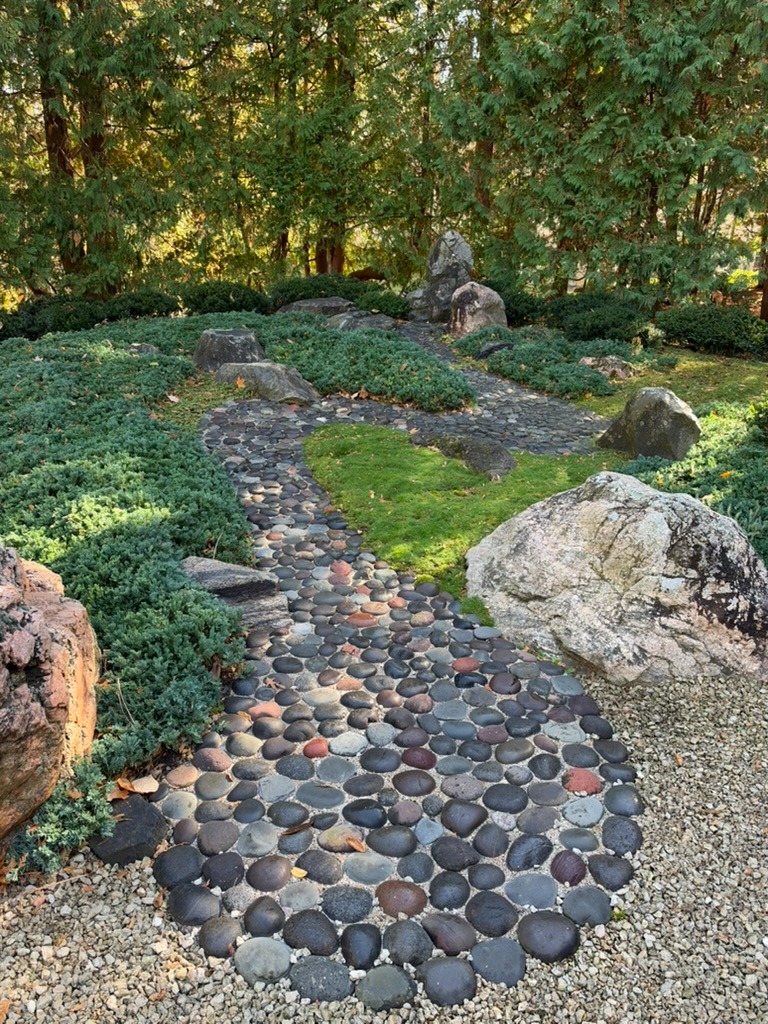
Photograph of Dark Stone “Stream” taken October 2026
Our team looked at the Dark Stone “Stream” which is a winding path composed of pebble stones. The stones were sourced from Lake Superior, adding a link to the element of water which is often associated with Japanese gardens. Because the Japanese Garden is a dry garden, no actual water (besides the Tsukubai washbasin) is present and like many of the other elements, the Dark Stone “Stream” is representative and not literal.
photogrammetry model
Our model can be accessed through sketchfab by following this link and is also displayed below.
How does attempting to model a building compare to simply viewing one through photographs or maps?
Attempting to model a building gives the modeler and the viewer a much better understanding of scale and proportion. Viewing a building through a photograph means that the size of everything is altered by the singular perspective of the camera. 3D models do not have this issue because one can change where they are viewing the model from at any given time, giving the viewer a more accurate idea of the relative size of each element. While a map can provide specific measurements, unless one uses a ruler to make sure they are correct, they could easily be over or underestimate the size in their head. For example, not many people can picture a perfect three inches in their head, so two people thinking of the same fourteen-foot by sixteen-foot room may picture two completely different room sizes. A 3D model prevents this confusion from occurring on some level because it can provide the viewer with more visual context to give them a more accurate idea of the actual size.
Additionally, viewing a model as opposed to a map or photo gives the viewer a better connection to the space. A map or photo cannot convey how walking into a space makes someone feel as well as a model can. A photo can convey some emotion and ideas of space, but that is often more due to the lighting and angle of the shot than the actual space. A model can convey just the space without any special effects.
How does moving from passive observer to active modeler change your thinking on communicating about campus, lived experience and history to various publics?
As a passive observer, it’s easy to appreciate what you see in the moment and then not really think about it again, especially if you’re simply observing a photograph or a map of a feature. However, actively modeling a feature forces you to visit the location of the feature and interact with its surrounding environment. By observing where the feature is situated, you gain a better understanding and appreciation of its intended purpose and the feelings it evokes. It shifts the priority from just conveying information on what the feature looks like, to conveying its origins, purpose, and how it fits into the Carleton campus. You begin to understand how people interact with the feature and therefore are better able to convey what it is to the general public who may never have the opportunity to see the feature in person.