“As artificial intelligence generates data about data, guided by schemas, ontologies, and ways of seeing built into algorithms that will guide our search and aggregation, attention to the metadata and rethinking how artificial intelligence generates it will likely become a key part of historical research”
Lauren Tilton, “Relating to Historical Sources,” ed. R. D. Meadows, The American Historical Review, AHR History Lab Forum: Artificial Intelligence and Its Implications for the Present and Future of Historical Research, 128, no. 3 (September 1, 2023): 1354–59, https://doi.org/10.1093/ahr/rhad365.
Since AI is not yet generative, any ethical qualms regarding it are really just our own, translated onto this software. If we as a society hold schemas and preconceived notions, then these instances of fundamental ignorance are sure to permeate the internet, and in turn the ways that artificial intelligence judges historical sources, especially black and white images. The “metadata” which the above quote references in this instance (in regard to the coloration of black and white images) is the color which AI applies to the image. Take, for example, the black and white historical photograph that I started with, from the diary of a student at Carleton in the early 20th century.
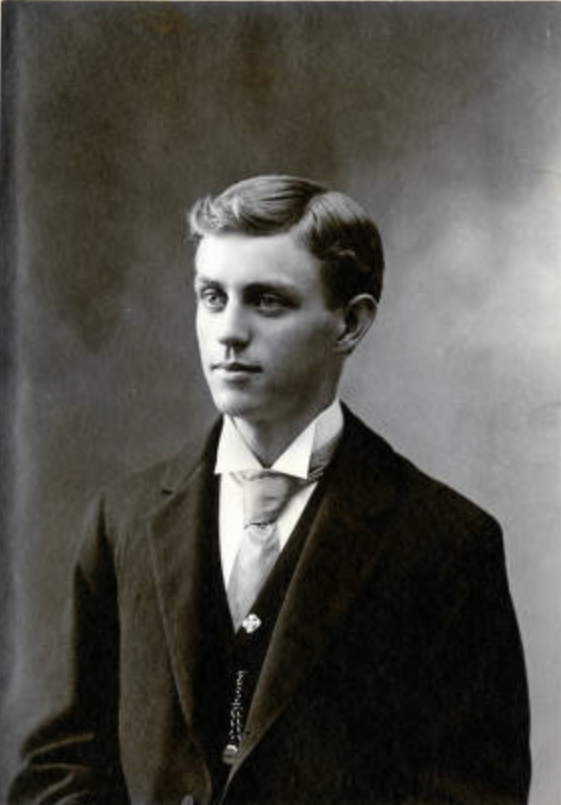
Not knowing anything of the historical context of this image, AI software was able to colorize it in a way that was, to me at least, quite convincing:
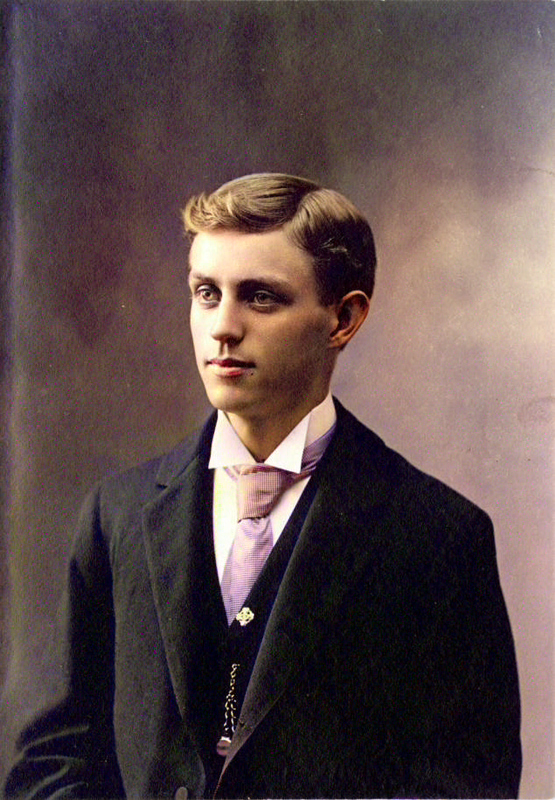
While at first glance the image does not look glaringly incorrect, there are a few things I would like to point out. The first is the color of the tie this student was wearing. The body of the tie, as well as the portion going around his neck, are both quite purple. The knot, however, is much pinker. Since I doubt the tie was truly a gradient of pink and purple, an important question arises: why did the AI software color different parts of the tie differently? Furthermore, since the colors of multiple areas of the tie are inconsistent, which part of the tie is its true color? Is any part of the tie correct as far as these colors go? Now, apply this logic to the skin color of the student. While one might expect the skin color of a male university student in early 20th century America to be generally white, how are we to be absolutely certain that the exact shade applied is accurate? The AI program seemed to come to a very particular conclusion about the student’s skin color. Is the assumption of AI any better than our own? It is probably, at the end of the day, equally fallible and prone to assumption. Thus, we must take to heart Sonja Drimmers’ statement that:
Adding color does not show things as they were but recreates what is already a recreation – a photograph – in our own image, now with computer science’s seal of approval.
Sonja Drimmer, How AI is Hijacking Art History, The Conversation
So the question is, what is this image we hold of ourselves that AI is applying to an initially ambiguous black and white photo? I cannot say for certain what the answer is, but it is clear that the reflection spurred by this thought must be critical and constant. For, AI does not just harbor (our own) ideas about aspects of appearance such as color, but also of fundamental physical forms.
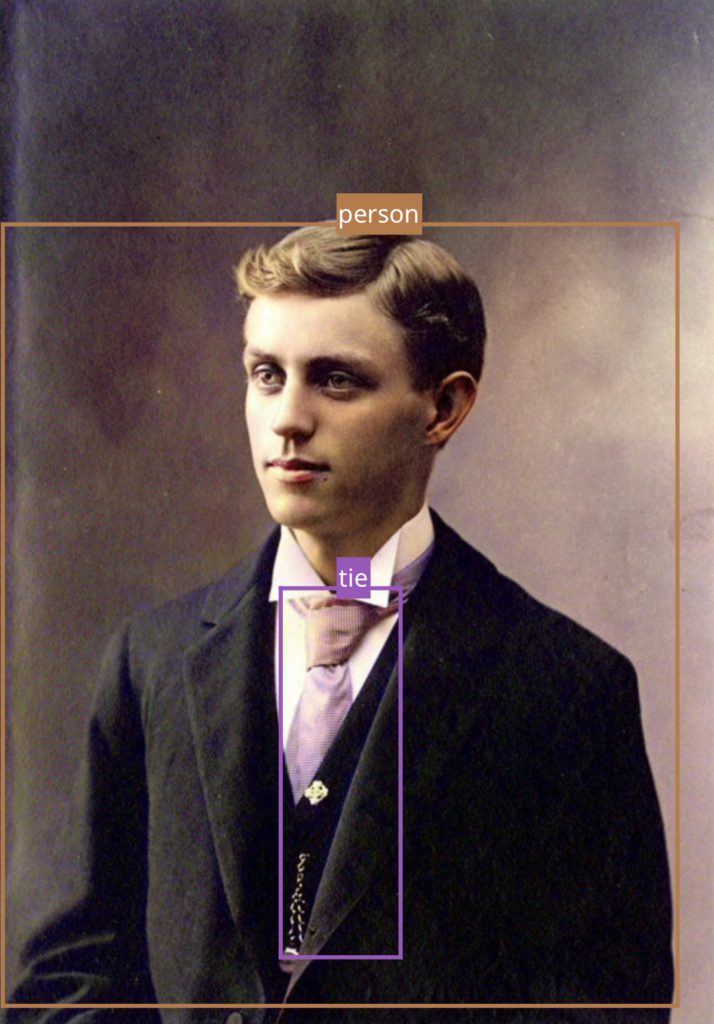
After putting my colorized image into an AI object detection software, it is clear that the program thinks it knows not just what makes a tie a tie, but what makes someone a person. I see a potential problem here: have we always been good at deciding what a person is? From what I know, people have been dehumanized quite often throughout history. What then, if anything, is stopping our AI child from carrying the prejudices of its parents?
I think that you raise a very interesting question when it comes to biases held by AI. I think that AI simply relies on the information that it’s provided with from all sides which could help to reduce bias in the long run. As long as it has access to all the facts and sides of the story I think it’ll be okay. But I do agree that bias could pose a major issue in the development of how we use AI in the future.
This is a fascinating analysis Luke. Your breakdown of how the colorized student portrait has inconsistencies between the tie knot and the rest of the fabric really highlights the guesswork involved in AI generation. I especially appreciate your point about how AI colorization simply recreates things in our own image rather than showing historical truth, raising crucial questions about algorithmic bias and historical representation moving forward.