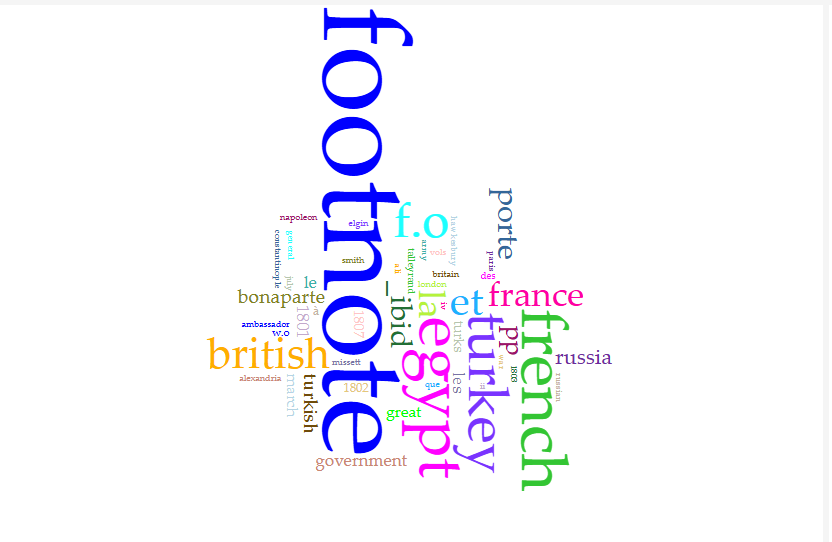
The book I choose from Gutenberg is called The Beginnings of the Egyptian Question and the Rise of Mehemet Ali. It’s a historical book that dives deep into the diplomatic complexities of the Napoleonic era and the origins of modern Egypt. To analyze this text, I first decided to try out Voyant Tools and a Spyral notebook to see what kind of patterns and insights I could uncover through distant reading methods. Loading the raw text file into Voyant gave me an instant visual breakdown of the most frequently used words across the entire corpus. Seeing terms like footnote and f.o. dominating the word cloud right alongside major historical names and places immediately showed heavily structured and academic this specific text is, full of archival references and source citations.
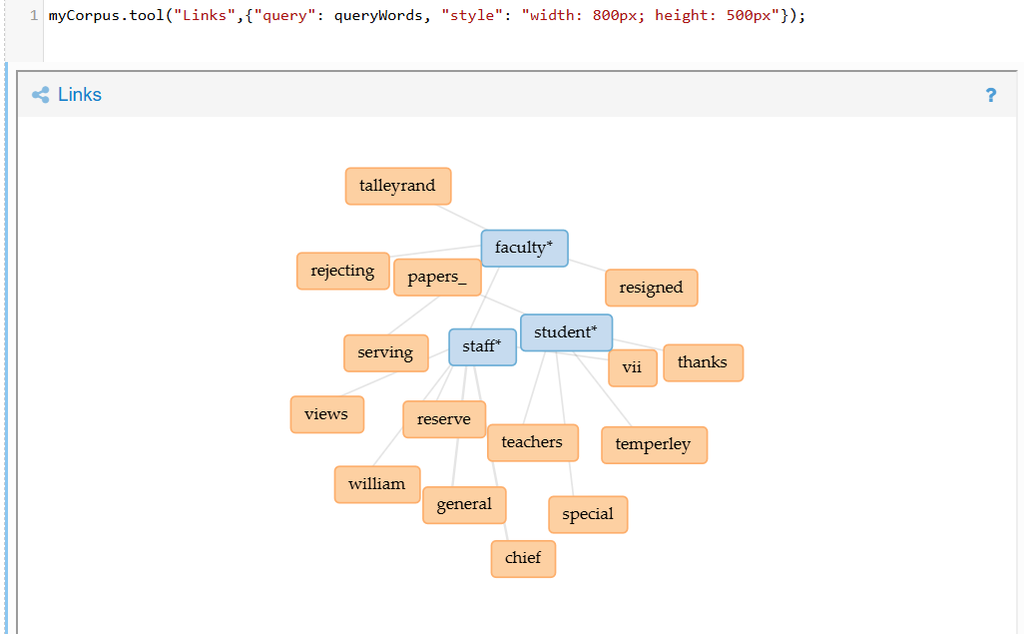
Using the Spyral notebook to interact with the corpus through JavaScript code cells added another layer to the experience. It felt a bit like coding a mini research project, allowing me to pull specific statistics and examine word distributions across different segments of the document. Working with these computational tools made me think a lot about the broader role of digital humanities and how we analyze literature today. While close reading allows us to appreciate the fine details and narrative flow of a historical study, distant reading can give us a macro perspective on large volumes of text that would take months to process manually.
At the same time, exploring these tools raised questions about what we might lose when we rely entirely on automated systems to interpret text. In this age of artificial intelligence, algorithms process language based purely on statistical frequencies and patterns without any real understanding of historical context or human emotion. If we depend too much on automated summaries and frequency counts, we risk stripping away the rich context and authorial intent behind historical sources. Moving forward, I think the best approach is to use computational tools as a complement to traditional analysis rather than a replacement for human critical thinking, finding a healthy balance between quantitative data and qualitative interpretation.