To look into the advantages and pitfalls of using AI to analyze a text, I put the play “The King’s Friend” (by Robert Sulivan) into Voyant Tools, and played around with various types of visualizations. The first of these that came up was the “links” tool, which not only shows high frequency terms within the text, but also other high frequency terms that commonly occur in the immediate vicinity of these. While this is an interesting tool for mapping textual connections, it nonetheless has some major room for error inherent to it. Firstly, it initially included “project” and “Gutenberg” as two of the most common words in the play (with these obviously actually coming from labels applied by the Project Gutenberg website to the .txt file). While I added these to the list of “stop words” to prevent them from appearing, I realized that some of the most common words were still just the names of characters in the play. There is also the danger present in the fact of there being stop words in the first place. If one is shown one of these link clouds, but has no way of knowing what words are omitted, there is no way to know if what is being displayed is faithful or not, and if the words that are restricted are reasonably set as such. There is also the question of the scope of the words included, which certainly affects the intricacy of the associations depicted. For this there must also be sound reasoning regarding any specific formatting decisions to avoid deceptiveness.
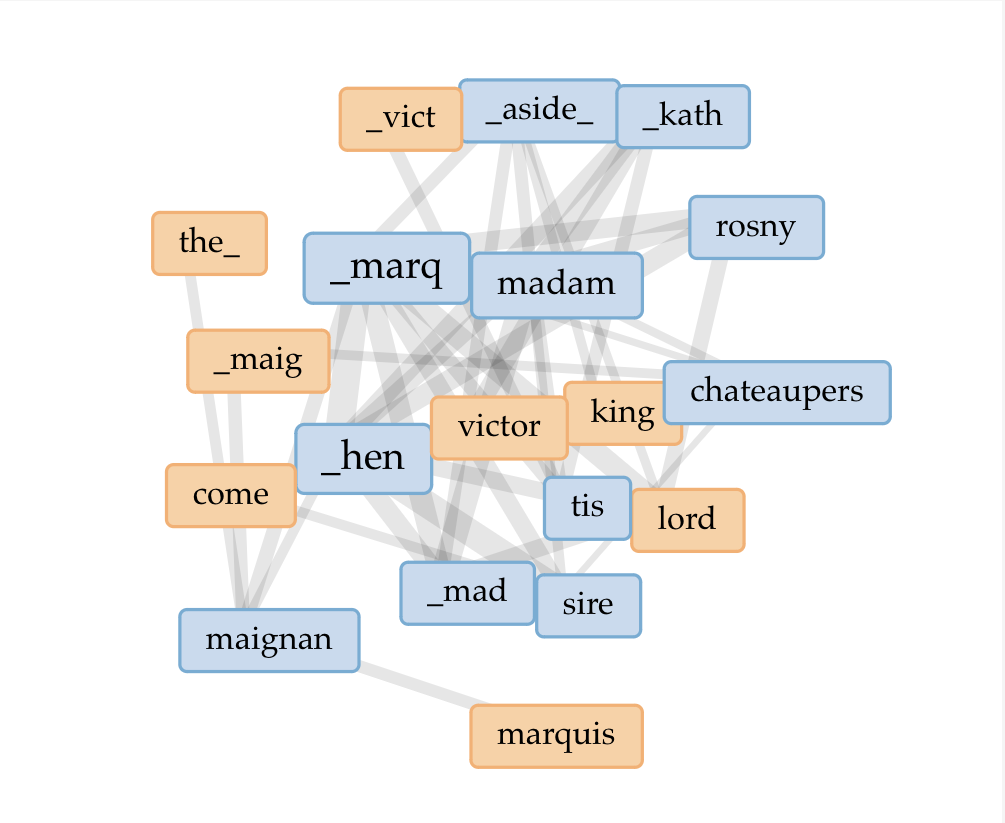
There is also the option to display purely the frequency of terms using either the “cirrus” cloud tool or simply the “terms” list tool. While they do not show anything nearly as intricate as the relationships between words in the text, there is still room for inaccurate (either incidental or intentional) manipulation of data through ambiguity regarding stop words and the overall scope of words included. For the terms list in particular, while it is the most rudimentary way to visualize the textual data, it also displays the exact number of times each word is used, which could eliminate some potential issues through this inherent transparency. At the end of the day, while AI (with some fine tuning) can surely analyze a text, if the necessary subsequent human manipulations of the visual results are not transparent and reasonable, it is dubious as to whether these results are true analysis, or just as fictional as the subject text.