Stance on learning coding
I fully agree that all students should learn the basics of web languages and the internet’s history. Coding makes up the websites and apps we use on a day to day basis, and is a fundamental part of today’s technological world. However, I don’t think it’s necessary for all students to know how to do complex coding, but understanding the fundamentals at a bare minimum is key. Knowing how to code is a useful skill not only in computer science but in other fields as well, such as marketing.
Discussion of prior coding experience
Before this class, I had no experience with HTML or CSS coding. The only prior coding experience I had was in elementary school when I made a few simple games on Scratch which is a program that uses very simple block coding. This was my first time learning how to use both HTML and CSS. I had very little knowledge of how programming languages work, so everything in the tutorials I completed was completely new to me. I chose to complete the beginner HTML and CSS tutorials on HTML Dog. I found the experience difficult and confusing at first, but then I eventually was able to get the hang of it. I find coding fascinating and it’s a skill I’d like to continue to learn in the future.
Expanding on whether students should learn to code
In the article, “Tim Berners-Lee Invented the World Wide Web. Now He Wants to Save It,” published in on September 29, 2025 on the New Yorker, Julian Lucas wrote that “[t]he internet itself is a platform. But the new web-based platforms were far less neutral. They grew at break-neck speed, and then, once network effects had made them indispensable, they squeezed sellers, served ads, and otherwise extracted value from users while making exit ever costlier.” The rapid rate in which the internet has grown since it was created, and continues to grow, cannot be ignored. This quote emphasizes the importance of understanding web languages.
In addition, learning the history of the internet is also crucial. The majority of 5 people use the internet in one way or another, so it’s important to understand it’s history in order to not repeat past mistakes. It’s generally good to know the history of the internet to understand how, why and in what ways people interact with the internet.
<!DOCTYPE html>
<html>
<head>

	<title>My first web page</title>
<link rel="stylesheet" href="style.css">
</head>
<body>
	 <p>This is my first web page</p>
	<p>How exciting</p>
	<p>Yes, that really <em>is</em> exciting</p>
	<strong>Warning:</strong> level of excitement
	may cause head to explode. </p>
Coding can be used to create websites, as portrayed in the line of code from my project that I pasted above. This was the first part of the code for the beginning HTML tutorial that I followed. Websites are a major line of communication and knowing how they work and how to create one opens the door to more opportunities.
h2 {
Border-style:dashed;
Border-width: 3px;
Border-left-width: 10px;
Border-right-width: 10px;
Border-color:green;
}
CSS, like in this line of code I used for my website, can be used to add style to a webpage, app or other platform. It’s key for students to understand the basics of CSS because well designed and stylized platforms are influential to viewers and convey the intended message. Knowing how this works is crucial to understanding how websites become popular and how sites on the internet grow and develop. Because of the internet’s major role in our lives, all students should learn the basics of web languages.
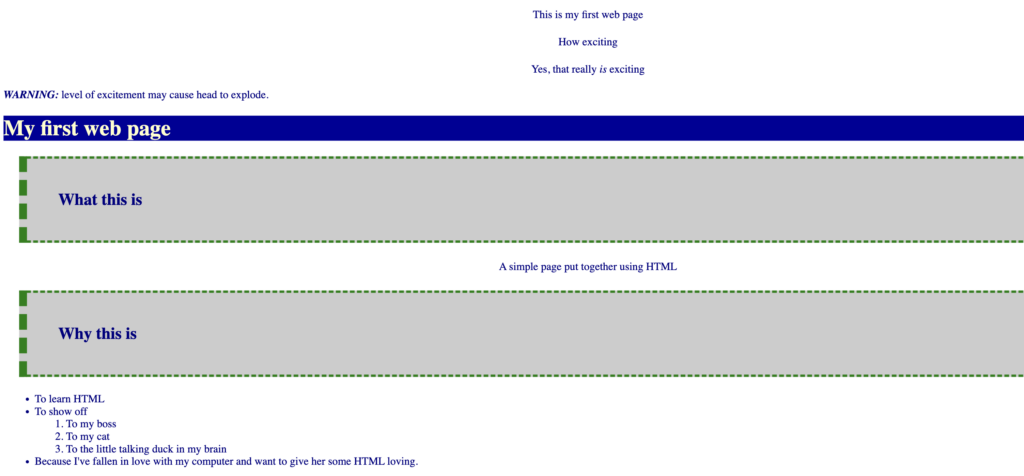
The above image is of top of my website that I coded using the HTML and CSS beginner’s tutorials.
Concluding thoughts
Ultimately, although I initially struggled with coding, I found it to be a rewarding and intriguing experience. I would definitely try it again. My findings in this lab and the readings support my belief that all students should learn basic web languages and the internet’s history.