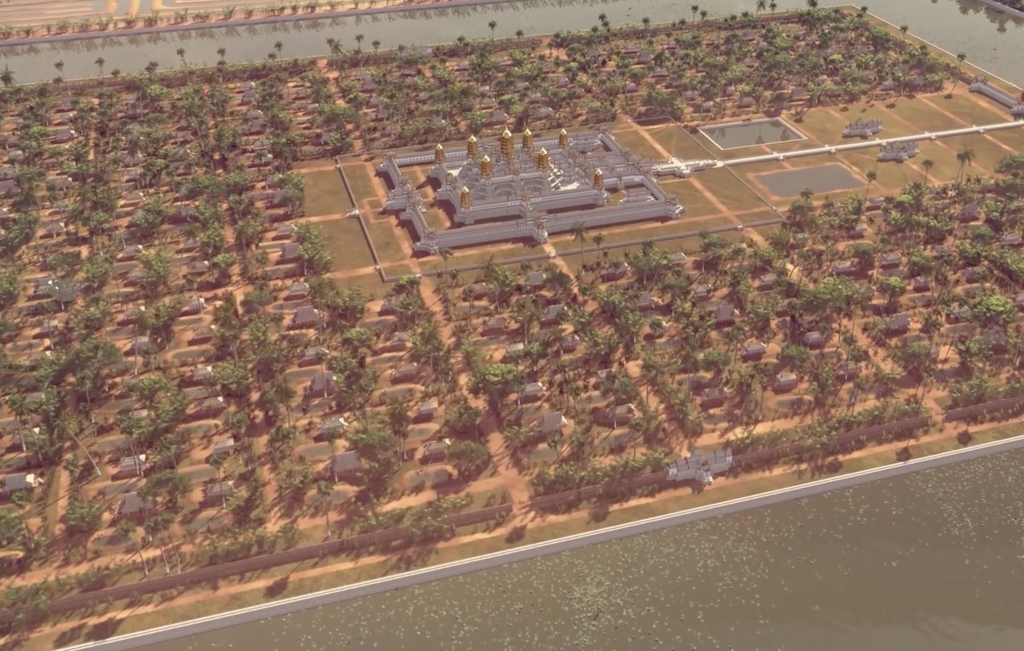
Virtual Angkor is a project that aims to digitally recreate Angkor at its peak during the Khmer empire’s reign and teach the broader public about it.
Sources
While there is a sources page on the Virtual Angkor site, I will summarize here. The sources used were sorted into in five categories:
- Sanskrit and Old Khmer inscriptions
- European accounts of nineteenth century Cambodia
- The bas-reliefs at Angkor Wat and Angkor Thom that depict them with great detail
- The accounts of Zhou Daguan (Chinese official who was dispatched to Angkor in 1296)
- Contemporary archaeological research
There are specific sources that are cited on the website, such as George Cœdès’ Angkor: An Introduction.
Processes
The Virtual Angkor team read through many sources to figure out what the city would have looked like and how the people would have lived. Then, they developed 3D models of the buildings, landscape, people, and animals in the city according to those specifications. After that, they used what they learned about the daily lives of people in Angkor to animate scenes and use the videos for their lessons.
Presentation
Virtual Angkor primarily uses the 3D models the team produced according to their various sources to allow users to look around, but they also used to make videos that pair with their written lessons. These lessons also come with citations and questions, as well as a “Further Reading” section for each one.
Questions
How Hard is it to Update?
We are constantly learning more about the past, and we are constantly proving ourselves wrong. While I believe that the Visual Angkor team has done their due diligence, in the event that there wasn’t enough information available to them to get something right, how hard will it be for them to fix something should new information come to light?
Who is the target audience?
The target audience for this project is the broader public, with the lessons also being applicable for schools. The site and lessons within are written to approachable and do not alienate a casual user.
Is the data available for broader use?
All of the sources used are scholarly and available for broader use, and I hope that they stay that way. The importance of learning cannot be overstated, and restricting knowledge of human history is how we end up repeating the mistakes of those who came before us.