Breaking down the project
According to the description within the introduction of the website, Authorial London compiles and maps references to places in London found within works and biographies of writers who’ve lived there.
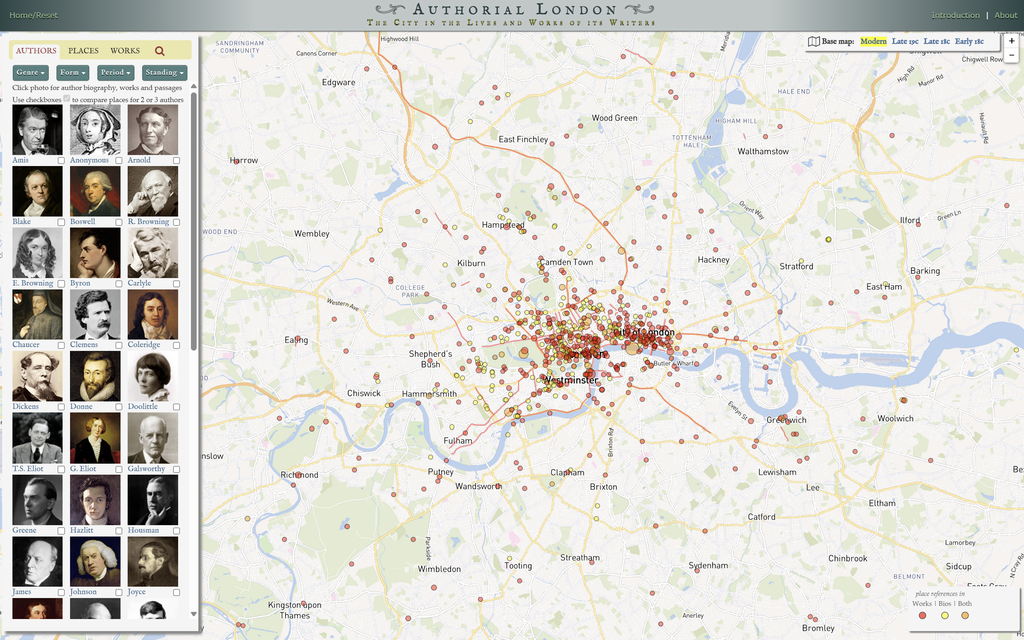
The website primarily gears toward the collection of data over an indefinite period of time. Specifically in this case, reading through the works of London born authors and gathering the various places they may have mentioned in one place onto a map. One main concept following this project is its plan for continuous input and updating. “A distinctive feature of the site is its openness to input and expansion: a dynamic data structure allow for the addition of new writers and works by the many scholars and readers of London literature. It is a future-facing site, designed to integrate a broadening canon of the past and the fresh writing of contemporary authors.”
The main component within this project is an interactive map that allows the user to view every pinned area around London, each displaying a card of info on the work(s) it was mentioned in, and by who. Accompanying these cards is a small excerpt from the piece of literature that allows users to read through a short bit and get a feel for the kind of writing was included. However there are “filters” to explore and analyze these locations and authors, such as genre, form of writing, time period, social standing, and neighborhood.
PRESENTATION
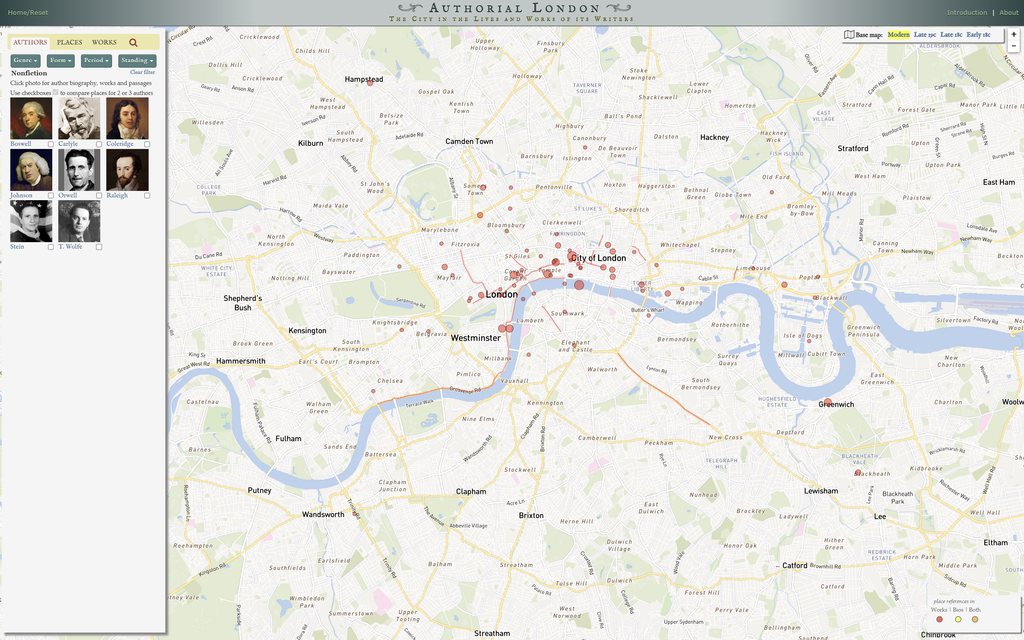
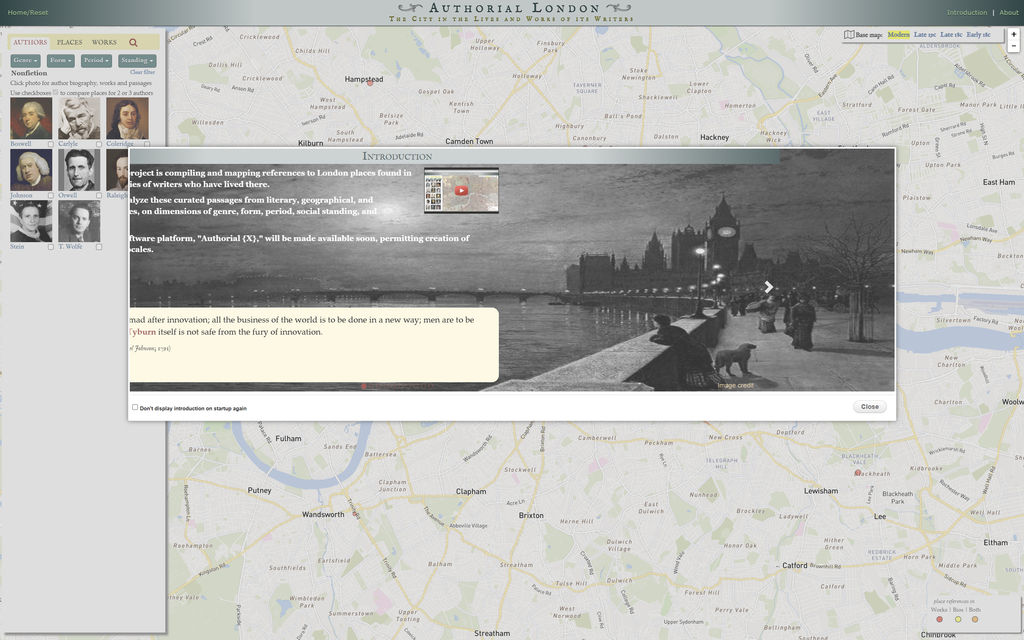
The overall presentation of the website is well done, and the format should be used more. Buttons are placed well in plain sight and not confusing to follow either, allowing for lots of customization within search. However there is a problem with the initial introduction pop up and its formatting. The way it’s trying to showcase information isn’t necessarily bad, i just think It’s simply a problem on the back end, zooming out the page from 100% to around 70% or further seems to allow readability.
PROCESSES
The initial list of London places came from around 40 texts and the collection of every place within the Greater London area. Those same references were then used to perform a machine search on Project Gutenberg on the 690 text files by Authorial London writers that were available. Things that came up from this search were used to generate a set of paragraph-length results tagged with the place references. Human rereading and curation were also an important part within the creation of this project, because of the often intentional misspelling or overlooked key words by machine searching.
According to the about section, the authorial website was built using a Ruby-on-Rails and PostgreSQL database backend, and a hybrid set of JavaScript front-end technologies, including the Backbone/Marionette framework, Leaflet/MapBox for mapping, JQuery, and D3.js. ElasticSearch was used to index the entire corpus of full texts, and an Apache Solr index of all passages is used for the free-text search function.
Sources
- Harvard College Library Digital Map Collection
- “Taylor Map of London, England, 1723”; Metadata
- “Bowles’s new pocket plan of the cities of London & Westminster with the borough of Southwark : comprehending the new buildings and other alterations to the year 1783”; Metadata
- “Indicator map of London: with the Recent improvements, 1880”; Metadata
Discussion Question
Thinking about how this project is based on longevity and the work that has been put into it, would tasks like these (reading through texts for specific keywords such as locations) become more automated and widely available due to the benefits of digital humanities and tools such as Authorial London?